John Hughes turned a disastrous Thanksgiving journey into a hilarious, heartfelt portrait of American travel, unlikely friendship, and the people who make the holidays matter.
The trouble begins in a place every business traveler knows: an airport terminal where the departure board has become an enemy. People hurry past carrying briefcases and overstuffed bags. Phones ring. Announcements dissolve into background noise. Somewhere in the crowd, a man in a dark business suit is trying to get home, and every passing minute makes the distance feel greater.
In Planes, Trains & Automobiles, that man is Neal Page, a tightly wound advertising executive played by Steve Martin. He has a schedule, a destination, and a clear idea of how the next few hours should unfold. Then a chain of delays, diversions, and increasingly ridiculous transportation failures puts him in the company of Del Griffith, a talkative shower-curtain-ring salesman played by John Candy. Del is warm, disorganized, and almost constitutionally incapable of reading a room. Neal wants to get away from him. Fate, as embodied by the American travel system, has other plans.
Released in November 1987, John Hughes’s comedy understands something fundamental about the Thanksgiving journey. Going home is supposed to be simple in principle and complicated in practice. You have to get there on time, negotiate crowds, endure strangers, and keep your temper while the distance between departure and arrival seems to grow with every new problem. The destination is familiar, but the journey can expose the least attractive parts of your personality.
That is where Planes, Trains & Automobiles becomes more than a string of transportation mishaps. Beneath the shouting, bad luck, and spectacular indignities, it is a film about the difference between getting somewhere and understanding why you wanted to go in the first place. It captures the impatient rhythms of 1980s America while finding tenderness in the collision between two men who would never have chosen each other as companions.
Nearly four decades later, its comedy still works because the frustrations are recognizable, the performances remain beautifully matched, and the emotional destination feels earned. It is an adventure across a familiar country that ends by asking a surprisingly difficult question: how much trouble are we willing to endure before we remember to treat one another like human beings?

1987 and the Making of an Unlikely Thanksgiving Classic
By 1987, John Hughes had become one of the defining filmmakers of the decade. His teen comedies, including Sixteen Candles, The Breakfast Club, and Ferris Bueller’s Day Off, had made him an astute observer of embarrassment, social divisions, family expectations, and the private anxieties hidden behind ordinary appearances. His characters could be funny because they were awkward, but their awkwardness usually concealed something real.
Planes, Trains & Automobiles marked a change of scale and audience. Rather than concentrating on teenagers negotiating high school, Hughes turned to an adult who had built a life around professional competence and personal control. Neal Page is not a misunderstood student or a rebellious outsider. He is a working man with responsibilities, a family waiting for him, and a powerful conviction that his time should not be wasted.
The film opened on November 25, 1987, the day before Thanksgiving. Paramount Pictures lists its theatrical running time as 93 minutes, and the American Film Institute identifies it as Hughes’s first comedy aimed squarely at adult audiences after his run of youth-centered films. It was also his first R-rated film as director, a significant departure for a filmmaker widely associated with the teen movie boom.
The rating reflected the movie’s willingness to let Neal express his frustration in language that conventional holiday entertainment might avoid. One notorious scene features an extended, profanity-laden outburst at a car-rental counter. The humor does not depend only on the words themselves. It comes from watching a normally controlled professional finally lose his grip in a public setting where the employee behind the counter appears almost impossible to reach.
This was a particularly apt comedy for the late 1980s. American life was increasingly organized around work schedules, business travel, highways, airports, and consumer services promising to make everything faster and easier. The decade’s material confidence could coexist with a deep irritation at systems that refused to cooperate. A reservation did not guarantee a car. An airline ticket did not guarantee arrival. A telephone call did not guarantee that anybody would solve your problem.
Hughes built his story around the gap between those promises and reality. The modern traveler is supposed to be mobile, efficient, and in control. Neal begins the film believing he can manage the journey through planning and persistence. The journey proceeds to dismantle that belief, one inconvenience at a time.
The film’s enduring appeal rests on the way Hughes connects this comic ordeal to something more intimate. Thanksgiving gives Neal a deadline, but it also gives him a reason to keep going. He is not simply trying to reach Chicago. He is trying to return to his family, and the obstacles between him and home gradually strip away the professional identity he uses to manage the world.
Steve Martin and John Candy: The Perfect Comic Mismatch
The central relationship works because Steve Martin and John Candy bring different kinds of comedy to the same predicament. Martin’s Neal is sharp-edged, precise, and visibly uncomfortable whenever events move beyond his control. Candy’s Del seems to have no internal mechanism for recognizing when he has overstayed a welcome. He talks, jokes, tells stories, and offers assistance that frequently creates fresh complications.
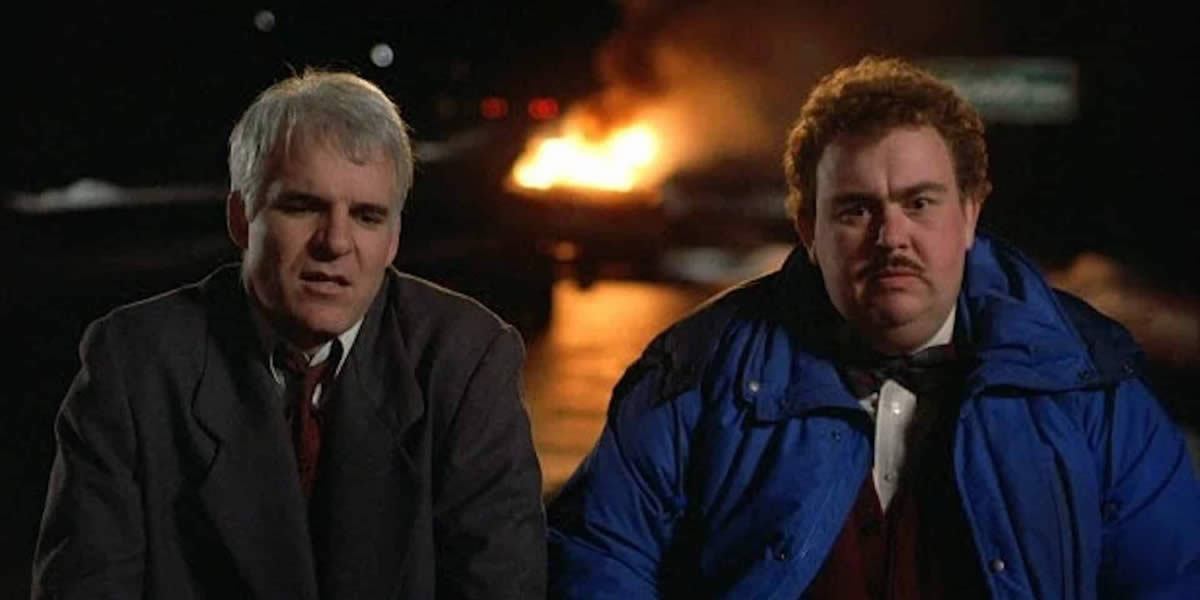
Their differences are immediately visible. Neal dresses like a man whose wardrobe has been arranged to eliminate uncertainty. His business clothes, neat grooming, and controlled movements suggest someone who expects the world to observe basic rules. Del’s appearance is more casual and less carefully managed. His bulky winter coat and open, expansive manner make him seem physically and socially impossible to overlook.
The contrast goes deeper than clothes. Neal interprets almost every interaction in terms of efficiency. Del is interested in people, even when his interest is clumsy or intrusive. Neal wants a conversation to end when the useful information has been exchanged. Del can turn an ordinary exchange into an extended performance, complete with a story, an observation, and a fresh reason to keep talking.
This is a classic comic pairing, but the actors prevent it from becoming a simple contest between the uptight man and the lovable fool. Martin gives Neal a convincing reserve of intelligence and self-discipline. His irritation has a recognizable logic. Del really does talk too much. He really does misunderstand signals. He really does make an already difficult journey more exhausting.
Candy, meanwhile, makes Del more than a source of inconvenience. His performance is expansive without being careless. Del’s humor can be loud and his habits embarrassing, but there is a genuine wish to connect underneath the performance. He is a man who fills silence because he seems uncomfortable leaving another person alone with it. His chatter can feel like an intrusion, yet it also becomes a form of companionship.
That balance is crucial. If Del were simply obnoxious, Neal’s hostility would seem reasonable and the story would have nowhere to go. If Neal were merely cruel, their conflict would lose its comic tension. Instead, both men are recognizable and imperfect. One has forgotten how to be patient; the other struggles to understand when patience has run out.
The casting gives the film a second source of pleasure. Martin and Candy were both established comic performers, but their styles were different enough to create a productive friction. Martin could make irritation precise, even elegant. Candy could make warmth feel physically present. Put them together in a cramped hotel room, a rental car, or an airport seat, and the comedy emerges from the fact that neither man can escape the other long enough to recover his preferred way of behaving.
Their chemistry also gives the film its emotional credibility. The relationship changes through small concessions rather than sudden declarations. Neal begins to recognize that Del’s behavior cannot be understood solely as a series of annoyances. Del, in turn, becomes more than a cheerful passenger who happens to be along for the ride. Their friendship grows in the uncomfortable spaces between disasters.
Planes, Trains & Automobiles Captures the Misery of American Travel
The film’s title promises three modes of transportation, but its real subject is the modern American travel experience as a series of systems that almost work. A plane is supposed to cross the country quickly. A train should carry passengers toward a fixed destination. A car should provide independence. In Hughes’s film, each becomes another stage in the gradual collapse of Neal’s plans.
The airports are especially revealing. Air travel in the 1980s still carried a measure of glamour for many passengers, but the practical business of getting through an airport could be tiring and impersonal. Crowded terminals, announcements, connecting flights, and unexpected diversions placed travelers at the mercy of schedules they did not control. Neal’s professional appearance cannot help him when the flight plan changes.
His journey becomes a catalogue of frustrations familiar to anyone who has traveled with a deadline. A seat is no longer where he needs it to be. A route that seemed direct becomes indirect. The people responsible for the next step have limited information or limited power to help. The traveler is expected to remain reasonable while the circumstances become increasingly unreasonable.
The movie’s transportation failures are exaggerated for comic effect, but the underlying dynamic is familiar. Modern travel depends on a complicated web of employees, machines, timetables, weather conditions, and institutional decisions. Most of the time, the system works well enough that passengers barely notice it. When several parts fail at once, the illusion of control disappears.
The train sequences extend that idea. A train can seem more grounded than an airplane, moving through a visible landscape rather than disappearing into the sky. Yet it can also leave a traveler with little control over timing or destination. Neal and Del’s efforts to get home become an exercise in accepting whatever arrangement remains available, however uncomfortable or absurd it might be.
Then there are the automobiles, which should represent the freedom of the open road. American culture has long treated the car as a symbol of independence. It offers a private space, a personal route, and the promise that the driver can choose where to go. In Planes, Trains & Automobiles, that promise is repeatedly undermined by bad luck, poor decisions, and the simple fact that a vehicle cannot solve every problem.
The rental-car sequence is the clearest example. Neal believes he has completed a straightforward transaction, only to discover that the practical arrangements do not match the promise. His fury at the rental counter is funny partly because it is so disproportionate, but also because viewers understand how helplessness can accumulate. One problem is manageable. A dozen problems, each requiring a new explanation to a new person, can turn an ordinary traveler into someone he would not recognize.
The film does not need to turn its transportation system into a villain with a plan. Its comic force comes from the indifference of the obstacles. The world is not conspiring against Neal. It simply does not care how badly he wants everything to go according to schedule.
Thanksgiving, Family, and the Pressure to Get Home
Thanksgiving gives the film its emotional structure. Unlike a vacation, which can be postponed or abandoned, the holiday carries a strong sense of obligation. People make plans, prepare meals, invite relatives, and arrange their working lives around a date that seems to demand a gathering. The expectation is not merely that you will travel. It is that you will arrive in time to take your place among the people who know you.
For Neal, getting home is a matter of family responsibility. His wife, Susan, and their children are waiting in Chicago. The more his journey deteriorates, the more sharply the distance between his actual circumstances and the ideal holiday takes shape in his mind. The film lets the audience feel the pressure of the approaching celebration without requiring an elaborate explanation of the family waiting at home.
That pressure is familiar because Thanksgiving combines affection with logistics. The holiday is often imagined as a warm domestic scene, but somebody has to buy the groceries, prepare the food, clean the house, coordinate arrivals, and keep the gathering running. Someone may be sitting in a delayed airport while the rest of the family wonders whether dinner should begin without them.
The film understands that the holiday’s emotional power can make its practical difficulties worse. Neal is not relaxed about missing Thanksgiving because he wants to maintain an impressive schedule. He wants to be there. His impatience is partly the product of a genuine attachment to the people waiting for him, even when he expresses that attachment through anger.
This distinction gives the movie its warmth. Neal’s desire to get home is real, but he becomes so consumed by the obstacles that he loses sight of the people sharing them. Del, for all his faults, is an unavoidable reminder that other people’s lives do not disappear simply because they complicate our plans.
The holiday setting also makes the ending more meaningful. Thanksgiving is associated with gratitude, but gratitude is difficult to practice when a person is cold, tired, hungry, and convinced that everyone around him is incompetent. The film does not pretend that frustration is solved by a single sentimental thought. It shows Neal being pushed through enough discomfort to recognize that his priorities have become distorted.
That is one reason the movie has become a recurring Thanksgiving favorite. It does not offer a flawless family gathering as an escape from ordinary life. It makes the effort to get there part of the story. The holiday becomes less a picture of domestic perfection than a reminder of what people are willing to endure for a place at the table.
The 80s Details That Make the Adventure Feel Real
Part of the film’s appeal comes from how naturally it inhabits its decade. Its world is filled with the physical details of pre-smartphone travel: printed tickets, public telephones, hotel desks, paper maps, rental-car paperwork, and information delivered by people whose answers may be incomplete. There is no pocket-sized screen to summon a ride, check a route, or track a delayed flight in real time.
A traveler in 1987 had fewer ways to verify information independently while moving from one place to another. If an airline employee announced a change, passengers generally had to respond to the information available at the gate. If a hotel was full, a desk clerk might be the only immediate source of help. A public phone could connect someone to home, but it could not provide the wider world of instant searches and location sharing that travelers now take for granted.
The resulting uncertainty gives the film much of its momentum. Neal and Del cannot simply consult an app and discover the most efficient alternative. They must negotiate with people, make decisions based on limited information, and live with the consequences. Every change of plan requires a new conversation or another journey to somewhere else.
The cars and hotels also carry the visual language of the period. Rental counters, fluorescent-lit interiors, modest roadside accommodation, and long stretches of highway place the characters in a practical America built around mobility. It is not the glamorous America of luxury advertisements or the carefully curated lifestyle imagery of a magazine spread. It is the country of roadside businesses, service counters, and rooms that look much the same from one town to the next.
Neal’s business attire offers another revealing detail. He belongs to a professional culture in which appearance communicates competence. His suit and controlled manner suggest that he knows how to conduct himself in the adult world. The journey repeatedly strips away the usefulness of that presentation. A pressed shirt cannot make a plane leave on time. A polished voice cannot conjure a rental car. Professional status offers little protection against a blizzard of ordinary bad luck.
Del’s more relaxed appearance and manner provide a counterpoint to that world. He is a traveling salesman, a figure deeply embedded in American commercial life. His work depends on moving between places and persuading strangers to buy something. He is accustomed to conversation as a tool, a habit, and perhaps a way to make the lonely road feel less empty.
These details make the film’s America specific without making it remote. Viewers who remember the 1980s can recognize the equipment, clothes, and routines. Younger viewers can see a world in which travel demanded more improvisation and where the inconvenience of being out of contact could become part of the adventure.
The technology has changed, but the underlying human behavior has not. People still become impatient when plans fail. They still blame the person standing nearest the counter. They still mistake a system’s limitations for a personal insult. The film’s period details show how those reactions played out in 1987, while making their emotional logic recognizable today.
John Hughes’s Road Comedy Has More Heart Than It First Reveals
Hughes’s reputation was built partly on his ability to find emotional stakes beneath comic embarrassment. In his teen films, a humiliating social encounter could reveal a character’s insecurity or longing. Here, the same method is applied to adults who have become accustomed to hiding behind their habits.
Neal’s anger is the most obvious source of comedy, but it also functions as a defense. He is uncomfortable with Del because Del refuses to behave according to the social rules Neal uses to organize his life. Del talks too much, stands too close, and seems unable to notice that his companion wants silence. Neal responds by treating him as a problem to be eliminated.
As the journey continues, however, the audience begins to see the limits of Neal’s judgment. He has made a habit of evaluating Del by the inconvenience he causes. That judgment is not entirely wrong, but it is incomplete. A person can be irritating without being worthless. A person can be socially awkward without deserving contempt.
Candy’s performance is essential to that shift. He allows Del to remain funny even when the story begins to reveal the sadness beneath his cheerfulness. The character’s openness is not simply a convenient comic trait. It is part of how he moves through a world in which he spends much of his time traveling, selling, and meeting strangers. His constant conversation can be understood as an attempt to keep other people close, even briefly.
Martin, for his part, gives Neal enough decency that the audience can believe in his eventual change. Neal is not a villain who must be punished. He is an ordinary person whose self-absorption has become more pronounced under pressure. His journey forces him to look beyond the immediate inconvenience and consider the person beside him.
The film’s structure supports this emotional movement. Each transportation disaster makes the pair more dependent on one another. Neal may want to separate from Del, but the journey keeps placing them in the same rooms, vehicles, and predicaments. Their relationship develops not because they suddenly discover a shared hobby or a common background, but because circumstances make it impossible to maintain their initial distance.
The comedy grows out of that forced proximity, while the drama grows out of what the proximity reveals. By the end, the story has moved beyond the question of whether Neal can reach Chicago. The more important question is whether he can see Del clearly enough to understand what their journey has meant.
That emotional progression is what distinguishes the film from a succession of travel gags. It allows the final moments to feel like the culmination of a relationship rather than a moral lesson added to the end of a comedy.
The Scenes That Turn Frustration Into Comedy
The film’s most famous moments work because they transform familiar annoyances into physical and verbal comedy. The rental-car confrontation, for example, takes a routine customer-service problem and lets it build into an eruption. Neal has endured too much, but the immediate cause of his anger is so mundane that his reaction becomes both outrageous and understandable.
The humor depends on timing. Martin’s controlled irritation builds until it becomes impossible to contain. The contrast between his fury and the ordinary setting makes the scene memorable. He is not facing a criminal or a life-threatening emergency. He is trying to obtain the car he believes he has reserved, and the failure of that transaction has become the last straw.
Other scenes use the confined spaces of travel. A plane seat or a hotel room offers little room to escape another person’s habits. The characters cannot simply walk away without creating a new practical problem. Their discomfort becomes visible in posture, facial expressions, and the small negotiations that take place when two people with different standards are forced to share a space.
The film also knows how to make a long journey feel longer. A single delay is rarely enough to produce despair. The comic effect comes from accumulation: one bad arrangement leads to another, a possible solution creates a fresh complication, and the characters discover that they are no closer to home than before. The title’s three forms of transportation begin to sound less like options than a list of additional ways things can go wrong.
Behind the apparent spontaneity, the finished film was shaped by a demanding editing process. The American Film Institute and later production retrospectives describe an unusually long initial version. Editor Paul Hirsch recalled that the first cut ran approximately three hours and 45 minutes, requiring extensive reductions before the film reached its theatrical form. The released version is notably leaner, moving from one obstacle to the next while preserving enough quiet moments for the characters to change.
The cutting mattered because the story’s emotional balance was delicate. Too many jokes could make Del seem merely selfish or Neal seem endlessly cruel. Too much explanation could slow the journey and soften the pressure of the approaching holiday. The finished film gives the audience time to recognize the characters’ flaws without losing the forward motion of the adventure.
The movie’s reputation has also grown through the recovery of deleted footage. In 2022, a 4K home-video release brought additional material to public attention, including a brief bus sequence in which Del attempts to lead passengers in a sing-along. The footage offered a glimpse of the more expansive film Hughes had originally assembled, while underscoring how much the theatrical version gained from compression.
That behind-the-scenes history mirrors the film’s own story. A long, messy journey became more effective when its distractions were reduced and its emotional destination made clearer. The finished comedy feels like a natural chain of disasters, but its rhythm reflects careful decisions about what to keep and what to leave behind.
Why Planes, Trains & Automobiles Became a Holiday Tradition
The movie did not become a perennial favorite simply because it takes place at Thanksgiving. Its initial release was successful, but its long life was helped by the way the holiday setting gave it a recurring place on television and in home-video collections. Thanksgiving has fewer established movie traditions than Christmas, and Planes, Trains & Automobiles offered a story that could return each November without feeling tied to a single year’s fashions or headlines.
Its premise is also easy to revisit. The audience knows the journey will be difficult, but the film’s pleasure lies in watching how the next problem develops and how Neal and Del respond. Familiarity does not eliminate the comedy because the jokes are grounded in character. Neal’s reactions remain funny because his frustration is so recognizable. Del remains engaging because his warmth is inseparable from his inability to stop talking.
The movie has become part of the holiday season’s cultural vocabulary. It captures the tension between the ideal of a generous, grateful gathering and the less noble emotions that can arise while trying to reach it. The journey brings out impatience, resentment, exhaustion, and pride before creating the conditions for empathy.
That is a more durable holiday message than the promise that everyone will behave well once they sit down to dinner. In real life, family gatherings often follow difficult journeys, and the people who arrive may be tired, distracted, or still angry about something that happened on the way. The film acknowledges those feelings without treating them as the final word.
Its influence can also be seen in the way audiences respond to travel comedies built around mismatched companions. The pairing of an organized traveler with an unpredictable companion is an old comic formula, but Hughes gives it an emotional destination. The obstacles are not just opportunities for gags. They gradually expose the limitations of Neal’s self-sufficiency and the loneliness that can sit beneath Del’s sociability.
The film’s lasting power is inseparable from Candy’s performance. His death in 1994 gave later viewings an added poignancy, but the warmth of Del was already central to the movie’s effect. Candy could make an awkward character funny without stripping away his dignity. That quality allows the final act to land with feeling rather than sentimentality.
For audiences who return to the film each year, its appeal is not that it makes travel look wonderful. It does almost the opposite. It reminds viewers that the route home can be exhausting, that other people can test every ounce of patience, and that a carefully organized plan may collapse without warning. Yet it also suggests that the people we meet along the way may matter more than the schedule we were determined to protect.
The Real Destination of This 80s Comedy Adventure
At first, Planes, Trains & Automobiles appears to be a story about a man trying to defeat a series of increasingly absurd travel problems. Neal’s goal is clear, and the comedy depends on how thoroughly the world frustrates him. Each setback seems to confirm his belief that somebody, somewhere, has failed to do a simple job properly.
But the journey gradually changes the meaning of that goal. Getting home remains important, yet Neal begins to understand that arriving on time is not the only measure of a successful journey. The people he encounters are not merely obstacles to be endured or services to be judged. They have their own needs, disappointments, and reasons for behaving as they do.
Del is the person who makes that realization unavoidable. He is not transformed into a different man, nor does the film pretend that every irritating habit suddenly becomes charming. Neal simply learns to see beyond the irritation. That change is small in practical terms, but it alters the emotional meaning of the entire trip.
The film’s achievement is that it arrives at this understanding without abandoning its comedy. It does not turn into a lecture about kindness. It lets bad luck, exhaustion, and the absurdity of travel do the work. The audience laughs at Neal’s loss of control and Del’s inability to recognize a social boundary, then discovers that the same situations have created room for an unexpected friendship.
The 1980s setting gives that story a particular texture. The phones, airports, rental counters, highways, and roadside hotels belong to a time when getting from one place to another required more direct negotiation with the world. Yet the film’s deepest concern has little to do with technology. It is about what happens when our plans are disrupted and we are forced to encounter people outside the neat categories we have assigned them.
That is why the movie remains the ultimate 80s comedy adventure. It offers the period’s appetite for broad, physical, occasionally outrageous humor while giving its characters emotional lives that survive beyond the punchlines. It understands that the road can be a place of humiliation, but also a place where a person discovers what he has been missing.
By the time Neal finally reaches the end of his journey, the title’s vehicles have become secondary. The planes, trains, and automobiles have delivered him to a more difficult destination: the recognition that getting home means little if he cannot make room for another person’s humanity.
The road to Thanksgiving is still long, and the journey is still capable of going wrong in a dozen ways. The lasting comfort of Hughes’s film is that the people beside us may be frustrating, unexpected, and entirely unlike us. They may also be the reason the journey becomes worth remembering.