Discover how E.T. the Extra-Terrestrial became an unforgettable 1980s classic, blending suburban childhood, groundbreaking filmmaking, and a timeless story of friendship.
On a warm summer night in 1982, a suburban backyard could become the most mysterious place on Earth. Beyond the familiar streets, the parked station wagons, and the glowing windows of family homes, something extraordinary might be waiting in the darkness. Perhaps it was hiding among the trees, frightened by the sound of approaching footsteps. Perhaps it was looking for a way home.
In Steven Spielberg’s E.T. the Extra-Terrestrial, that possibility begins with a spaceship landing in a California forest. The visitors are gathering plant specimens when government agents approach, forcing them to leave in a hurry. One small creature is left behind. Lost, alone, and thousands of miles from anything it recognizes, the alien wanders into a nearby neighborhood and encounters Elliott, a lonely boy whose own family has been unsettled by separation and change.
What follows is one of the most enduring stories in American popular cinema. Released on June 11, 1982, E.T. the Extra-Terrestrial transformed an ordinary suburban setting into a place of wonder, made a strange-looking creature an object of affection, and gave an entire generation a new expression for the desire to return home. The film became a phenomenal box-office success and received nine Academy Award nominations, winning four. Yet its cultural importance cannot be measured by ticket sales and trophies alone.
The movie arrived during a decade increasingly associated with technological ambition, blockbuster entertainment, colorful consumer culture, and a growing appetite for spectacular cinematic experiences. Its visual effects were remarkable, but its emotional center was surprisingly modest. A boy wants a friend. An alien wants to go home. Adults, with their official responsibilities and scientific equipment, struggle to understand what the children have already discovered.
More than four decades later, E.T. the Extra-Terrestrial remains a defining 80s movie because it understood that wonder does not always require another galaxy. Sometimes it begins in a child’s bedroom, beneath a blanket, with a flashlight and a secret that no grown-up would believe.
E.T. the Extra-Terrestrial and the America of 1982
The early 1980s were a period of change in American life. Personal computers were beginning to attract mainstream attention, video games were becoming familiar household entertainment, cable television was expanding, and home video promised new ways to experience movies outside theaters. The decade’s popular culture celebrated innovation, but it also retained a strong attachment to familiar domestic settings and the rituals of family life.
E.T. the Extra-Terrestrial brought these two impulses together. Its central event was extraordinary, but the world surrounding it was deliberately ordinary.
Elliott’s home is not a futuristic laboratory or a wealthy family’s showplace. It is a lived-in suburban house, complete with bedrooms, a kitchen, toys, schoolbooks, and the everyday disorder of family life. Children move through its rooms with the ease of people who know which cupboards contain snacks and which doors can be closed when adults ask too many questions.
The setting matters because Spielberg does not introduce the alien into a world that already seems magical. He introduces him into a world that resembles the one audiences knew. The extraordinary becomes more convincing because it has to share space with ordinary responsibilities.
Elliott’s family is also experiencing a difficult transition. His parents are separated, and his mother, Mary, is trying to manage a household while caring for three children. The absence of Elliott’s father is not simply background information. It helps explain why Elliott responds so strongly to the arrival of another being who appears to understand loneliness without requiring him to explain it.
For a child, a family disruption can make familiar surroundings feel suddenly uncertain. Adults may understand the practical reasons for a separation, but children often experience its consequences without having the language to describe them. Elliott’s encounter with E.T. gives that uncertainty a shape.
The alien is a stranger who needs protection, and Elliott is a child who wants to feel needed. Their relationship gives both of them a sense of purpose.
That emotional arrangement helped the film connect with audiences who came from different family circumstances. Its story did not depend on every viewer having the same childhood or the same household. It depended on the recognizable desire to be understood, particularly when the people around you are preoccupied with their own problems.
The suburban landscape also reflects an American cultural ideal that was being examined in many films of the period: the home as a place of security. Spielberg turns that idea inside out. The house is a refuge, but it cannot completely shield the children from fear. The neighborhood is familiar, but its streets become threatening when government vehicles arrive. The family home is where Elliott and E.T. form their bond, yet it is also a place where adults may accidentally expose their secret.
The film’s magic comes from allowing these contradictions to coexist. Home can be comforting and complicated, just as childhood can be joyful and lonely. The extraordinary visitor does not erase those realities. He helps Elliott see them differently.
A Friendship That Begins With Loneliness
Before E.T. arrives, Elliott is a boy searching for connection. His older brother, Michael, occupies a different position in the family, while his younger sister, Gertie, is still at an age when her responses to the world can shift rapidly between innocence and excitement. Elliott often seems caught between them, old enough to recognize family tensions but too young to do much about them.
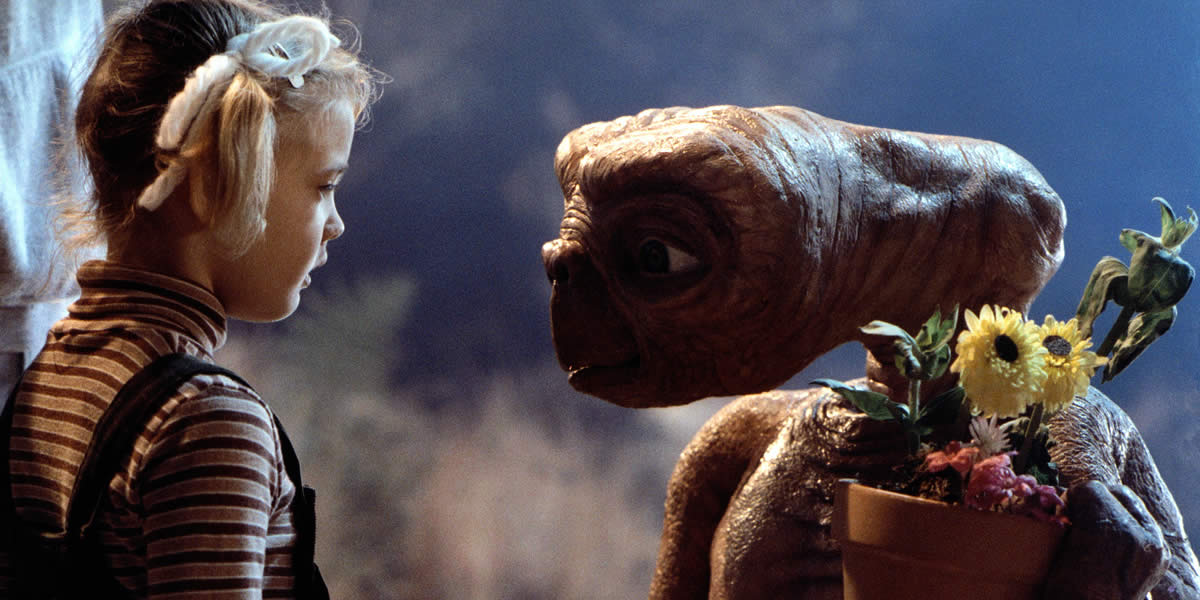
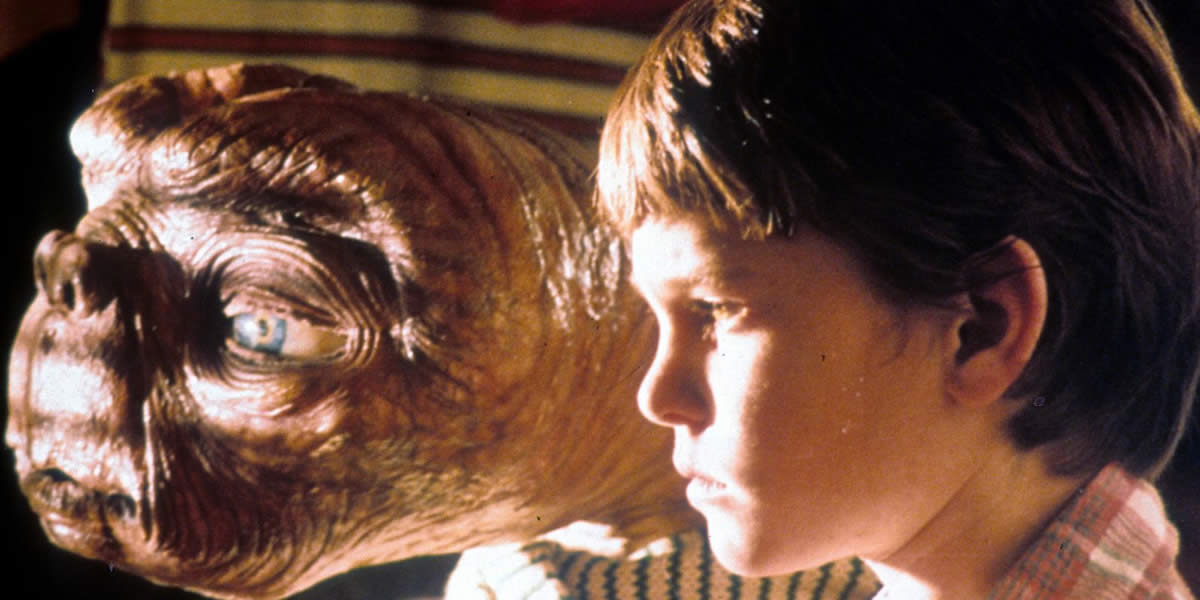
His first encounters with E.T. are shaped by curiosity and fear. The creature is not immediately cuddly or reassuring. He has an unusual face, a long neck, thin limbs, and movements that seem unfamiliar. He is an unknown presence in a familiar environment.
But Elliott’s fear gradually gives way to sympathy. He recognizes that the alien is frightened and alone. Their connection develops through small acts of communication, imitation, and trust rather than through lengthy explanations.
The film’s emotional intelligence lies in this gradual process. E.T. cannot simply explain his circumstances in fluent English. Elliott has to learn how to interpret him, and the audience learns alongside the boy. A gesture becomes meaningful. A sound communicates distress. A shared experience establishes trust.
Henry Thomas’s performance is crucial to this relationship. Elliott is not written as an unusually wise child who always knows the right thing to do. He can be impatient, frightened, and stubborn. Thomas gives him the intensity of a boy whose feelings arrive before he has developed the ability to manage them.
The relationship becomes more complicated as Elliott discovers that his own emotional state is connected to E.T.’s. Their bond extends beyond ordinary friendship, making the alien’s condition increasingly difficult for Elliott to separate from his own well-being.
Yet the connection never feels like a simple fantasy of having a pet or an imaginary companion. E.T. has his own needs, memories, and desire to return to his people. Elliott’s affection is meaningful precisely because he cannot keep the creature for himself forever.
This is where the film begins to move beyond the pleasures of a childhood fantasy. Friendship does not mean possessing another person or preventing them from leaving. It means recognizing that someone you love has a life beyond your immediate needs.
For Elliott, that lesson comes through an experience no child could reasonably anticipate. He has found someone who understands him, only to discover that helping his friend may require letting him go.
The E.T. Movie’s Most Memorable Moments Were Built From Ordinary Things
One of the remarkable achievements of E.T. the Extra-Terrestrial is the way it makes everyday objects and activities feel charged with possibility.
Reese’s Pieces, a telephone made from household materials, a child’s bicycle, and a Halloween costume all become part of the film’s visual vocabulary. None of these objects is extraordinary by itself. Their significance comes from the unusual circumstances in which the characters use them.
Consider the candy. Elliott leaves Reese’s Pieces to guide the alien toward him, transforming a familiar snack into a trail through the neighborhood. The scene communicates an important part of their relationship: Elliott does not begin by trying to control E.T. He tries to establish contact through something inviting.
The candy also became one of the film’s most famous examples of product placement. The production had initially approached Mars about using M&M’s, but the company declined. Hershey agreed to support the film through Reese’s Pieces, and the association proved remarkably successful. The American Film Institute’s production history records that sales reportedly tripled within the first two weeks of release.
The story has become a familiar lesson in the commercial influence of popular entertainment, but its original effectiveness was not simply a matter of advertising. The candy serves a narrative purpose. It is an offering from a child to a frightened stranger, a practical expression of goodwill before the two can properly understand one another.
The improvised telephone is equally revealing. E.T. wants to communicate with his home planet, and the children help him assemble a device from materials they can find. Their solution is not a polished piece of futuristic technology. It is a homemade contraption that reflects their ingenuity and limited resources.
That detail belongs to a recognizable world of childhood experimentation. Before online tutorials and instant access to technical information became everyday conveniences, children often learned through trial and error, toys, household objects, books, and whatever they could persuade their families to let them take apart. The film turns that spirit of improvisation into a matter of cosmic importance.
The Halloween sequence works in a similar way. A public celebration becomes a practical opportunity to move E.T. through the neighborhood without attracting attention. Costumes and familiar traditions offer cover for something that would otherwise be impossible to conceal.
These scenes are funny because the children’s solutions are so simple. They are also moving because the children take E.T.’s needs seriously. The alien’s problem is immense, but their response is to use what they have.
That combination of resourcefulness and affection is one of the film’s most enduring qualities. Its wonder is not reserved for advanced machinery or impossible scientific discoveries. It grows from the ordinary materials of childhood, transformed by imagination and friendship.
How Steven Spielberg Made E.T. Feel Real
A film about a stranded extraterrestrial could easily have become a showcase for special effects. Spielberg understood that the creature would only matter if audiences believed the children cared about him.
That required a convincing physical presence. E.T. needed to look unusual enough to suggest an entirely different form of life, yet expressive enough for viewers to recognize fear, curiosity, sadness, and affection in his movements.
The task fell in large part to Italian special-effects artist Carlo Rambaldi, whose work helped give the character his distinctive appearance. E.T.’s design combined an elongated neck, a small body, delicate hands, and large, expressive eyes. The result was neither conventionally handsome nor conventionally frightening. He looked vulnerable, ancient, and faintly comic, with a face that could seem bewildered one moment and deeply sympathetic the next.
Rambaldi developed complex mechanical models that allowed E.T. to move and respond to the other characters. Different versions of the creature were used for different requirements, including models designed for particular expressions and movements. Performers also helped bring E.T. to life in scenes requiring a more physical presence.
These techniques predated the digital character effects that would become commonplace in later decades. The production relied on practical models, puppetry, mechanical controls, performers, and carefully planned camera work. The audience did not need to understand how the illusion was achieved. It needed to believe that E.T. was really sitting at the kitchen table.
That belief was supported by the performances around him. The young actors had to respond to a character who was, in practical terms, a complicated creation of the production team. Their reactions could not look as though they were waiting for an effect to be added later. They had to convey the awkwardness of sharing a room with someone who was physically present but fundamentally unfamiliar.
The production’s visual approach also helped preserve the children’s point of view. In many early scenes, adults are framed in ways that emphasize their authority without making them the emotional center of the story. The children’s faces, their movements through the house, and the places where they hide E.T. guide the audience’s attention.
The film frequently lets viewers discover things at the same pace as Elliott. This creates a sense of intimacy that a more explanatory approach might have weakened.
The production was not without its practical challenges. According to the AFI Catalog, principal photography began in September 1981 and continued through the end of the year, with additional filming in early 1982. The crew used sound stages to recreate key parts of the family home and filmed outdoor sequences in California.
The final result is a useful reminder that believable screen magic depends on more than technical novelty. A sophisticated mechanical character can attract attention, but it is performance, framing, sound, and storytelling that persuade audiences to care.
E.T. remains memorable not because he looks like a convincing human being, but because he looks unmistakably like himself.
John Williams and the Music That Made the Sky Feel Bigger
Some films announce their emotional intentions through dialogue. E.T. the Extra-Terrestrial often communicates through music.
John Williams’s score gives the story much of its emotional scale. His music can turn a quiet exchange between a boy and an alien into an event of almost mythic importance, then retreat into gentler passages that allow the characters to inhabit their domestic surroundings.
The score’s most famous contribution is the soaring music associated with the bicycle flight. As the children rise above the landscape, the orchestral writing expands with them. The scene is not simply a display of a supernatural ability. It is the moment when the limits of the children’s ordinary world seem to fall away.
The effect depends on the relationship between image and sound. The bicycle itself is an everyday object, familiar to anyone who has ridden through a neighborhood after school. The music transforms that modest vehicle into a means of escape, making a suburban street feel connected to the vastness of space.
Williams’s work also gives the film its emotional continuity. The story moves between comedy, suspense, wonder, and sadness, but the score helps those shifts feel like parts of a single experience. The music does not treat the film’s emotional moments as separate attractions. It binds them together.
At the 55th Academy Awards in 1983, E.T. the Extra-Terrestrial received nine nominations and won four Oscars, including Best Original Score for Williams, along with awards for sound, sound effects editing, and visual effects.
The recognition was fitting. The film’s soundscape is essential to its storytelling, from the small noises that make E.T. seem physically present to the music that accompanies the story’s most expansive images.
The score also illustrates a defining characteristic of Spielberg’s filmmaking during this period. He could take an intimate story and give it the emotional proportions of an epic without abandoning the ordinary people at its center.
The sky in E.T. feels enormous, but the reason the audience cares about what happens there is the relationship between two characters who have learned to trust one another.
Why E.T. the Extra-Terrestrial Became a Box-Office Phenomenon
When E.T. the Extra-Terrestrial opened in American theaters on June 11, 1982, it entered a movie culture increasingly shaped by the summer blockbuster. The success of films such as Jaws and Star Wars had demonstrated that a release could become a major cultural event, drawing audiences repeatedly and extending its presence well beyond its initial theatrical run.
Spielberg was already associated with that shift. Jaws had transformed the commercial possibilities of the summer release, while Raiders of the Lost Ark had established another major adventure franchise. But E.T. offered a different kind of spectacle. It did not depend on a relentless succession of action sequences or a villain who needed to be defeated.
Its central attraction was the possibility that an extraordinary friendship could develop in an ordinary neighborhood.
The film became the highest-grossing release of 1982 in the United States and Canada. Its original theatrical run earned roughly $359 million domestically, according to Box Office Mojo, before subsequent rereleases added to its total.
Those figures reflected more than a successful opening. The movie’s appeal crossed age groups. Children could respond to E.T.’s appearance, the humor of the household scenes, and the excitement of the escape. Adults could recognize the emotional tensions within Elliott’s family and the bittersweet quality of the story’s conclusion.
Parents did not need to explain a complicated science-fiction universe before children could follow the plot. The film established its rules through action and emotion. E.T. was lost. Elliott wanted to help. The adults were becoming suspicious. The children had to work out how to protect their friend.
This clarity helped the movie reach audiences who might not have considered themselves science-fiction fans. It was an adventure, a family drama, a comedy, and a story about separation, all without requiring any one genre to dominate the others.
Its commercial life also extended into the wider world of consumer culture. The film inspired toys, books, posters, clothing, games, and other licensed products. E.T.’s face became recognizable even to people who had not yet watched the movie, and the character’s popularity helped make him one of the most commercially visible movie creatures of the decade.
The Reese’s Pieces partnership became an especially notable example of the connection between entertainment and retail marketing. Meanwhile, E.T.-themed products offered children ways to extend the film beyond the theater and into their bedrooms and playtime.
That merchandise was part of the wider business surrounding 1980s blockbuster cinema, but it also revealed something about the character’s appeal. E.T. was not primarily a figure of menace or power. He was a companion, an outsider, and someone children wanted to protect.
The film’s commercial success did not make it emotionally shallow. Instead, it demonstrated that a popular movie could combine imaginative spectacle with a story whose central feelings were accessible without explanation.
The 80s Childhood of Bicycles, Flashlights, and Homemade Inventions
Part of the film’s lasting appeal comes from the way it depicts childhood as a world with its own geography and technology.
The children travel by bicycle, move through neighborhoods on their own, and use familiar objects to solve problems that adults have failed to recognize. Their world is not entirely free of adult supervision, but it contains spaces where they can make decisions, keep secrets, and test their abilities.
For many viewers who grew up during the 1980s, these details recalled a recognizable part of childhood. Bicycles were important instruments of independence. A ride to a friend’s house could provide a sense of freedom that was difficult to find elsewhere. A flashlight could turn an ordinary room into a hiding place, and a cardboard box could become almost anything a child imagined.
Such experiences were not universal, and childhood varied considerably by family, location, and circumstance. Yet the film captured a familiar pleasure: the feeling that children could temporarily transform the world around them through imagination.
Its depiction of technology is equally revealing. The children are surrounded by radios, household appliances, telephones, toys, and school equipment, but they do not inhabit a world of constant digital communication. Their inventions are physical, improvised, and dependent on what they can find.
E.T.’s homemade communication device is a fantasy of engineering, but it draws on the same logic as a child’s experiment in the garage or bedroom. The parts may not seem compatible, the design may look improbable, and the outcome is uncertain. What matters is the willingness to try.
The movie arrived just as electronic entertainment was becoming an increasingly important part of family life. Arcade games had become a major cultural presence, home consoles were familiar to many children, and personal computers were beginning to move from specialist environments into more homes and schools. Yet E.T. did not portray technology as the primary source of wonder.
Its most important discovery was a living being.
That contrast gives the film an unusual durability. Modern viewers may notice the absence of smartphones and online messaging, but they can still recognize the underlying experience of childhood. The need to keep a secret, the excitement of a daring plan, and the conviction that a trusted friend deserves protection are not tied to a particular device or decade.
The film’s bicycles are also essential to its identity. They represent movement without machinery more complicated than pedals, chains, and handlebars. They allow the children to travel beyond the immediate limits of home while remaining physically connected to the landscape beneath them.
When those bicycles eventually carry the story into the sky, the transformation feels earned because the film has already established what they mean. They are instruments of freedom before they become instruments of flight.
From Phone Home to a Lasting Cultural Legacy
Few film expressions have traveled as far beyond their original story as the idea of phoning home. In E.T., the phrase is both practical and deeply emotional. The alien needs to contact his people, but his desire to communicate is inseparable from his longing to return to a place where he belongs.
The line works because it expresses a universal problem in simple language. Home is a location, but it is also a relationship to the people and surroundings that make life familiar. To be away from home is to lose access to those things, even if the place itself remains unchanged.
That idea has helped the film remain accessible to audiences who do not share its historical setting. The story takes place in a recognizable American suburb of the early 1980s, but its central conflict is not limited to American childhood. It concerns separation, belonging, and the fear of losing someone who has become important.
The film’s influence can also be seen in the way it helped establish a model for family-oriented science fiction. It demonstrated that a story involving extraterrestrial life could be suspenseful and commercially successful without treating the alien as a threat that must ultimately be destroyed. The visitor could instead become a source of empathy, prompting the human characters to reconsider their assumptions about unfamiliar beings.
That was not an entirely new idea in science fiction, but E.T. brought it to a particularly broad audience through the language of a children’s adventure. The film made the emotional relationship more important than the scientific explanation.
Its place in popular culture has been reinforced through rereleases, home video, television broadcasts, anniversary screenings, and continued critical recognition. The American Film Institute has included the film on multiple lists celebrating American cinema, including its selections of great science-fiction films, movie thrills, and memorable quotations.
The film also helped cement the association between Spielberg’s name and stories that balance spectacle with emotional intimacy. His work repeatedly returned to childhood, family relationships, and the encounter between ordinary people and extraordinary circumstances. E.T. remains one of the clearest expressions of that combination.
Its continuing popularity does not depend on viewers believing that the 1980s were a simpler or happier time. The film’s family is troubled, its children are frightened, and its adults do not always understand what is happening around them. Its world is not free of anxiety.
What it offers instead is the possibility that kindness can emerge in an uncertain world. Elliott does not need to understand everything about E.T. to recognize that he deserves help. He begins by responding to another being’s loneliness, and that simple decision gradually changes his understanding of friendship and responsibility.
The film’s cultural legacy is therefore larger than a famous line, a recognizable silhouette, or a successful merchandising campaign. It helped generations of viewers imagine that an encounter with the unfamiliar might produce not fear, but friendship.
Why E.T. the Extra-Terrestrial Still Makes Us Feel Something
Watching E.T. the Extra-Terrestrial today means encountering a film whose technology belongs to another era but whose emotional questions remain immediate.
The practical effects may now carry the charm of an earlier filmmaking tradition, and the suburban setting offers a glimpse of a particular moment in American life. Yet neither has become the film’s defining feature. Its lasting strength comes from the way it connects wonder to vulnerability.
Elliott and E.T. are both outsiders in different ways. One is a child struggling with changes he cannot control. The other is a visitor who has lost the only world he understands. Their friendship gives each a temporary refuge, but it cannot eliminate the circumstances that brought them together.
That is why the film’s ending carries such emotional weight. The prospect of separation is painful because the friendship has been real. Elliott cannot make E.T. part of his family permanently, and E.T. cannot abandon his own people simply because he has found someone who loves him on Earth.
The story recognizes that caring for someone does not guarantee that they will remain beside you. Sometimes affection requires helping another person reach a destination that lies beyond your own wishes.
This is a more complicated lesson than the film’s family-adventure reputation might suggest. Its optimism is not based on the belief that every problem can be solved or that every goodbye can be avoided. It comes from the conviction that a meaningful connection can change a person, even when the circumstances that created it cannot last.
The film also gives childhood a dignity that can be overlooked in stories told from an adult perspective. Elliott’s concerns are not treated as trivial simply because he is young. His fear, loneliness, and affection are as real as the adult problems unfolding around him. The children are not merely waiting to become grown-ups. They are already experiencing the world in ways that matter.
That understanding helps explain why the movie continues to appeal across generations. Parents may respond to Mary’s struggle to protect her children. Younger viewers may identify with Elliott’s desire to keep a remarkable discovery to himself. Adults looking back on their own childhoods may recognize the bittersweet experience of having once believed that a friendship could last forever.
The film does not ask audiences to return to the 1980s in order to appreciate it. It asks them to remember what it feels like to encounter something unfamiliar, to care for someone who needs help, and to discover that belonging can be found in unexpected places.
When E.T. looks toward the sky, the longing in the story is not simply for another planet. It is for the people and places that make him whole. Elliott understands that longing because, in his own way, he has been searching for a place where he feels understood, too.
That is the secret behind the film’s enduring appeal. The alien makes the adventure extraordinary, but the friendship makes it human.
More than forty years after its release, E.T. the Extra-Terrestrial remains one of the defining movies of the 1980s because it brings together everything a great popular film can offer: imaginative storytelling, memorable performances, inventive filmmaking, humor, suspense, and a genuine understanding of the people at its center.
The bicycles may still fly in our memories. The homemade telephone may still inspire a smile. The phrase about phoning home may remain inseparable from the character who made it famous.
But the moment that stays with us is quieter. A child has found someone who understands him, and now he must face the possibility of losing that friend.
In a decade famous for larger-than-life movie heroes, E.T. offered a different kind of adventure. It reminded audiences that the most extraordinary journey might begin with a small act of kindness, unfold in the most ordinary neighborhood, and end with the understanding that love sometimes means letting someone go.
And that is why, long after the special effects have become a part of cinema history, the story still finds its way home.