
Discover why Stand by Me remains one of the most moving 80s adventure movies, capturing childhood friendship, small-town America, and the bittersweet moment growing up begins.
Summer in a small Oregon town, 1959. The roads are dusty, the trees stretch high above the railway tracks, and four boys set out on foot with the sort of confidence that only children possess. They have heard about a dead boy lying somewhere in the woods, and they want to find him. There are no elaborate plans, no expensive equipment, and no guarantee that the journey will amount to anything. There is just a rumor, a stretch of countryside, and the possibility of an adventure worth telling their friends about.
In Stand by Me, released in 1986, the destination matters far less than the boys who are trying to reach it. Gordie Lachance, Chris Chambers, Teddy Duchamp, and Vern Tessio begin their expedition as friends looking for excitement. Along the way, they encounter danger, embarrassment, uncomfortable truths about their families, and the uneasy realization that childhood cannot protect them from everything the adult world has to offer.
Directed by Rob Reiner and adapted from Stephen King’s novella The Body, the film is often remembered as a coming-of-age classic. Yet describing it that way does not quite capture its particular magic. Stand by Me is an adventure movie in which the greatest discovery is not a hidden treasure or a long-lost secret. It is the discovery that the people standing beside you can make an otherwise frightening world feel survivable.
Among the most heartfelt 80s adventure movies, it occupies a distinctive place. It has the movement and suspense of a journey into the unknown, the humor of a story told among friends, and the melancholy of an adult looking back at a time he can never recover. Its world is rooted in 1959, but its emotional perspective belongs to anyone who has ever looked back on childhood and wondered how something that felt permanent could disappear so completely.
Nearly four decades after its original release, Stand by Me continues to resonate because it understands a truth that many larger, louder adventure films overlook: growing up is not simply about discovering what lies beyond the familiar. It is about discovering who you are when you finally get there.
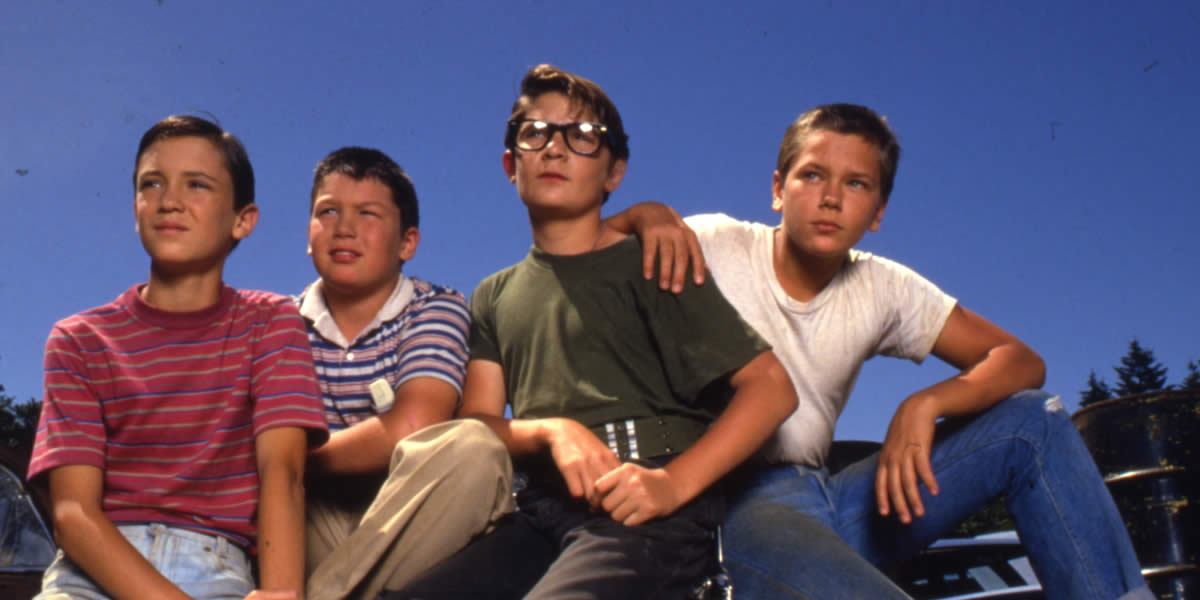
Stand by Me and the Lost Freedom of a Summer Adventure
There is something immediately recognizable about the boys’ expedition. The plan is impulsive, slightly ridiculous, and entirely believable. They have heard that a missing teenager’s body can be found beyond the usual boundaries of their small-town lives. Instead of treating the news as a reason to stay away, they see an opportunity.
For children, the possibility of doing something forbidden can be irresistible. A long walk beyond the neighborhood becomes an expedition. A railway line becomes a dangerous crossing. A night spent outdoors becomes a test of courage. The ordinary landscape acquires a second identity, one that exists only because the children have decided to explore it.
That is the foundation of Stand by Me. Its adventure grows from familiar places rather than spectacular scenery. The boys walk through woodland, cross tracks, follow roads, and negotiate terrain that would hardly register as exotic to an adult. Yet the film makes every stretch of the journey feel consequential because it understands how distance works in childhood.
A few miles from home can feel like another country when you are twelve. The adults who normally determine your movements are absent. The familiar rules no longer seem quite as solid. You have to decide what to do when you become frightened, when a friend makes a mistake, or when the person who appears toughest turns out to be vulnerable.
The journey also recalls a kind of childhood freedom that was never universal, but that remains deeply embedded in popular memories of mid-century America. Children rode bicycles through neighborhoods, wandered into wooded areas, visited friends without elaborate arrangements, and sometimes returned home only when hunger or darkness made further exploration impractical. Their freedom depended on their circumstances, their families, and their communities, but the basic pleasure of going somewhere without knowing exactly what would happen remains widely recognizable.
Stand by Me does not present that freedom as entirely innocent. The boys swear, smoke cigarettes, tell crude stories, and venture into situations they do not fully understand. Their independence is accompanied by poor judgment and genuine danger. They are not miniature adults with perfectly formed moral compasses. They are children improvising their way through a world that has given them responsibilities without necessarily providing the emotional tools to handle them.
This is what makes the adventure feel authentic. The boys are not searching for destiny. They are searching for something to do, something to prove, and perhaps something that will make them feel important.
They find all three, though not in the way they expect.
Why Stand by Me Feels Like a Memory Rather Than a Movie
Although Stand by Me was released in the 1980s, its story takes place in the summer of 1959. That distinction is central to its emotional effect.
The film looks backward from two directions. Its adult narrator, the writer Gordie, remembers the experience from a later point in his life. The audience, meanwhile, encounters a fictional childhood rooted in a period that was already part of America’s cultural past when the movie arrived in theaters.
This distance allows the film to explore memory without making every detail carry the weight of historical explanation. Its period setting appears in the boys’ clothing, the railway lines, the cars, the music, and the rhythms of small-town life. There is no need for a character to announce that the world is different. The details establish that difference quietly.
The landscape is particularly important. The woods are not simply a picturesque backdrop for youthful exploration. They create a sense of scale that the boys cannot control. Trees obscure the path ahead, the railway stretches beyond sight, and open spaces offer little protection when the group finds itself in trouble.
The cinematography by Thomas Del Ruth helps give these locations a physical presence. The natural environment feels inhabited rather than arranged for the camera. The boys move through it with the awkwardness, energy, and occasional exhaustion of children who have been walking longer than they anticipated.
There is also a difference between how a child experiences an event and how an adult remembers it. During childhood, an afternoon can seem endless. Years later, the same afternoon may survive as a handful of images: a friend’s expression, the smell of the woods, the heat of the day, or a conversation whose importance was not apparent at the time.
The film reproduces that unevenness of memory. Its adventure has a clear destination, but its most revealing moments are often detours. A story told around a campfire, an argument between friends, or a confession made while walking becomes more significant than the mechanics of reaching the body.
That approach makes Stand by Me feel less like a conventional mystery than an old recollection being carefully reconstructed. The story is not only about what happened. It is about what the experience came to mean.
And memory, the film suggests, does not preserve every person equally. Some people remain vivid because they changed us. Others disappear from our lives so gradually that we hardly notice until we attempt to explain who we once were.
Four Boys, Four Different Ways of Surviving Childhood
The emotional strength of Stand by Me rests on its four central characters. Each boy brings a different understanding of the world, and each carries a burden that the others do not entirely recognize at first.
Gordie Lachance, played by Wil Wheaton, is the most introspective of the group. He is an aspiring storyteller, observant and imaginative, but he struggles with a painful sense that he has disappointed his family. His older brother, Denny, was admired by their father. After Denny’s death, Gordie finds himself living in the shadow of a loss that has reshaped the household.
His father does not know how to connect with him, and Gordie interprets that distance as evidence that he is not good enough. The boy’s talent for storytelling offers an escape, but it also raises an uncomfortable question: can he trust his own abilities when the person whose approval he wants most seems unable to see them?
Chris Chambers, portrayed by River Phoenix, carries a different kind of burden. His family has a troubled reputation in town, and he is painfully aware that other people judge him through it. Chris is intelligent, perceptive, and capable of remarkable tenderness, but he knows that his name can determine how adults treat him before he has done anything at all.
His friendship with Gordie is especially revealing because Chris refuses to accept the idea that Gordie’s future has already been decided. He recognizes the boy’s talent and encourages him to take it seriously. In doing so, Chris offers something Gordie cannot easily find at home: the belief that he might become more than his circumstances suggest.
Teddy Duchamp, played by Corey Feldman, is loud, impulsive, and fiercely loyal. His bravado is inseparable from his difficult home life, particularly his complicated relationship with his father, a veteran whose behavior has left Teddy emotionally wounded. Teddy’s attachment to his father survives despite the damage, creating a painful contradiction between the man he admires and the harm he has suffered.
Vern Tessio, played by Jerry O’Connell in his feature-film debut, provides much of the group’s comic energy. He is anxious, talkative, and often the least prepared for whatever lies ahead. His enthusiasm for the expedition is genuine, even when his confidence falters.
It would be easy to dismiss Vern as the funny one, but his presence gives the group an important balance. He is not trying to become a tragic hero or prove that he is wiser than his friends. He simply wants to belong.
Together, the boys form a small community in which each person can occupy a role that would be difficult to maintain elsewhere. Gordie can be a storyteller. Chris can be a trusted friend rather than a boy marked by his family. Teddy can display his courage without having to explain his pain. Vern can contribute to an adventure despite his fears.
The film does not suggest that friendship erases their problems. Instead, it shows how friendship gives them room to be understood.
That is one reason the performances remain so affecting. The young actors do not need to make their characters consistently likable. Their behavior is sometimes selfish, immature, or foolish. What matters is that the affection beneath their arguments feels real.
The Heartbreak Beneath the Humor in Stand by Me
For much of its running time, Stand by Me is funny in the way children are funny when they are trying to impress one another.
The boys compete to tell the most outrageous stories. They insult each other, invent elaborate fantasies, and treat profanity as a badge of maturity. Their conversations move rapidly between jokes and serious observations, often without acknowledging the change in tone.
The famous pie-eating story, delivered by Gordie, is a particularly revealing example. It is an absurd tale of revenge involving an eating contest and a disastrous physical reaction. The humor depends on escalating excess, but the scene also demonstrates Gordie’s imaginative confidence. For a while, he commands the attention of his friends simply by telling a story well.
In that moment, the boy who feels overlooked at home becomes the center of the group. His imagination is not a distraction from his life. It is one of the ways he makes sense of it.
The laughter also gives the film room to approach more difficult subjects without turning every scene into a solemn lesson. The boys can be ridiculous because they are children, and they can be perceptive because children are often more aware of emotional tensions than adults assume.
The darker elements of their lives emerge through conversation rather than elaborate explanation. Chris reveals the unfairness of being associated with his family’s reputation. Gordie struggles with his father’s apparent disappointment. Teddy’s bravado hints at the damage beneath it.
These experiences are not presented as interchangeable. The boys face different problems, and the film does not pretend that all childhood pain can be solved through a few days of companionship. What connects them is the difficulty of explaining what they feel to the adults who are supposed to understand them.
For Gordie, grief is particularly isolating. His older brother’s death has altered the family’s emotional balance, leaving him feeling as though his own existence has become an unwelcome reminder of what has been lost. He is not simply sad. He is struggling to understand why he seems less valuable to his father than the brother who is no longer there.
Chris recognizes that Gordie needs to hear something from another person before he can begin to believe it himself. Their conversation becomes one of the film’s emotional turning points, not because it produces an instant solution, but because Chris gives Gordie a perspective he cannot easily reach alone.
The most moving aspect of the scene is its restraint. Chris does not deliver a polished speech about healing. He speaks as a boy who has experienced his own share of injustice and knows what it feels like to be judged unfairly.
The film understands that a friend does not need to fix everything to make a difference. Sometimes it is enough for someone to recognize your pain and refuse to treat it as a flaw.
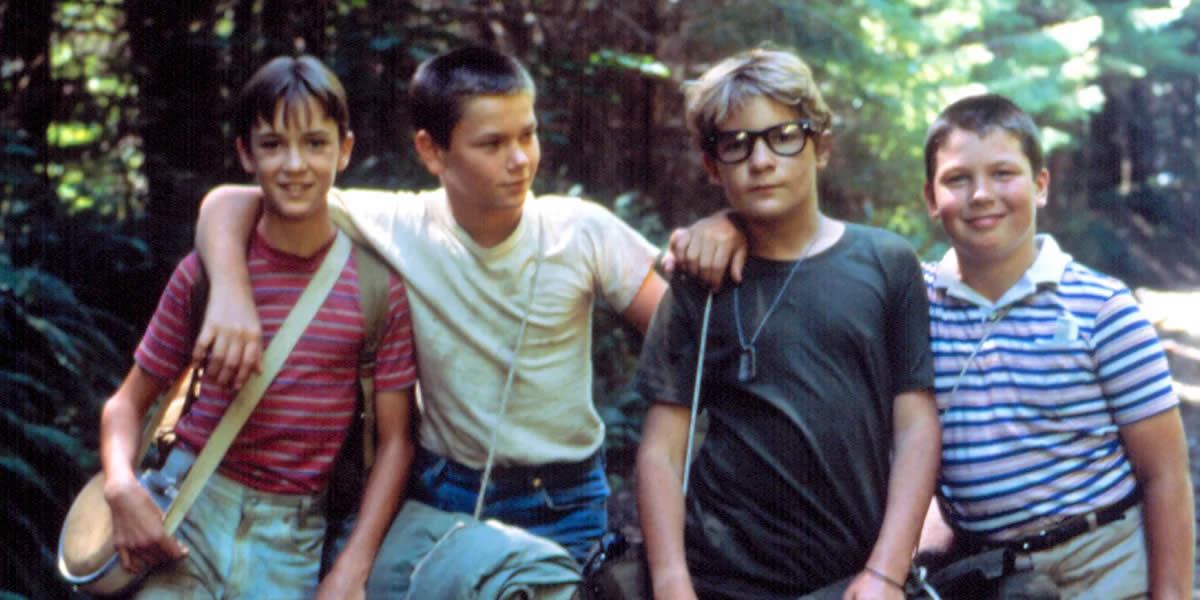
How Stand by Me Captured the 1980s Without Setting Its Story There
By 1986, American popular culture offered audiences many different versions of adolescence. Teen movies explored romance, social status, rebellion, family conflict, and the transition into adulthood. Adventure films frequently promised larger-than-life experiences, while blockbuster entertainment increasingly emphasized spectacle and easily identifiable heroes.
Stand by Me drew on some of those traditions without being confined by them.
Its characters belong to 1959, a period associated in American cultural memory with postwar prosperity, traditional family structures, and the confident optimism that preceded the upheavals of the 1960s. But the film’s portrait of small-town life is not a simple celebration of a supposedly more innocent past. The boys encounter prejudice, emotional neglect, social judgment, and the consequences of adult behavior. The town may look orderly from a distance, yet the children know that its moral certainties do not always translate into kindness.
That tension would have been familiar to audiences in the 1980s, when popular culture frequently revisited earlier decades to explore the roots of contemporary identity. Nostalgia was part of the era’s entertainment landscape, but the strongest period stories did more than recreate old fashions or revive familiar songs. They used the past to investigate what had changed and what had remained stubbornly unresolved.
Stand by Me does this through its treatment of childhood. The boys’ world is distinctly pre-digital. Their entertainment comes from conversation, imagination, physical exploration, and whatever they can find along the way. Their journey is not interrupted by mobile phones, online maps, or messages from worried friends. The absence of those technologies is not presented as a grand statement about modern life. It is simply part of the conditions under which the story unfolds.
For audiences in 1986, that world was separated from their own by roughly a generation. For viewers today, it belongs to a more distant historical landscape. Yet the central social experience remains recognizable: children create private worlds with their friends, establish rules that adults may not understand, and use humor to manage feelings they cannot comfortably express.
The film’s release also coincided with a period when coming-of-age stories could attract adult audiences without abandoning a youthful point of view. Its characters were not glamorous high school students navigating parties and romance. They were preteens dealing with family grief, loyalty, fear, and the desire to be taken seriously.
That distinction gave the movie its particular identity. It did not ask viewers to admire the boys for being exceptional. It asked them to recognize something of themselves in ordinary children who had no idea how important their experiences would become.
Rob Reiner’s Direction and Stephen King’s Surprisingly Tender Story
The origins of Stand by Me help explain why it feels different from many films associated with Stephen King.
The source material, The Body, was published in King’s 1982 collection Different Seasons. King was already widely known for horror, suspense, and supernatural fiction, but the novella demonstrated his ability to explore fear without relying on the supernatural. Its central journey takes place in a recognizable world, where the most unsettling discoveries concern human behavior rather than monsters.
The dead boy’s body gives the plot its initial momentum. It also forces the characters to confront mortality before they possess much understanding of it. Their curiosity is mixed with fear, excitement, and the desire to experience something that will set them apart from their usual routines.
Screenwriters Raynold Gideon and Bruce A. Evans adapted the novella for the film, while Rob Reiner directed it. Reiner had already demonstrated an ability to work across different kinds of comedy and character-driven storytelling, including This Is Spinal Tap in 1984 and The Sure Thing in 1985.
With Stand by Me, he found a balance between humor, suspense, and emotional realism. The film allows the boys to be funny without reducing their problems to jokes, and it allows their circumstances to become frightening without turning the story into a conventional horror picture.
The result depends heavily on performance and rhythm. Scenes are allowed to develop through dialogue, expressions, and the awkward pauses that occur when children do not know how to respond to one another. The camera does not need to announce the importance of every interaction. Often, the emotional significance becomes clear only after the conversation has moved on.
Reiner’s approach also preserves the physical dimension of the adventure. Walking takes time. The boys become tired, irritated, hungry, and frightened. Their surroundings impose practical difficulties, and their progress is not always graceful. These details keep the story connected to the experience of moving through the world as a child.
The production itself faced a challenge when the project needed financing. According to the American Film Institute’s account, Norman Lear helped finance the film after Columbia Pictures passed on an opportunity to acquire it during production. Columbia subsequently distributed it.
That history is a reminder that the film’s eventual reputation was not inevitable. A modest, character-focused adventure about four boys walking through the countryside did not have the obvious commercial profile of a science-fiction spectacle or an effects-heavy action picture.
Its success depended on the conviction that the characters and their relationships could sustain the film. The finished work vindicated that belief, earning a strong audience response and later recognition through major award nominations.
Gideon and Evans received an Academy Award nomination for their adapted screenplay, while the film was also nominated for Golden Globe awards for best motion picture drama and best director. These honors reflected the film’s ability to reach beyond the category of children’s adventure, even though its central characters were children.
The Sound of Stand by Me and the Power of an Older Song
Music plays a quiet but essential role in the film’s atmosphere. Rather than relying on a contemporary pop soundtrack to establish its emotional credentials, Stand by Me draws heavily on songs associated with the period in which the story takes place.
The use of Ben E. King’s 1961 recording of “Stand by Me” is especially significant. The song postdates the film’s 1959 setting, so its presence should not be mistaken for a perfectly literal recreation of what the boys would have heard during their journey. Instead, it connects the film’s emotional themes with a familiar piece of American popular music whose message of loyalty and companionship fits the story.
The title itself carries a promise. To stand by someone is to remain present when circumstances become difficult. It is an expression of solidarity that does not depend on being able to solve another person’s problems.
That meaning is particularly appropriate for Gordie and Chris, whose friendship becomes the emotional center of the film. Their bond is not based on identical backgrounds or personalities. It grows from their willingness to take each other seriously when the rest of the world seems inclined to dismiss them.
The soundtrack also helps locate the film within the wider culture of the 1980s. Audiences had become accustomed to movie soundtracks that could revive older recordings for new listeners, connecting a film’s story with a musical past. In this case, the relationship between the song and the movie became especially visible after the film’s release, when renewed interest in King’s recording helped bring it back to public attention.
The music does not have to explain the film’s feelings because the story has already established them. Instead, it gives those feelings a familiar shape. A song about loyalty can sound different after watching four children struggle through an adventure in which their friendships are tested by fear, exhaustion, and the knowledge that their lives outside the group are far from simple.
This is one of the reasons the title has endured beyond the film itself. It expresses something fundamental about friendship without requiring a particular age, decade, or setting. The phrase belongs as easily to adults remembering childhood as it does to children trying to understand the people they care about.
The Ending of Stand by Me and the Pain of Growing Apart
The conclusion of Stand by Me is moving because it refuses to pretend that an important friendship must last forever to have mattered.
For much of the journey, the boys experience themselves as a unit. Their disagreements are temporary interruptions, and their shared destination gives them a reason to remain together. They have escaped the ordinary routines of home and entered a world where their identities are shaped by what they do for one another.
But the expedition cannot preserve that arrangement indefinitely. The boys will return to their families, their town, and the separate futures waiting for them. Their shared experience will become a memory, and the meaning of that memory will change as they grow older.
Adult Gordie’s narration gives the ending its distinctive weight. The story has been filtered through a consciousness that understands more than the boy could have understood at the time. He can recognize the importance of events that seemed ordinary while they were happening, and he can acknowledge the limits of what he knew about his friends.
That perspective also introduces the possibility of regret. Childhood friendships often feel permanent because children have not yet experienced how easily circumstances can change. People move away. Interests diverge. New relationships develop. Family obligations and work gradually reshape the time available for old companions.
Sometimes a friendship ends through conflict. Sometimes it fades without a decisive moment. And sometimes the people involved cannot fully explain why they stopped seeing one another.
Stand by Me treats this separation as a natural part of growing up, but it does not minimize the loss. The boys’ friendship matters partly because it cannot remain unchanged. Its significance lies in what it gave them during a particular period of their lives.
For Gordie, the journey becomes inseparable from the people who shared it with him. Remembering the adventure means remembering who he was before adulthood gave him a different vocabulary for grief, loyalty, and regret.
The film’s emotional power comes from that distinction between an experience and its later meaning. At twelve, a walk through the woods can feel like the most important thing in the world. At forty, fifty, or sixty, the memory may survive not because of the destination but because of the friend who stood beside you when you were afraid.
That is a quieter idea of heroism than the one offered by many adventure movies. The boys do not emerge with permanent solutions to their problems. Their families remain complicated, their futures uncertain, and their friendship subject to the passage of time.
What they gain is something more modest and, in its own way, more lasting: proof that they were not entirely alone.
Why Stand by Me Remains the Most Heartfelt 80s Adventure Movie
The continuing appeal of Stand by Me rests on its refusal to make childhood either entirely innocent or entirely miserable.
Its boys are mischievous, competitive, frightened, and occasionally cruel. They make mistakes and tell lies. They want to impress one another, and they do not always know how to express affection without disguising it as an insult. Yet they are also capable of loyalty, empathy, and an emotional honesty that the adults around them sometimes lack.
The film gives these contradictions room to coexist. It understands that childhood is not simply a preparation for adulthood. It is a distinct period of life, full of immediate concerns and intense relationships whose importance may become clearer only years later.
That understanding distinguishes Stand by Me from adventure films built primarily around conquest or achievement. Its central accomplishment is not the discovery of a body. It is the gradual revelation of the people the boys are becoming, and the ways they help one another confront circumstances they cannot control.
Its place in the history of 1980s cinema is also worth considering. The decade produced many enduring films about friendship, adolescence, and the transition into adulthood, but Stand by Me approached those themes with unusual economy. It relied on four young performances, a carefully observed setting, a strong screenplay, and the tension between the immediacy of childhood and the perspective of memory.
Its emotional restraint has allowed the film to reach successive generations without requiring them to share the same childhood experiences. A viewer who grew up in the 1950s may recognize the period details. Someone who came of age in the 1980s may respond to the film’s treatment of friendship and independence. A younger viewer may encounter a world without digital technology and still recognize the feeling of walking somewhere with friends simply because the day seems too promising to spend at home.
The details change, but the emotional structure remains familiar. Everyone has to learn how to deal with fear, how to recognize the value of another person, and how to accept that not every relationship can accompany them through every stage of life.
There is also something significant in the film’s treatment of storytelling. Gordie grows into a writer, and the adult narrator’s account becomes a way of preserving an experience that might otherwise have faded. The film itself performs the same act. It takes a brief period in four fictional lives and gives it a permanence that the characters could never have achieved for themselves.
That is perhaps the most heartfelt thing about Stand by Me. It does not insist that the past was perfect or that growing up inevitably ruins everything. It acknowledges that people can be shaped by moments they did not fully understand, and that remembering those moments can be both comforting and painful.
The boys set out to find a dead stranger. What they discover along the way is the fragility of their own lives, the complexity of their families, and the extraordinary value of being understood by another person.
They return from their journey without becoming superheroes. They remain children, with all the uncertainty and vulnerability that entails. But for a brief stretch of summer, they have been able to see one another more clearly than the outside world allows.
That is why Stand by Me remains such an enduring 80s adventure movie. Its greatest adventure is not the distance traveled or the danger overcome. It is the experience of belonging to a small group of people who know you before you know yourself.
And its deepest lesson arrives only with time: the friends who shape our lives do not always stay, but the people we became in their company can remain with us long after the summer is over.