Released in 1980, the Grateful Dead’s “Alabama Getaway” paired a restless rock-and-roll groove with Robert Hunter’s sly storytelling, becoming a defining sound of the band’s early 80s era.
There is a particular kind of energy that announces itself before you have time to settle in. A guitar snaps into place, the rhythm section starts pushing forward, and suddenly the room feels a little smaller and the evening a little more promising. In 1980, the Grateful Dead bottled that sensation in “Alabama Getaway,” a brisk, guitar-driven song that sounded ready to roll before the needle had finished finding its groove.
For a band known for performances that could stretch a musical idea into an expedition lasting half an hour, “Alabama Getaway” was refreshingly direct. It had a sturdy rock-and-roll pulse, an instantly recognizable opening, and a compact arrangement built to get a crowd moving. Jerry Garcia supplied the music, while Robert Hunter provided the words, drawing on the rough-edged characters and uneasy humor that made so many of his songs feel like fragments from stories already underway.
The song arrived at an interesting moment in the Dead’s history. The 1970s had brought the group from the loose, exploratory spirit of the psychedelic underground into the wider world of arena concerts, ambitious albums, and an increasingly devoted audience. As the 1980s began, the band was adjusting to a new decade without abandoning the musical instincts that had carried it this far. Keyboardist Brent Mydland had joined in 1979, and his presence brought another color to the group’s sound. The resulting record, Go to Heaven, offered a snapshot of a band experimenting with a cleaner, more contemporary studio presentation while remaining unmistakably itself.
“Alabama Getaway” became one of the album’s most immediate statements. Its appeal was not mysterious: it moved, it had character, and it left enough space for the musicians to sound like individuals rather than cogs in a polished production. Yet the song also carried the strange little shadows that made the Grateful Dead more interesting than a straightforward rock band. Its story never quite settles into a single interpretation, and its jaunty momentum sits beside a world of trouble, suspicion, and hard luck.
That contrast is the magic of “Alabama Getaway.” It is a song that sounds like an invitation to hit the road, even as its narrative suggests that getting away may not be as simple as it first appears.

“Alabama Getaway” and the Grateful Dead’s New Decade
By the end of the 1970s, the Grateful Dead had become a remarkable American institution. The band had developed from a San Francisco group associated with the counterculture into a touring operation with a loyal following, a deep catalog, and a concert culture all its own. The audience was no longer simply discovering the group. Many fans were building parts of their lives around its music, following tours, swapping tapes, and learning the particular language of a band whose performances were rarely identical from night to night.
The new decade presented a different musical landscape. Punk had challenged the excesses of arena rock, disco had reshaped the sound of popular radio, and synthesizers were becoming increasingly prominent in mainstream recordings. Rock bands were being asked to sound current without losing the qualities that had made them successful. The Grateful Dead had little reason to chase every new fashion, but they were hardly insulated from change.
Their 1980 album Go to Heaven reflected that tension. It had a more polished presentation than some of the band’s earlier recordings, with a sound that could sit comfortably alongside contemporary rock releases. The cover, featuring the musicians in coordinated white suits, made the shift especially visible. For a group whose image had long been tied to denim, tie-dye, and the informal look of the touring counterculture, the styling was an unusually conspicuous choice.
Inside the sleeve, however, the familiar personalities remained. Garcia’s guitar still had its supple phrasing. Bob Weir’s rhythm playing supplied its own angular motion. Phil Lesh approached the bass as a melodic instrument rather than simply reinforcing the bottom of the arrangement, while Bill Kreutzmann and Mickey Hart provided the interlocking percussion that helped give the band its distinctive rhythmic character.
“Alabama Getaway” was a useful introduction to this version of the Dead. It was accessible without being anonymous, energetic without sounding frantic, and compact enough to work as a radio single. It did not ask a listener to understand the band’s history before enjoying it. The song simply began, took off, and made its case.
For established fans, that directness did not mean the band had abandoned its adventurous side. It meant the Dead had another kind of song in their repertoire, one that could set a concert in motion before the evening opened into stranger and more expansive territory.
How “Alabama Getaway” Turned Rock and Roll Into a Road Story
The song’s most obvious strength is its movement. “Alabama Getaway” draws on the lean, forward-driving tradition of American rock and roll, the kind of music built around a strong backbeat, a memorable guitar figure, and a singer who sounds as if he is telling you something important while keeping one eye on the exit.
Garcia’s composition has often been described as having a Chuck Berry-like quality. That comparison makes sense in its rhythmic economy and sense of propulsion. The arrangement does not need a long introduction or a complicated build. It establishes a groove and trusts the musicians to make it compelling. The result has a certain old-fashioned efficiency: the song gets where it is going, but the trip is the pleasure.
This was a useful quality for the Grateful Dead. Their reputation rested heavily on improvisation, but the band was also deeply rooted in older American musical forms. Country, blues, folk, rhythm and blues, and rockabilly all informed its approach. The group could play an extended psychedelic passage one moment and turn to a compact, almost vintage rock-and-roll number the next. Those different instincts were not contradictions. They were part of the band’s musical vocabulary.
“Alabama Getaway” draws on the more direct side of that vocabulary. Its rhythm feels physical. The beat encourages movement, and the guitar work gives the song an edge without weighing it down. It is a rocker with a sense of humor and a little danger in its stride.
The song also benefits from the band’s ability to make a tight arrangement sound alive. The musicians do not flatten the performance into a rigid studio exercise. Instead, the parts interact. The rhythm has a spring to it, the guitar cuts through the mix, and the keyboard adds a distinctive flash of color. There is enough precision to make the song memorable and enough looseness to remind listeners that the musicians are responding to one another.
That balance is central to the Dead’s appeal. Even when the form is compact, the music suggests that something could change at any moment. “Alabama Getaway” is not an extended jam, but it carries the alertness of a band accustomed to playing without a safety net.
Jerry Garcia, Robert Hunter, and the Song’s Unsettled Story
The Grateful Dead’s songwriting partnership between Garcia and Hunter produced songs that often felt both specific and elusive. Hunter could give a character a name, a place, a predicament, and a handful of vivid details, then leave the listener to work out the larger meaning. His lyrics were rarely just decoration for the music. They helped create a world, even when that world remained partly obscured.
“Alabama Getaway” follows that tradition. The title evokes a place and an escape, but the song is not a simple celebration of Southern hospitality or a travelogue about heading for warmer weather. Its atmosphere is closer to an outlaw tale, populated by hard characters, uneasy encounters, and the sense that trouble may be waiting just beyond the next turn.
The song’s imagery draws on a familiar American storytelling tradition: the road as a place of possibility and risk. In popular music, a journey can represent freedom, reinvention, escape from responsibility, or an attempt to outrun the consequences of an earlier decision. The same road can promise adventure and expose a traveler to danger. Hunter understood how effectively those ideas could coexist in a short song.
His approach leaves room for listeners to form their own impressions. The narrative has enough concrete detail to feel like a story, but it does not pause to explain every character’s motives or establish a tidy moral. The song’s momentum keeps moving even when its circumstances remain uncertain.
That uncertainty makes the cheerful musical surface more interesting. Garcia’s music propels the song forward, while Hunter’s words introduce a world that is not entirely safe. The arrangement seems ready for a good time, but the narrative carries a little grit beneath the shine. Instead of cancelling each other out, those elements create the song’s personality.
This was familiar territory for the Grateful Dead. Their catalog is full of narrators who are unreliable, unlucky, defiant, or caught in circumstances larger than themselves. Some are sympathetic; others are difficult to trust. Many seem to be speaking from the middle of a story rather than at its beginning or end. “Alabama Getaway” belongs to that tradition, offering a vivid scene without pretending that every mystery can be resolved.
The title itself helps maintain the ambiguity. An escape can be a destination, an impulse, or a temporary reprieve. The song does not need to tell us which one matters most. Its power comes from the uneasy combination of a lively beat and a story that never feels completely settled.
Brent Mydland’s Keyboard Sound Helped Give the Song Its Spark
One of the important changes in the Grateful Dead’s late-70s lineup was the arrival of Brent Mydland. He joined the band in 1979, replacing Keith Godchaux, and became the group’s keyboard player during a period of transition. By the time Go to Heaven was recorded, Mydland was helping shape the band’s new studio sound while finding his place in a musical partnership that had been developing for years.
Mydland brought more than a new set of fingers to the keyboards. His playing and singing gave the Dead additional options, from soulful vocal harmonies to bright keyboard textures that could cut through a dense arrangement. He was not trying to replicate the musicians who had come before him. Over time, he became a distinctive part of the group’s identity, particularly during its 1980s performances.
On “Alabama Getaway,” the keyboard contribution is especially noticeable in the instrumental break. Mydland’s Minimoog solo adds a sharp electronic voice to a song otherwise grounded in familiar guitar-led rock and roll. The synthesizer’s sound was unmistakably of its time, but it was used in a way that served the tune rather than overwhelming it. The solo gives the arrangement a burst of color, then lets the song return to its central groove.
That moment captures an important feature of Go to Heaven. The album could sound more polished and contemporary than the Dead’s earlier studio work, but the musicians were not simply following a production trend. They were finding ways to incorporate different sounds into a group whose musical foundation remained rooted in live interplay.
The keyboard also helps distinguish “Alabama Getaway” from a straightforward throwback to 1950s rock and roll. The guitar and rhythm section supply the familiar drive, while the Minimoog places the song firmly in the technological world of 1980. That mixture of old and new was increasingly common in popular music, but the Dead approached it from their own direction, bringing a keyboard texture into a band arrangement that was still built around the movement of its players.
Mydland’s role would grow more important over the following decade. For listeners discovering the band in the early 1980s, he became part of the sound they associated with this era of the Grateful Dead. “Alabama Getaway” offered an early, accessible example of how his presence could alter the group’s musical colors without erasing its familiar character.
“Alabama Getaway” on Go to Heaven
An album is more than a collection of songs. Its sequence, production, artwork, and overall atmosphere shape how listeners remember the music. Go to Heaven is particularly interesting because it captures the Grateful Dead at a point when the band’s public image and studio presentation were changing, even as its live performances remained at the heart of its identity.
Released in 1980, the album included several songs that became closely associated with the band’s next phase, among them “Alabama Getaway,” “Althea,” “Feel Like a Stranger,” and “Saint of Circumstance.” They offered different glimpses of the group’s musical range. Some leaned into a strong rock pulse; others created more space for reflection, atmosphere, or extended performance.
“Alabama Getaway” was the most immediately forceful of the group. Its compact form made it a natural candidate for a single, and it was released in April 1980 with “Far from Me” on the B-side. The pairing gave listeners two contrasting examples of the band’s songwriting at that moment: one a hard-driving rocker, the other a song with a different mood and rhythmic feel.
The single also gave the album a point of entry for listeners who might not have been inclined to start with the Dead’s more expansive recordings. A three-minute-plus rock song was an easier introduction than a live performance that might shift through multiple themes over the course of an entire side of a record. For a casual listener, the appeal was immediate. For a longtime fan, the single was another part of a much larger musical picture.
The record’s polished sound and conspicuous visual presentation sometimes made Go to Heaven seem like an unusual fit for a group whose reputation had been built on musical exploration and a fiercely independent concert culture. But that contrast is part of what makes the album worth revisiting. The Grateful Dead were not frozen in one period of their own history. They continued to absorb new influences, make new records, and adjust to changing circumstances.
The studio version of “Alabama Getaway” reflects that process. It is carefully shaped but not sterile, accessible but not generic. Its groove has the directness of classic rock and roll, while its keyboard work and band interplay reveal musicians who were still curious about the possibilities inside a familiar form.
For anyone looking back at the music of 1980, the song offers a small but telling snapshot of the decade as it began: guitar-led rock still had plenty of life in it, synthesizers were becoming a standard part of the sound, and veteran musicians were finding ways to adapt without abandoning what made them distinctive.
From the Record Player to the Concert Stage
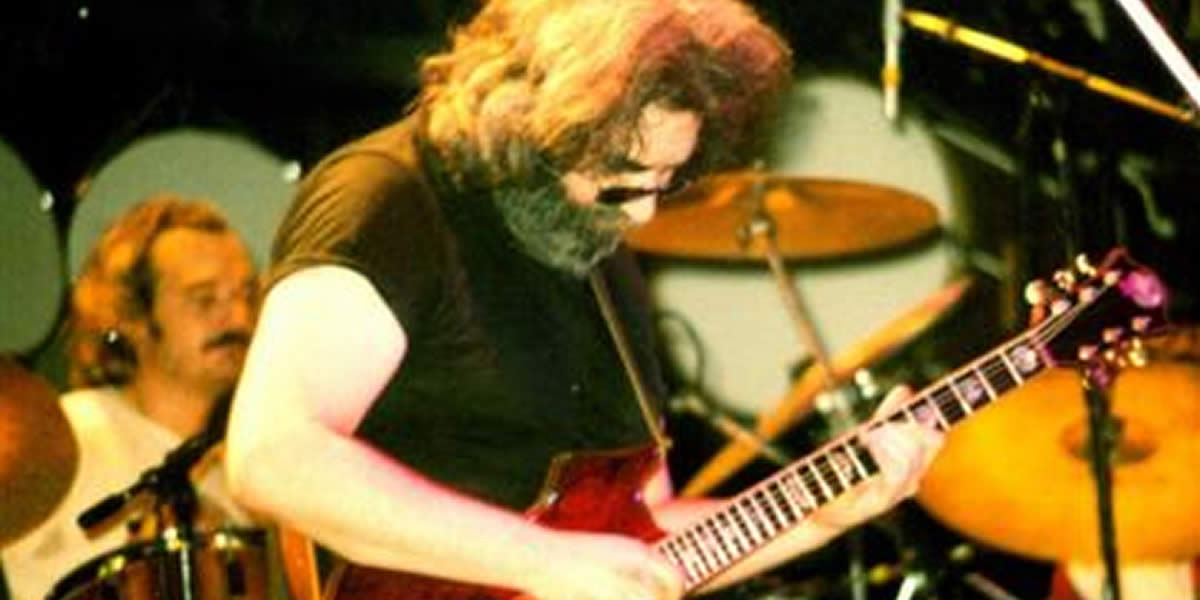
The studio single tells only part of the story. For the Grateful Dead, a song’s life was never limited to its official recording. The stage was where the band tested material, changed arrangements, built musical connections between songs, and allowed familiar compositions to evolve through repetition.
“Alabama Getaway” made its concert debut on November 4, 1979, before its studio release. That timing is characteristic of the Dead’s working method. A new song could become part of the live repertoire before listeners encountered the polished album version. By the time Go to Heaven arrived, the band had already been developing the tune in front of audiences.
It became a regular presence during the early 1980s. Concert records and set lists show the song turning up in a variety of positions, often as an opening number or in combination with another energetic rocker. One especially natural pairing was “Promised Land,” the Chuck Berry song that had long been part of the Dead’s repertoire. Both songs move with an uncomplicated rock-and-roll urgency, making the transition feel like an extension of the same musical conversation.
That pairing also made historical sense. The Grateful Dead had always drawn on American musical traditions rather than treating their original songs as a closed world. By placing “Alabama Getaway” alongside a Berry composition, the band connected its own songwriting to the rock-and-roll foundations that had influenced it.
The live performances were not carbon copies of the studio track. Tempo, phrasing, instrumental emphasis, and transitions could shift from one night to another. The song remained recognizable, but its placement in a set could change its effect. As an opener, it could establish a brisk mood immediately. In an encore, it could provide one more shot of energy before the audience headed back into the night.
That flexibility mattered because the Dead’s concerts were built around a relationship between individual songs and the larger shape of a performance. A number did not have to become a long improvisation to contribute to that experience. Sometimes the value of a compact rocker was precisely its ability to get a room moving and clear the way for whatever came next.
“Alabama Getaway” served that purpose well. It gave the band a direct, high-energy song that could work within a varied set list without forcing the rest of the evening into the same mood. The Dead could move from it into another rocker, a country-flavored tune, or a more spacious composition. The song was a doorway, not a destination.
The Early 80s Deadhead Experience and the Power of a Familiar Song
By 1980, being a Grateful Dead fan meant participating in a musical culture that extended far beyond buying an album or hearing a song on the radio. Fans followed tour dates, exchanged recordings, compared performances, and developed their own memories of particular nights. A song could become familiar through repeated listening, yet still carry the excitement of the unexpected when the band played it live.
That culture helps explain why “Alabama Getaway” mattered even though it was not one of the Dead’s longest or most exploratory compositions. Its strength was its immediacy. A few bars were enough to establish the song’s character, and the opening could bring a recognizable burst of energy to a concert. In a set filled with older favorites, new compositions, and extended musical passages, that kind of directness had real value.
Fans also had reasons to pay attention to how the song changed. The band could tighten or loosen its delivery, emphasize a keyboard passage, or use the ending to move into another number. Listeners who collected concert recordings could compare performances and notice small differences that might escape someone hearing the song only once. The same composition could become part of different musical stories depending on the night.
This was one of the pleasures of following a band that treated its repertoire as something living. A studio recording established the basic shape, but it did not settle every question about how a song should sound. The stage remained a place for discovery, even when the material was as compact and approachable as “Alabama Getaway.”
There was also a social dimension to that familiarity. At a concert, recognizing a song was not merely a private pleasure. It was a shared moment between musicians and audience, a small point of connection among thousands of people who might have traveled from different places for the same performance. The music created a temporary community, and a strong opening number could make that community feel present almost immediately.
“Alabama Getaway” fit comfortably into that world. It was lively enough to raise the energy in a room, distinctive enough to be recognized quickly, and flexible enough to survive repeated performances. Its appeal did not depend on being rare. It depended on the pleasure of hearing a good song played by musicians who knew how to make it move.
Why “Alabama Getaway” Still Captures the Magic of the 80s
The song’s place in the Grateful Dead’s history is unusually revealing because it captures several sides of the band at once. It is rooted in traditional rock and roll, colored by the synthesizer sounds of its period, driven by Garcia’s guitar, and given an unsettled narrative by Hunter. It is also a reminder that the Dead’s identity was never limited to lengthy improvisations or the psychedelic reputation that followed them from the 1960s.
Its subsequent history reinforces that point. “Alabama Getaway” remained in the live repertoire through the 1980s, although it became less frequent as the decade progressed. It returned for a handful of performances in 1995, near the end of the Grateful Dead’s original touring era. The song had a life beyond the moment when it was new, but it remained especially associated with the band’s transition into the 1980s.
That period is sometimes remembered through broad visual shorthand: tie-dye shirts, crowded arenas, road trips, and a fan culture that seemed to operate by its own rules. Those images are part of the story, but the music gives a more useful account of what was happening. The Grateful Dead were an established band navigating a changing musical world, with a new keyboardist, a new studio sound, and a touring audience that continued to grow.
“Alabama Getaway” belongs to that story because it demonstrates how much the band could accomplish with a straightforward rock song. It did not need to become an epic to feel individual. Its energy came from the interplay of the musicians, its story from Hunter’s ability to make a few details suggest a larger world, and its lasting appeal from the tension between a buoyant tune and a narrative with rough edges.
There is something appealing about a song that makes no grand claims for itself. “Alabama Getaway” does not attempt to summarize the Grateful Dead, explain the band’s philosophy, or stand in for its entire catalog. It simply gets moving. A guitar catches the ear, the beat carries the song forward, and the story leaves just enough unresolved to invite another listen.
That may be the most enduring part of its magic. The song sounds like motion, but it also sounds like possibility. It belongs to a band whose music was built around the idea that a familiar starting point could lead somewhere different each time. In the studio, “Alabama Getaway” is a tight and energetic rocker. Onstage, it became part of a wider conversation between the musicians and their audience.
For listeners returning to the early 1980s, it offers more than a burst of nostalgia. It captures a moment when the Grateful Dead were adapting to a new decade without losing their appetite for musical discovery. The sound is unmistakably of its time, yet the central pleasure remains immediate: a good groove, a compelling story, and a band that knows how to keep the road open.