Chevy Chase’s 1983 comedy turned a family drive to a dream destination into a hilarious portrait of vacation disasters, suburban ambition, and the American open road.
The American family road trip begins with a particular kind of optimism. The car is packed, the cooler is wedged into place, the children have been assigned seats, and somebody has insisted that leaving before sunrise will make all the difference. Ahead lies a ribbon of highway, a collection of attractions promised in glossy brochures, and the comforting belief that a few days away from home will bring everyone closer together.
Then the traffic starts. Someone needs a bathroom. The motel looks nothing like the photographs. The children are fighting, the adults are losing patience, and the destination that seemed so irresistible from the kitchen table is still hundreds of miles away.
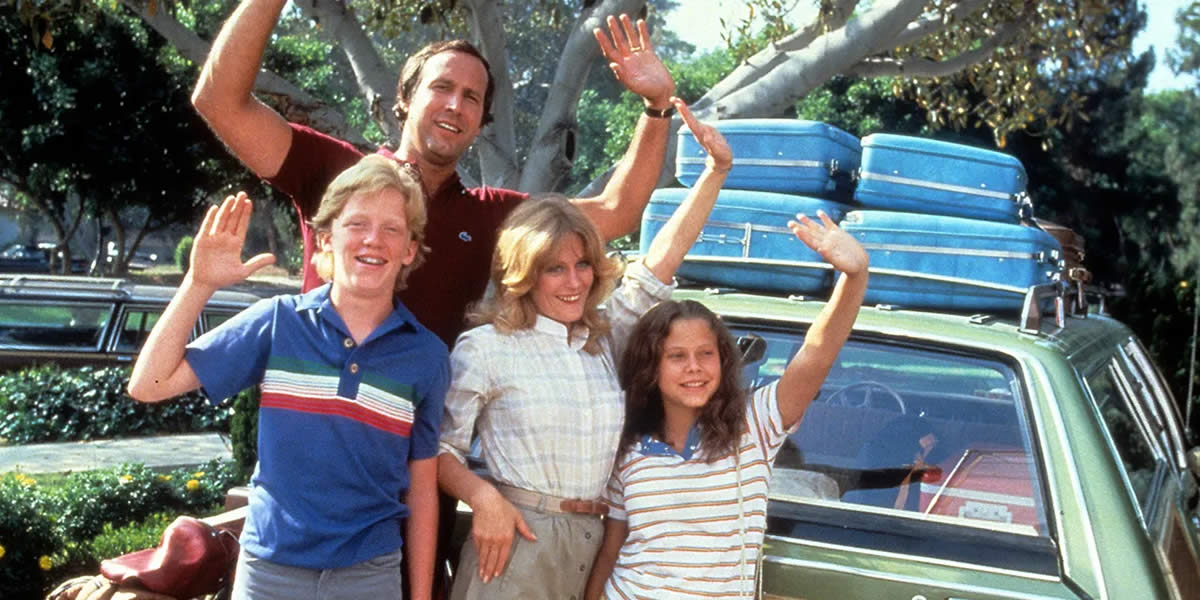
In the summer of 1983, National Lampoon’s Vacation took that familiar American predicament and pushed it toward glorious absurdity. Chevy Chase played Clark Griswold, a determined family man who wanted to deliver the perfect holiday to his wife, Ellen, and their children, Rusty and Audrey. His chosen destination was Walley World, a California amusement park that existed in his mind as the ultimate reward for all the planning, driving, and family togetherness along the way.
The problem was that Clark could not seem to get out of his own way. His confidence exceeded his judgment, his itinerary left little room for reality, and every new setback only strengthened his determination to carry on. What should have been a carefree journey became an escalating series of indignities, mishaps, and increasingly desperate attempts to keep the dream alive.
Directed by Harold Ramis and written by John Hughes, National Lampoon’s Vacation was more than a string of road jokes. Released on July 29, 1983, it captured the friction between the idealized American family holiday and the exhausting business of actually taking one. It understood that a vacation could be both a cherished family ritual and an ordeal that tested everyone’s patience.
The movie also arrived at a revealing moment in American popular culture. The automobile remained a symbol of independence, the interstate made long-distance travel accessible to millions, and the family vacation promised a break from the routines of work and suburban life. Yet the Griswolds discovered that putting miles between themselves and home did not necessarily make life easier.
Their journey became one of the defining comedy road trips of the decade, and Clark Griswold became a recognizable figure in the mythology of family travel: the father who wants everything to be wonderful so badly that he helps make everything go wrong.
National Lampoon’s Vacation and the American Road Trip Dream
By the early 1980s, the family road trip was a well-established American tradition. The postwar expansion of car ownership, the growth of the interstate highway system, and the spread of roadside motels and tourist attractions had helped make long-distance driving a practical option for families who wanted to see the country on their own terms.
The appeal was easy to understand. A car offered flexibility that a train or plane could not always match. Families could bring luggage, stop when they wanted, visit relatives, and turn a journey into an adventure. The highway connected familiar suburbs to distant landscapes, national parks, roadside diners, souvenir shops, and attractions designed to make the drive itself part of the holiday.
For parents, a road trip could also be a kind of family project. There were routes to plan, supplies to buy, maps to study, and schedules to coordinate. A successful holiday promised not only recreation but evidence that the household was working as it should. Everyone would get along, the children would have fun, and the family would return home with stories worth telling.
National Lampoon’s Vacation understood the pressure hidden inside that ideal. Clark does not simply want to reach Walley World. He wants the trip to justify itself. Every inconvenience threatens the larger idea he has constructed around the holiday, and every fresh disaster becomes something he must somehow overcome.
His mistake is treating the vacation as a test he can pass through sheer persistence. The road is supposed to be the means to a happy ending, not an unpredictable experience with its own demands. Clark has planned the destination so thoroughly that he has left little room for the people traveling with him.
That is where the comedy finds its footing. A family trip is an unusually confined social experiment. People who might ordinarily spend much of the day in separate rooms are suddenly sharing a small space for hours. Parents must make decisions while tired. Children have little control over where they go or how long they must wait. Minor irritations accumulate because there is nowhere to escape them.
The Griswolds’ journey makes these pressures visible in exaggerated form. Their car becomes a moving household, complete with familiar arguments and uneven distributions of authority. The road offers new scenery, but the family’s habits come along for the ride.
The movie’s humor depends on recognizing the gap between the vacation advertised in a brochure and the one that unfolds in real life. The destination may promise excitement, but getting there can involve boredom, expense, confusion, and exhaustion. A family can spend months anticipating a holiday only to discover that the people they brought along remain the same people they were at home.
Clark Griswold: The Father Who Had to Make Everything Perfect
Clark Griswold is the engine of the movie’s escalating disasters. He is not a man who sets out to ruin his family’s holiday. Quite the opposite. He wants to give them something memorable, and he approaches the task with the conviction that a sufficiently detailed plan can protect everyone from disappointment.
That makes him more interesting than a conventional comic fool. Clark’s intentions are recognizable, even when his actions become ridiculous. He has invested so much of himself in the idea of a successful vacation that he struggles to accept evidence that the plan is failing. Instead of adjusting his expectations, he doubles down.
Chevy Chase was particularly well suited to this kind of character. By 1983, audiences knew him for a comic persona built around self-confidence, physical awkwardness, and the capacity to behave as though an embarrassing situation had not quite happened. Clark has that same brittle certainty. He wants to appear competent, in control, and thoroughly pleased with himself, even when circumstances have made those ambitions impossible.
Chase plays him as a man who can turn a minor setback into a personal crisis without recognizing the transformation. Clark’s face often does part of the work. A look of wounded disbelief can communicate the distance between what he expected and what he has received. His reactions make the ordinary frustrations of travel feel like assaults on the natural order.
Yet the character also exposes a familiar form of family pressure. Clark assumes responsibility for the vacation, but that responsibility becomes a claim on everyone else. He decides what the family should enjoy, how the journey should proceed, and what the holiday will mean. When reality refuses to cooperate, his disappointment can become more important than the needs of the people around him.
Ellen, played by Beverly D’Angelo, often serves as the family’s emotional counterweight. She is more practical and perceptive than Clark, and her responses help establish that his version of events is not the only one available. She loves her family, but love does not require her to mistake every bad decision for a good one.
The children, Rusty and Audrey, played by Anthony Michael Hall and Dana Barron, experience the trip from the back seat. Their perspective makes the imbalance especially clear. Clark imagines a shared adventure, while his children are living through a journey largely dictated by their father’s ambitions.
The film’s central joke is that Clark’s commitment to family togetherness can make togetherness unbearable. He wants to create memories, but he becomes so concerned with the final result that he struggles to enjoy the experience in front of him. His family is supposed to be the reason for the trip, yet he repeatedly behaves as though the trip itself matters more than their comfort.
That contradiction gave the movie a lasting appeal. Clark is absurd, but his basic mistake is not confined to comedy. Many people recognize the impulse to make a special occasion perfect, to justify the expense and planning, or to keep going because too much effort has already been invested to admit defeat.
From John Hughes’s Story to the Big Screen
The film began with a piece of writing by John Hughes, whose observational comedy often found drama in the small pressures of ordinary American life. Before becoming one of the defining screenwriters of 1980s teen cinema, Hughes had worked in the world of National Lampoon, the irreverent humor magazine that helped shape a generation of comedy writers and performers.
His story “Vacation ’58” supplied the foundation for the movie. The original piece drew on a family journey across America, viewed through the memories of a boy. The screen version shifted the emphasis toward the father, giving the story a central comic figure whose determination could propel a series of increasingly outrageous episodes.
That change suited the road-trip structure. A journey naturally breaks into encounters: a stop in one town, a night at a motel, an unexpected relative, a wrong turn, another delay. The narrative does not need a single villain or a complicated mystery. Each new location can introduce a fresh problem, and the problems can grow more ridiculous as the miles accumulate.
Producer Matty Simmons, a co-founder of National Lampoon and a producer of Animal House, helped bring the project to the screen. Harold Ramis, who had co-written and directed Caddyshack, took charge behind the camera. The combination connected the movie to the irreverent comedy tradition that had emerged from the magazine while giving it the shape of a mainstream studio release.
The creative team also had to solve a structural problem. A film built around a series of travel mishaps could easily become a collection of disconnected sketches. The audience needed a reason to follow the Griswolds from one disaster to the next.
Clark provided that reason. His fixation on Walley World gives the story a clear destination, while his refusal to surrender keeps the journey moving. The audience can see that his approach is making things worse, but his commitment ensures that the family continues toward the promised reward.
The destination itself is a useful comic device. Walley World represents the kind of attraction that occupies a central place in a child’s imagination and becomes a major objective in a parent’s vacation plan. It is the prize at the end of the highway, the place that will make the preceding inconveniences worthwhile.
The movie’s production history also reflects the practical demands of filming a journey. The production used locations across the American West and Midwest, combining real landscapes and recognizable travel settings with carefully staged comic situations. The result feels like a cross-country trip, even though a movie’s geography is assembled through editing, production design, and the selective use of locations.
The film’s original ending was substantially revised after test audiences responded poorly. The replacement, featuring John Candy as a Walley World security guard, gave the story a different conclusion and helped bring the Griswolds’ ordeal to its final confrontation. It was a reminder that even a comedy about a family determined to stick to its plan could require a major change of direction behind the scenes.
The Wagon Queen Family Truckster and the Look of 80s Family Travel
Every great road-trip comedy needs a vehicle that feels like part of the family, and National Lampoon’s Vacation had the Wagon Queen Family Truckster. The oversized station wagon was a comic exaggeration of the American family car, a machine designed to carry people and luggage across long distances while making a strong visual statement about domestic practicality.
The station wagon had long been associated with family life. It offered room for children, groceries, suitcases, and the various items that seemed essential to a household on the move. By the 1970s and early 1980s, it remained a familiar sight in suburban driveways and on interstate highways. A family preparing for a long trip might measure the success of its packing strategy by how much could be squeezed behind the rear seats.
The Truckster turns that ordinary vehicle into an object lesson in bad judgment. Its awkward styling and conspicuous size make it memorable before it has even begun the journey. It is not sleek or glamorous. It is a machine built around the idea that bigger and more family-oriented must mean better, even when the result is visually absurd.
Clark’s relationship with the car mirrors his relationship with the vacation itself. He has committed to a plan that is supposed to deliver comfort, convenience, and happiness, but the plan becomes an obstacle to all three. The vehicle is meant to serve the family, yet it becomes one more source of embarrassment and frustration.
The car also anchors the film in its period. Road trips in the early 1980s depended on a recognizable collection of material details: paper maps, fuel stops, motel rooms, highway signs, and large cars carrying families toward destinations promoted on billboards and in travel advertisements. Before digital navigation and smartphones, a missed turn could mean pulling over to consult a map, arguing over directions, or driving farther than intended before finding a place to turn around.
Travel required a degree of improvisation that modern technology has reduced but not eliminated. Drivers had to judge distances, look for service stations, and work out how to find an unfamiliar address. Children might watch the scenery through the window, complain about the length of the drive, or count the miles until the next stop. The car was both transportation and a temporary living room, except that nobody could easily leave it when tempers rose.
The Truckster captures that environment in comic shorthand. It is a moving symbol of the family vacation as a major logistical undertaking, complete with the promise that a little more space, a little more planning, and the right equipment will make the journey successful.
The joke is not simply that the car looks ridiculous. It is that the Griswolds have invested so much hope in the trip that even the machinery of the holiday becomes part of the pressure. The Truckster carries them across the country, but it cannot carry them past their own expectations.

Roadside America: Motels, Maps, and the Places Between Destinations
One of the pleasures of National Lampoon’s Vacation is the way it treats the American landscape as a sequence of experiences rather than a series of postcard views. The country is not merely something to admire through a windshield. It is a place to get lost, spend money, find a meal, ask for help, and occasionally discover that the promised attraction is not what the family expected.
The road-trip genre has always depended on the spaces between destinations. A family may begin with a national park or amusement park in mind, but much of the actual experience takes place in parking lots, roadside restaurants, motel corridors, and service stations. These are the practical spaces of travel, necessary to the journey but rarely included in the idealized version of the holiday.
In the early 1980s, such places formed a familiar part of American mobility. Interstate exits were lined with signs advertising food, fuel, lodging, and attractions. Motels offered a bed for the night, sometimes with a swimming pool or a view of a parking lot. Restaurants promised a quick meal before the family got back on the road. Tourist stops competed for attention with giant signs, unusual roadside displays, and claims of being the biggest or best of something.
For children, the drive could seem endless. The passing landscape changed, but the experience of sitting in the back seat could remain stubbornly similar. Parents might focus on mileage and arrival times, while younger passengers asked how much longer the journey would take. The difference between a good day and a bad one could come down to heat, hunger, boredom, or a disagreement over who was taking up too much space.
The film turns these ordinary irritations into comic set pieces. Its mishaps are often extreme, but the circumstances surrounding them are recognizable. Travel creates opportunities for misunderstandings because people are away from familiar routines and operating with limited information. A reservation may not meet expectations. A route may be more complicated than it looked on paper. A stop that seemed convenient can become a source of fresh trouble.
This is part of what makes the movie’s geography feel meaningful. The Griswolds are not simply racing from Illinois to California. They are moving through a landscape of American aspirations, each stop offering another promise of novelty, convenience, or entertainment. The country appears full of attractions, but the family cannot always make sense of what it encounters.
The movie also gently punctures the belief that travel automatically broadens the mind. Seeing more places does not guarantee that someone will become more thoughtful or flexible. Clark can cross state lines without reconsidering his assumptions. He treats each new experience as a problem to overcome rather than an opportunity to change his approach.
That stubbornness is funny because the road keeps offering him evidence that his plan needs adjustment. The family is not failing to have a vacation because America has run out of interesting places. It is struggling because Clark cannot separate the idea of a perfect trip from the messy business of being on one.
Why Walley World Became the Perfect Comic Destination
Every road-trip story benefits from a destination that carries more meaning than its location on a map. For the Griswolds, Walley World is that place. It represents the ultimate family attraction, a theme park that promises a concentrated dose of excitement at the end of a long drive.
The name itself suggests the commercial language of entertainment. It sounds cheerful, uncomplicated, and designed to appeal to children and adults alike. The park is a world of rides, mascots, and carefully packaged fun, the sort of destination that can become a family legend before anyone has visited it.
Clark’s determination to reach Walley World gives the film its central irony. The attraction is supposed to reward the family for enduring the journey, but the journey becomes so miserable that the promised reward grows almost absurdly important. Clark cannot accept that the trip might have value apart from its final destination, and he cannot accept that the destination might fail to justify everything that has happened along the way.
That is a recognizable feature of family travel. A theme park or major attraction can become the focal point of a holiday because it gives the family a shared objective. Tickets are purchased, dates are chosen, and expectations build. Children imagine the rides. Parents calculate the cost and the driving time. The event becomes a promise that everyone is expected to enjoy.
The problem is that anticipation can become its own burden. Once the trip has been framed as a special occasion, ordinary disappointments feel larger. A delay is not simply a delay. It threatens the day everyone has been waiting for. A bad meal or an argument in the car can seem like evidence that the whole holiday is going wrong.
Walley World is therefore more than a parody of an amusement park. It is a symbol of the perfect experience that people try to purchase, plan, and deliver to their families. Clark believes that reaching the park will make the preceding misery worthwhile. The audience can see the flaw in that logic long before he does.
The movie’s climax brings this contradiction to the surface. By the time the Griswolds reach their destination, the simple act of getting there has become an ordeal in itself. The park cannot be treated as an ordinary attraction because Clark has loaded it with the emotional weight of the entire vacation.
The final confrontation, involving Candy as a security guard, turns the family’s arrival into one last escalation. The comedy becomes increasingly unreasonable, but the underlying idea remains clear: when a person becomes fixated on getting the promised reward, the pursuit can overwhelm the original purpose.
Walley World has endured in popular culture because it is an unusually effective shorthand for that kind of expectation. It represents the place everyone has been promised, the destination that must be worth the trouble, and the conviction that happiness is waiting just beyond the next stretch of road.
National Lampoon’s Vacation and the Comedy of Family Dysfunction
The film’s humor is often broad, physical, and deliberately outrageous, but its strongest observations come from the dynamics inside the Griswold family. The journey forces the characters to spend time together while exposing the ways they misunderstand one another.
Clark believes he is giving his family a wonderful experience. Ellen recognizes that his determination is creating problems. The children are expected to accept the itinerary even when it is plainly not working. Each person experiences the same trip differently, but Clark behaves as though his own interpretation should settle the matter.
The movie also understands how family roles can become comic traps. A parent who is accustomed to making decisions may struggle to admit an error. A child who has little control over the situation may express frustration in ways that irritate the adults. A spouse who has become the voice of reason can end up managing both the children and the person who planned the holiday.
Clark’s most revealing quality is his inability to distinguish persistence from good judgment. He often treats changing course as a kind of defeat. Rather than admit that a plan has gone wrong, he keeps investing effort in it, even when the cost to the family is obvious.
The arrival of extended family adds another layer. Relatives bring their own habits, expectations, and social complications. They may be part of the family, but that does not mean their presence makes a difficult trip easier. The film’s encounters with relatives underline the uncomfortable truth that family obligations do not always arrive at convenient moments.
The performance by Randy Quaid as Cousin Eddie became one of the movie’s most memorable elements. Eddie’s disheveled manner and disregard for ordinary social boundaries create a contrast with Clark’s image of himself as a respectable, organized family man. Clark wants his vacation to reflect a polished version of middle-class life. Eddie is a reminder that family reality is rarely so neatly arranged.
This contrast fits the wider comic tradition of National Lampoon, which often found humor in the gap between respectable appearances and the behavior people preferred to keep out of view. The Griswolds want to experience the country, but the most disruptive forces in their lives are not strangers or distant landscapes. They are the people they already know, including one another.
The movie is not a realistic study of a family in crisis, nor does it pretend that every conflict can be solved through a sincere conversation. Its characters are pushed into comic extremes, and the plot repeatedly rewards escalation. But the familiar tensions beneath the exaggeration help explain why audiences continue to recognize themselves in the Griswolds.
A family vacation is supposed to be a break from everyday life. In practice, it often concentrates everyday life into a smaller space. The same habits, resentments, affections, and competing needs come along, with less privacy and more opportunities for friction. National Lampoon’s Vacation understood that the road does not suspend family dynamics. It gives them more room to become ridiculous.
The Legacy of National Lampoon’s Vacation
The commercial success of National Lampoon’s Vacation helped establish the Griswolds as one of American comedy’s enduring fictional families. The film was followed by National Lampoon’s European Vacation in 1985, National Lampoon’s Christmas Vacation in 1989, and later entries that returned to the characters and their recurring struggle to achieve a holiday that would finally go according to plan.
Each sequel offered a new setting, but the basic comic engine remained familiar. Clark would form an ambitious idea of what a special occasion should be, the family would be drawn into his plans, and reality would begin dismantling the fantasy. The details changed, but the gap between intention and outcome remained the source of the humor.
The original film also helped define a recognizable type of 1980s comedy: an ordinary American setting pushed into outrageous territory by a protagonist who cannot recognize when he has gone too far. Its humor was not dependent on elaborate fantasy or an exotic world. It drew on cars, motels, relatives, amusement parks, and the pressures of a family trying to have a good time.
That ordinariness is part of the movie’s staying power. The road trip remains a powerful American image because it promises freedom and togetherness while requiring a great deal of coordination. Modern families may rely on digital maps, online reservations, and phones that can locate the nearest restaurant, but the emotional complications have not disappeared. A better route planner cannot guarantee that everyone will agree on when to stop, what to eat, or how much longer they can stand being in the car.
The movie also leaves behind a more reflective observation about the pursuit of leisure. People can work hard to arrange a break from routine, only to bring the pressures of routine with them. They may try to schedule every hour, control every outcome, and make sure the money spent produces a memorable experience. The result can be a holiday so tightly managed that nobody has room to enjoy it.
Clark Griswold remains funny because he wants something genuinely good for his family. His failure is not a lack of affection but a mistaken belief that affection can be demonstrated through an unyielding plan. He wants to provide happiness as though it were a destination he can reach by driving far enough.
The film’s most enduring joke is that the perfect vacation cannot be guaranteed by a map, a carefully selected vehicle, or a famous attraction at the end of the highway. The road will always contain delays and surprises. The people traveling together will always bring their own needs and moods. A family holiday can be memorable for reasons nobody planned, including the things that went wrong.
That is why National Lampoon’s Vacation remains the ultimate road-trip comedy. It celebrates the ambition behind the American family journey while dismantling the fantasy that a successful holiday depends on everything going right. The Griswolds set out to make an ideal memory. What they create instead is a comic disaster that audiences have remembered for decades.
The highway stretches ahead, the car is loaded, and Clark is certain that this time everything will work out. For everyone watching, the fun begins when we realize that it probably will not.