Before Tony Hawk brought skateboarding to a generation of gamers, Skate or Die captured the rebellious spirit, daring tricks, and streetwise style of 80s skate culture.
Picture a skateboard rolling across sun-warmed concrete, its wheels rattling over cracks in the pavement. Somewhere nearby, a portable radio is playing rock music. A teenager in scuffed sneakers tries a trick, loses balance, and steps off the board before the fall gets any worse. There is no scoreboard, no helpful tutorial, and no guarantee that the next attempt will go any better. There is just the pavement, the board, and the desire to get it right.
By the late 1980s, that combination of freedom, frustration, and nerve was finding a new home in video games. One title made an especially memorable entrance: Skate or Die!, Electronic Arts’ 1987 skateboarding game, which brought a collection of competitive skating events to home computers before arriving on the Nintendo Entertainment System.
The name sounded like a challenge scrawled across a skateboard deck. The game delivered on that attitude with half-pipe tricks, downhill racing, freestyle competition, and an unusual event in which skaters tried to knock each other from their boards using padded jousting poles. It was a strange, playful mix of sport and arcade spectacle, but it captured something important about skateboarding’s appeal. Skating was not just about getting from one place to another. It was about skill, style, risk, and the satisfaction of doing something difficult in your own way.
Skate or Die! did not invent skateboarding games, and it did not simulate real skating with modern precision. Its importance was different. It helped establish a recognizable vocabulary for skateboarding in video games, giving players multiple events, distinct challenges, a countercultural atmosphere, and a world that revolved around the skateboard rather than treating it as a passing novelty.
Long before elaborate 3D skate parks and customizable trick combinations became familiar features of the genre, this game invited players to find out what they could do on four small wheels. Its controls could be demanding, its graphics were limited by the hardware, and its competitions sometimes bordered on the absurd. Yet its identity was unmistakable. Skate or Die! felt like a game made for a sport that had never been particularly interested in following the rules.

Skate or Die Arrived at the Right Moment for 80s Skate Culture
Skateboarding had a long history before Skate or Die! appeared. Its roots stretched back to mid-20th-century California, where surfers experimented with wheeled boards as a way to bring some of the feeling of surfing onto dry land. Over the following decades, improvements in boards, wheels, and trucks helped transform the activity from a quirky pastime into a sport with its own techniques, personalities, competitions, and subcultures.
By the 1980s, skateboarding had become especially associated with individual expression. A skateboarder could practice in a driveway, cruise along a sidewalk, explore an empty parking lot, or seek out a pool or ramp. Some riders were drawn to competition, while others cared more about inventing tricks and developing a personal style. Skateboarding could be athletic without resembling traditional team sports, and its culture often celebrated independence rather than obedience.
The surroundings mattered. Concrete banks, curbs, ramps, and swimming pools offered different possibilities. The best skating spots were not necessarily purpose-built facilities. A neglected piece of urban infrastructure might become an opportunity, while an ordinary stretch of pavement could turn into a place to practice the same movement over and over.
The broader visual culture reinforced the sport’s identity. Skateboard magazines, graphic deck designs, punk and hard rock, and casual clothing helped distinguish skating from more conventional athletic pursuits. The skateboard was equipment, but it was also a way to communicate taste and belonging.
Video games were developing their own youth culture at the same time. Home computers such as the Commodore 64 were becoming fixtures in many households, while Nintendo’s console was establishing itself as a major presence in American living rooms. Games could bring activities that required specialized equipment, physical confidence, or access to particular locations into the home.
Skateboarding was an appealing subject because it had obvious visual and mechanical ingredients. A player could understand a ramp, a jump, a downhill course, or a trick attempt without needing much explanation. Yet skating also presented a design challenge. The appeal of the real sport depended on balance, momentum, timing, and bodily movement, all difficult things to reproduce with a joystick or a handful of buttons.
Skate or Die! arrived at a time when developers were still working out how to translate those qualities into digital form. It offered a lively interpretation rather than a perfect reproduction, and that approach helped make the game distinctive.
How Skate or Die Turned Skateboarding Into a Video Game World
Released for the Commodore 64 in October 1987, Skate or Die! was developed and published by Electronic Arts. It was subsequently adapted for other home-computer platforms, including the Apple II, MS-DOS, Amstrad CPC, and ZX Spectrum. A Nintendo Entertainment System version followed in North America in 1988, with Konami handling development of that conversion and Ultra Games publishing it.
The different versions reflected the varied landscape of late-80s gaming. A household with a Commodore 64 could experience the game as a computer title, while Nintendo owners encountered it through a console already becoming central to family entertainment. The basic idea traveled across platforms, although technical differences meant that the experience was not identical everywhere.
One of the game’s most effective decisions was to organize skating into several separate events. Instead of asking players to master one long course, it offered different ways to demonstrate skill. The events included downhill racing, a downhill jam, freestyle competition, high jumping, and pool jousting.
That variety mattered. Skateboarding itself encompasses different kinds of movement and different ways of measuring success. Speed down a hill is not the same achievement as executing a controlled trick on a ramp. A contest built around jumps asks for different timing from a race that rewards keeping a board moving through a course. By separating these activities, the game suggested that skating had more than one measure of ability.
It also made the game easier to revisit. A player who struggled with one event could try another, while friends could take turns competing in their preferred challenges. The structure created a small digital skateboarding scene rather than a single test to be completed and forgotten.
The game was not a free-roaming skate park in the modern sense. Players selected discrete events and learned the specific demands of each. But within the limits of 1980s hardware, that design provided a useful range of experiences.
There was an additional benefit: each event offered a different kind of failure. A missed trick, a poor jump, or a collision in a race produced a distinct lesson. Players had to learn the rhythms of the event rather than assume that one technique would work everywhere.
In retrospect, that variety is one of the game’s most important contributions. It helped establish skateboarding as a subject capable of supporting an entire sports game, with its own rules, challenges, and personality.
From Half-Pipe Tricks to Downhill Racing: What Made Skate or Die Fun
The freestyle event placed the player in a half-pipe, where the goal was to build a strong performance through tricks and well-timed movements. A half-pipe is a curved ramp that allows a skateboarder to travel back and forth, gaining speed and launching into the air. In real skating, the challenge involves timing, balance, body position, and control. In Skate or Die!, those physical demands had to be translated into button presses and directional input.
The result was less intuitive than modern games might lead players to expect. Success required experimentation. A move that looked simple on screen could take repeated attempts to perform reliably, and the limited animation sometimes made it difficult to understand precisely why a trick had gone wrong.
But the effort was part of the attraction. The player was not simply watching a skateboarder perform. The player was responsible for the result, and the gap between intention and execution gave the game its tension. A successful move felt earned because it followed a period of trial and error.
Downhill racing offered a different kind of excitement. Instead of concentrating on a trick, the player had to navigate a course at speed. The basic appeal was easy to understand: stay moving, avoid trouble, and reach the finish ahead of the competition. The challenge came from managing the course while resisting the temptation to treat speed as the only consideration.
The downhill jam and other competitive events expanded that basic idea. They encouraged players to think of skating as a sport with different disciplines, not merely as a character riding down a screen. High jumping added a direct test of performance, while the game’s most unusual event, pool jousting, turned a skateboarding contest into a comic collision between opponents.
Pool jousting was especially memorable because it pushed the game away from realism. Two skaters faced one another in an empty swimming pool, each using a padded pole in an attempt to knock the other off balance. It was not the sort of activity most skateboarders would identify as a central part of the sport, but it suited the game’s playful, exaggerated personality.
The mix of events meant that Skate or Die! could shift between athletic competition and arcade absurdity. One moment called for precision; another invited players to enjoy a ridiculous showdown. The contrast helped keep the game from feeling like a dry sports simulation.
It also reflected the freedom with which 1980s video games often approached their subjects. Developers were not always aiming to reproduce an activity faithfully. They were searching for mechanics that made it entertaining on a screen. In Skate or Die!, the result was a skateboarding game that understood the sport’s image even when its events took a detour into comic fantasy.
Rodney Recloose and the Game’s Distinctive Skate Shop
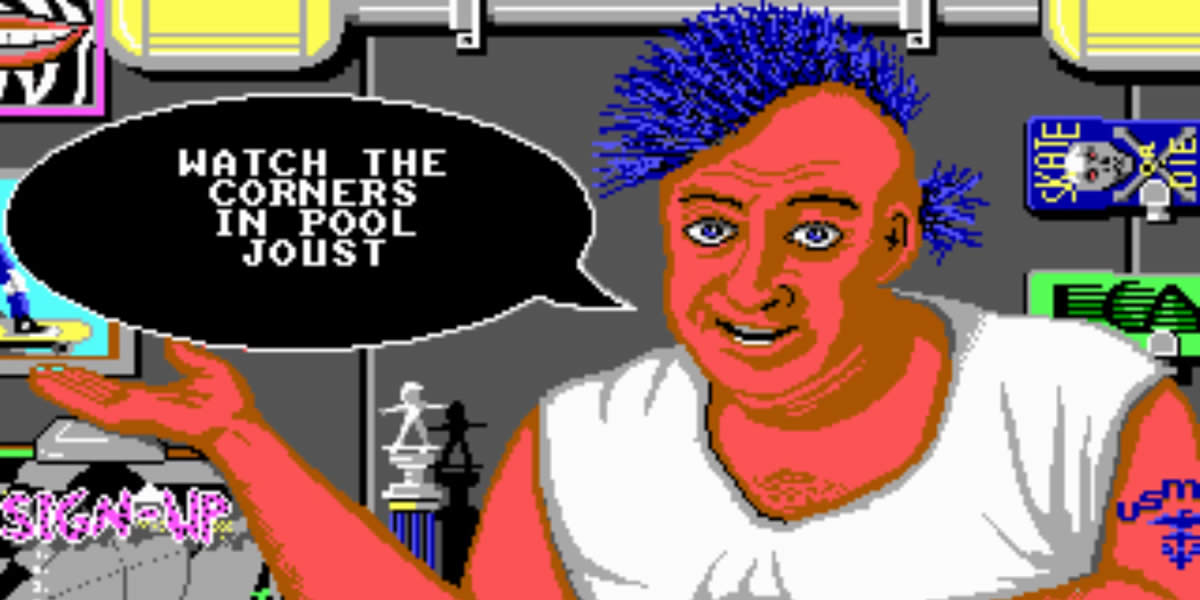
In the NES version, the game begins at a skateboard shop run by Rodney Recloose, a character whose blue mohawk and exaggerated appearance establish the title’s irreverent tone. The shop acts as a central hub, allowing players to choose between practice and competition before heading toward the different events.
This was a useful piece of design. A sports game can feel like a menu of disconnected challenges if it offers no sense of place. By giving the events a shared setting, Skate or Die! created the impression that the player was entering a small skateboarding community. The shop was not just a functional screen. It was the game’s social center.
The character design also helped establish the intended audience and mood. Rodney was not a conventional coach in a tracksuit, offering sober advice about technique. He looked like someone from a cartoon version of an underground skate scene, an eccentric gatekeeper who could send players toward a race or a strange competition without much ceremony.
The visual style was necessarily limited. The NES could not reproduce every detail of a real skate park, and the characters were assembled from small sprites. Even so, a distinctive haircut, a shop interior, and a few memorable animations could do a surprising amount of work. Players filled in the world around the images.
That process was familiar to anyone who played games in the period. The hardware offered a few visual clues, and the imagination supplied the rest. A small cluster of pixels became a rival. A simple ramp became a place worth mastering. A shop screen suggested a wider world of skaters who shared the same interests.
The shop also made the game feel less formal than a conventional sports title. It suggested that skateboarding belonged to a scene with its own characters and rituals. Players were not merely entering a tournament under the supervision of a referee. They were stepping into a stylized version of skate culture.
That atmosphere helped Skate or Die! stand apart from games that borrowed the surface of a sport without considering its surrounding identity. It was not enough to put a skateboard on the screen. The game needed a world in which skateboarding made sense, and Rodney’s shop provided a compact introduction to that world.
The Music, Graphics, and Attitude That Made Skate or Die Memorable
For many players, the first impression of Skate or Die! was not a trick or a race. It was the music.
The Commodore 64 version featured an energetic title tune by British composer Rob Hubbard, whose work became widely admired among fans of computer-game music. The Commodore 64’s SID sound chip gave composers distinctive tools for producing electronic tones, rhythmic patterns, and effects. Hubbard used those capabilities to create a track with a driving, rock-influenced character that suited the game’s subject.
This was important in a period when game music had to work under strict technical limits. Composers could not simply record a full band and place the performance over the action. They had to build music from synthesized sounds, carefully managing the available channels and memory. A strong tune needed to establish mood quickly and remain recognizable despite the limitations.
The Skate or Die! theme helped give the game an identity before the player had even begun an event. Its energy belonged to the same broad cultural world as skateboarding’s association with rock music and youth rebellion. The sound did not reproduce a live concert, but it conveyed movement and attitude.
The NES version used an arranged version of the theme composed by Kouji Murata. The difference between the computer and console versions is a reminder that games of the period were not single, uniform experiences. A title could move between systems and acquire a slightly different musical character as developers adapted it to new hardware.
The graphics were similarly shaped by technical constraints. Characters, boards, and ramps had to remain legible at low resolution, and the animation could only suggest the full range of human movement. Compared with later skateboarding games, the visual world was simple. Compared with the expectations of 1987, however, the combination of multiple events, recognizable settings, and an energetic presentation helped the game feel like a complete sporting experience.
Its attitude was just as important as its audiovisual details. The title itself borrowed the blunt, confrontational language associated with skateboarding culture. It did not invite players to participate in a gentle demonstration of athletic skill. It promised competition, risk, and a certain amount of chaos.
The game never needed to be a documentary about skateboarding. Its music, characters, and events worked together to create a playful impression of the culture surrounding the sport. That impression helped it remain recognizable long after its technical limitations became obvious.
Why Skate or Die Mattered Before Tony Hawk’s Pro Skater
It is tempting to look at Skate or Die! through the lens of later skateboarding games, especially the Tony Hawk’s Pro Skater series, which arrived in 1999 and helped bring skateboarding games to a much wider audience. But the earlier title deserves to be understood on its own terms.
The games belonged to different technical eras. Skate or Die! used separate events and relatively simple controls, while later 3D games could give players more freedom to move through environments, connect tricks, and build long combinations. Modern games benefited from more powerful hardware, more sophisticated animation, and decades of accumulated design experience.
Even so, Skate or Die! helped establish some of the ideas that made skateboarding an appealing video-game subject. It treated skating as a collection of related disciplines. It placed the sport within a recognizable visual culture. It offered challenges based on speed, trick execution, and head-to-head competition. And it made the skateboard central to the experience rather than a decorative detail.
That groundwork mattered because skateboarding is a difficult sport to represent. In real life, a rider uses the whole body to maintain balance and control. The board responds to subtle shifts in weight, and a successful trick depends on a sequence of movements that may take years to master. A controller reduces those physical actions to a limited set of inputs.
Early games had to decide which aspects of skating to preserve and which to simplify. Skate or Die! chose variety and immediate competition over a continuous, realistic simulation. It gave players several recognizable skating challenges and let them learn each one through repetition.
The title also helped demonstrate that skateboarding had enough cultural personality to sustain a dedicated game. The sport was not simply a variation on racing or a novelty attached to a general sports collection. It had a distinctive look, a recognizable soundtrack, and a reputation for individual expression. Those qualities gave game designers a foundation on which to build.
Its limitations should not be ignored. The controls can feel awkward to players accustomed to modern games, and the individual events do not offer the same depth or freedom found in later releases. Nor was Skate or Die! the first skateboarding video game. Atari’s arcade title 720°, released in 1986, had already brought skateboarding into arcades, while other games were exploring action sports in different forms.
The more accurate claim is that Skate or Die! became one of the recognizable early home-game interpretations of skateboarding. It helped bring the subject to players who could compete on a Commodore 64 or Nintendo console, making the sport part of the everyday home-gaming landscape.
Its legacy is not that it solved the problem of simulating skateboarding. It showed how much character a skateboarding game could have even when the technology was still catching up with the sport.
From Commodore 64 to Nintendo: How Skate or Die Reached More Players
The original Commodore 64 release placed Skate or Die! in the world of home computing, where games arrived on disks or tapes and were often played on a television or monitor shared with other household uses. Loading a game could be part of the experience, and the computer’s keyboard or joystick served as the link between player and action.
The move to other computers expanded its audience across different markets. Each platform had its own technical strengths and constraints, so ports required adjustments rather than a simple one-to-one transfer. What worked on one machine might need different graphics, sound, or controls on another.
The NES release brought the game into a different domestic setting. Nintendo’s console was designed around game controllers and television play, making it a natural fit for quick competitive sessions. The North American version appeared in 1988, giving console owners a chance to experience the game’s collection of skateboarding events.
That wider reach helped the title become part of the late-80s gaming conversation. A player did not need access to a skate park, specialized equipment, or a local skating community to try its version of the sport. The game offered an approximation that could be explored from home, with friends taking turns or competing for better results.
This did not mean that playing Skate or Die! was the same as skateboarding. A game could not reproduce the feeling of wheels rolling over concrete, the physical effort of pumping through a ramp, or the consequences of losing balance. But it could offer a point of entry into the sport’s imagery and basic challenges.
For younger players, that exposure could make skateboarding seem more familiar. For those who already skated, the game offered a digital interpretation of a world they recognized, even if some of its events were exaggerated. For everyone else, it provided a way to participate in the idea of skateboarding without needing to learn the physical skills.
The game also belonged to a period when home entertainment was increasingly divided between passive viewing and interactive play. A sports broadcast let viewers watch professionals compete. A skateboarding game asked players to make the decisions themselves, however limited those decisions might be. Success depended on timing and practice rather than simply following the action on screen.
That distinction is easy to overlook today, when interactive sports games are commonplace. In the 1980s, however, a title that let players attempt tricks, race downhill, and compete against one another offered a novel form of participation. Skate or Die! turned skateboarding from something seen in magazines, on television, or in the street into something players could actively try to master.
The Lasting Legacy of Skate or Die’s 80s Skateboarding Spirit
Looking back, Skate or Die! is a product of its era in both its strengths and its limitations. Its controls are less forgiving than those of many modern games, its graphics are simple, and its events can feel repetitive once their patterns become familiar. The sport has also evolved, and later titles would offer far more sophisticated ways to express the creativity of skateboarding.
Yet the game retains an important place in the history of the genre because it understood that skateboarding was about more than a board moving across a screen. It had a recognizable culture, a sense of humor, a visual style, and a relationship with music that could give a game personality.
The title’s range of events was central to that identity. A half-pipe trick, a downhill race, and a jousting match are not interchangeable activities, but together they created a world in which skating could be competitive, expressive, and ridiculous. The game did not need to reproduce every detail of the sport to communicate its appeal.
Its soundtrack helped, too. The Commodore 64 theme has continued to attract attention among listeners interested in classic game music, demonstrating how a piece of music created under technical constraints can outlive the machine for which it was composed. The tune remains connected to the game’s personality: energetic, direct, and unmistakably rooted in the sound of 1980s home computing.
The title’s cultural shorthand is equally durable. The phrase Skate or Die! evokes a particular strain of 80s youth culture, one that prized independence and treated skating as a statement as much as an activity. The game turned that attitude into a playable collection of challenges, allowing players to inhabit a stylized version of the scene.
Its influence should not be exaggerated. The later popularity of skateboarding games came from many developers, technological advances, and changing ideas about what a sports game could offer. Skate or Die! was one part of that history, not the sole cause of it. But it helped establish a foundation on which later games could build, demonstrating that a skateboard could support a distinctive and memorable video-game identity.
The most revealing thing about the game may be how clearly its ambitions reflect the period. Developers had limited pixels, limited sound channels, and controllers that could not reproduce the physical complexity of a skateboard. They responded with separate events, memorable characters, a strong musical theme, and an attitude that made the limitations feel less important.
That approach remains instructive. A game does not need to reproduce every detail of an activity to capture something meaningful about it. Sometimes a handful of well-chosen challenges and a strong sense of personality are enough to make players understand why the subject matters.
Skate or Die! brought that lesson to skateboarding in the late 1980s. It gave the sport a home on computer desks and living-room televisions, where players could practice, compete, fail, and try again. It was not the final word in digital skating, but it was an important early chapter.
Long before realistic skate parks and elaborate trick systems, the game’s message was straightforward. Find your line, learn the timing, and take another run. The board might be made of pixels, but the desire to get better was real enough.