Bill Murray’s Scrooged turned Charles Dickens’s Christmas classic into a sharp, strange 1988 comedy about greed, television, and the holiday spirit hiding beneath all that cynicism.
Christmas in 1988 came with a generous helping of commercial noise. Department stores competed for shoppers, television networks prepared their seasonal specials, and advertisers wrapped familiar sentiments in glossy promises of a happier holiday. On movie screens, however, one Christmas film imagined what might happen if the person responsible for selling the season had lost the ability to believe in it.
That film was Scrooged, Richard Donner’s irreverent adaptation of Charles Dickens’s A Christmas Carol, starring Bill Murray as a ruthless television executive who treats Christmas as another opportunity to improve ratings. Frank Cross does not simply dislike the holiday. He sees it as programming, packaging, and a chance to make money. His colleagues become disposable employees, his former girlfriend is an inconvenient reminder of his past, and even a story about generosity becomes a spectacular television production designed to hold an audience.
Released on November 23, 1988, Scrooged took a story about moral redemption and dragged it through the fluorescent offices, corporate ambitions, and media excesses of the late 1980s. Its Christmas is noisy, commercial, occasionally grotesque, and populated by ghosts who seem more interested in frightening their visitor than gently guiding him toward enlightenment.
Yet beneath the insults, visual chaos, and Bill Murray’s trademark deadpan hostility is a surprisingly traditional holiday story. Frank Cross must confront the person he has become, recognize the people he has hurt, and discover whether it is possible to recover the generosity he abandoned along the way.
That tension is what makes Scrooged such an enduringly unusual Christmas movie. It wants to believe in kindness, but it does not trust easy sentiment. It wants to celebrate the season, but it cannot resist mocking the machinery that turns Christmas into a business. More than three decades later, its combination of cynicism and sincerity still feels remarkably recognizable.

Scrooged Captured the Commercial Spirit of the Late 80s
The 1980s were a decade when success was often presented as something measurable. A larger salary, a more impressive office, a better car, or a higher position on the corporate ladder could all serve as evidence that a person was moving in the right direction. Popular films frequently examined the costs of ambition, even as television advertising and consumer culture celebrated the rewards.
Scrooged takes that world and gives it a Christmas makeover. Frank Cross has risen from the mailroom to become the president of a major television network. He is powerful, wealthy, and surrounded by people who want something from him. He has also become exceptionally good at treating human beings as obstacles to his plans.
For Frank, Christmas is not a pause in the business year. It is a commercial opportunity with a deadline. His network’s festive programming must attract attention, generate ratings, and keep viewers watching. A traditional story about generosity becomes an elaborate television event, complete with celebrity appearances, musical numbers, and outrageous production ideas.
The joke works because it exposes a contradiction at the heart of commercial Christmas. The holiday is associated with giving, family, and goodwill, but its public celebration also creates enormous opportunities to sell products and entertainment. Scrooged pushes that contradiction until it becomes absurd.
Frank’s proposed television version of A Christmas Carol is designed to attract viewers through spectacle. The casting and staging turn a familiar moral tale into a ratings-driven extravaganza. Rather than allowing the story’s emotional meaning to guide the production, Frank attempts to make the story serve the demands of the network.
The result is a comedy about a man who has confused the business of communicating emotion with the experience of feeling it. He knows how to make an audience react. He understands how to manufacture excitement, fear, and anticipation. What he has lost is the ability to recognize why those emotions matter outside the studio.
This made Scrooged particularly well suited to its period. The movie was not offering a neutral picture of corporate success. It was satirizing a culture in which money and professional advancement could become measures of personal worth. Frank’s transformation begins when he is forced to see the human consequences of that worldview.
The film’s critique is deliberately broad rather than systematic. It is a comedy, not an economic treatise. But its central joke remains effective: a man who can turn Christmas into a profitable television event has somehow forgotten how to celebrate it.
Bill Murray Was the Perfect 80s Scrooge
Bill Murray’s casting gives Scrooged much of its distinctive character. Frank Cross needs to be funny enough to hold the audience’s attention, unpleasant enough to make his transformation necessary, and familiar enough that viewers can believe there is still a decent person buried beneath his behavior.
Murray’s comic persona was unusually well suited to that balance. His performances often relied on understatement, irritation, sudden bursts of absurdity, and the suggestion that he was watching the foolishness around him from a slightly separate position. He could deliver a cutting remark with the expression of someone who considered the whole conversation beneath his attention.
In Scrooged, those qualities become the tools of a modern Scrooge. Frank does not greet the world with theatrical villainy. He treats it with contemptuous efficiency. He interrupts, belittles, manipulates, and calculates. His cruelty frequently arrives wrapped in the language of professional competence.
That distinction makes the character more unsettling than a conventional comic villain. Frank is not a monster who lives outside ordinary society. He is a successful executive whose behavior has been rewarded. His employees know how to anticipate his moods, and his superiors value the commercial results he produces. His worst qualities have become part of his professional identity.
Murray’s performance also creates a problem for the film, and one of its most interesting tensions. His comic timing makes Frank’s hostility entertaining. The audience can enjoy the insults even while recognizing that the people receiving them do not deserve the treatment. The movie must therefore find a way to make viewers laugh at Frank without allowing his charm to excuse him completely.
The supernatural encounters gradually shift that balance. Frank’s confidence becomes harder to sustain when he is confronted with evidence that his behavior has consequences beyond the office. The ghosts are not simply there to frighten him. They expose the gap between his public success and his private life.
Murray does not abandon his familiar comic style when Frank begins to change. Instead, the performance allows glimpses of vulnerability to emerge beneath the sarcasm. The transition is uneven, but that unevenness is part of the character. A lifetime of selfish habits cannot be erased by one emotional revelation.
The role also draws on the broader tradition of Murray’s screen work in the 1980s, when audiences had come to associate him with intelligent irreverence and a resistance to conventional authority. Frank Cross is a darker variation on that sensibility. He possesses the wit but has lost the perspective that might make it humane.
Murray makes the character compelling because the film does not ask him to become a different kind of performer. It asks him to reveal what happens when a familiar comic defense becomes a way of avoiding responsibility.
Scrooged Reimagined A Christmas Carol for the Television Age
Charles Dickens’s A Christmas Carol, published in 1843, has proved remarkably adaptable. Its basic structure is clear enough to survive changes in setting and style: a miserly or selfish man encounters supernatural visitors who force him to reconsider his past, present, and possible future.
The story has been transformed into stage productions, animated films, musicals, television specials, and comedies. Scrooged distinguishes itself by placing the familiar moral journey inside the modern entertainment industry. Frank Cross is not a Victorian businessman counting coins in a dark office. He is a television executive counting viewers.
The adaptation makes the network itself part of the story’s argument. Frank is preparing a live television production of A Christmas Carol while undergoing his own version of the same events. He is attempting to package redemption for public consumption even as he remains personally resistant to its lessons.
That arrangement creates a useful irony. Frank understands the story’s commercial potential, but he has failed to absorb its meaning. He can recognize a successful piece of programming without recognizing the moral question at its center.
The film also updates the ghosts in ways that reflect its comic sensibility. The supernatural visitors are not uniformly dignified figures offering solemn advice. They are disruptive, frightening, physical, and often unpredictable. Their methods are designed to break through Frank’s defenses rather than politely appeal to his better nature.
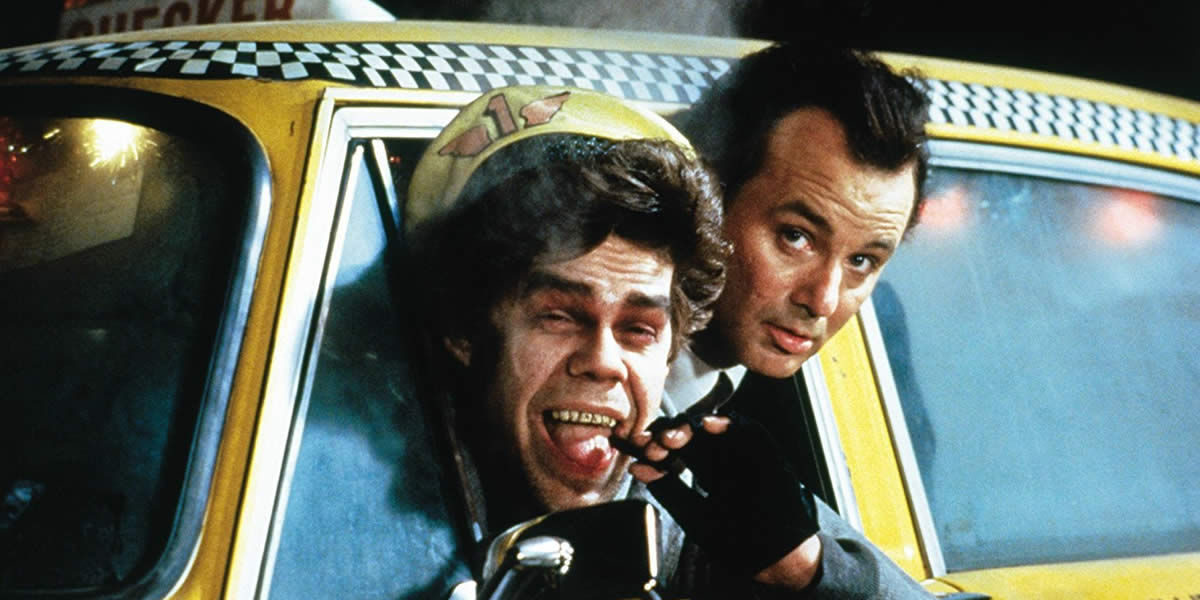
David Johansen plays the Ghost of Christmas Past, presented as a New York cab driver whose rough manner is a long way from the quiet solemnity of many traditional interpretations. Carol Kane’s Ghost of Christmas Present is a seemingly sweet fairy-like figure whose small stature and cheerful appearance conceal an unexpectedly violent approach to correcting Frank’s behavior. The Ghost of Christmas Yet to Come provides a more ominous presence, carrying the story toward the consequences Frank would prefer not to imagine.
These choices make the supernatural episodes feel less like a formal lesson and more like a night in which the universe has decided that Frank’s excuses are no longer acceptable. He cannot negotiate with the ghosts, fire them, or turn their warnings into a publicity opportunity.
The modern setting also makes the story’s moral framework more immediate. Frank’s behavior is recognizable as a product of contemporary office culture, where ambition can be mistaken for leadership and the demands of an organization can be used to justify personal cruelty.
The film does not replace Dickens’s story so much as translate its central conflict into a new language. The counting house becomes a television network. The miser becomes a media executive. The moral consequences of selfishness arrive in a world of corporate hierarchies, broadcast schedules, and promotional campaigns.
The result is an adaptation that understands the continuing relevance of the original. The objects of ambition change, but the question remains: what is the value of success if it leaves a person unable to care about anyone else?

Scrooged Turned Christmas Television Into a Spectacle
One of the film’s most memorable ideas is its fictional television production of A Christmas Carol. Frank wants to stage a live event large enough to command attention, using celebrity performers, elaborate costumes, and deliberately outrageous choices to turn a familiar story into must-see television.
The production is funny because it takes a recognizable commercial instinct to an extreme. A holiday special is not enough. It must be bigger, louder, and more attention-grabbing than anything competing for viewers. Even the emotional center of Dickens’s story becomes an opportunity for a promotional stunt.
The opening sequence establishes this satirical approach through a succession of imagined Christmas programs. The network’s lineup includes titles and concepts that turn seasonal goodwill into absurd entertainment. The point is not simply that television executives can make bad decisions. It is that the demand for novelty can become so powerful that the underlying subject barely matters anymore.
This was a familiar concern in the television culture of the 1980s. Network programming depended on attracting large audiences in a competitive environment. Special events, celebrity appearances, and elaborate productions could be used to distinguish one broadcast from another. Christmas programming offered a particularly attractive opportunity because it combined a reliable seasonal audience with a familiar collection of stories and expectations.
Scrooged exaggerates those incentives for comic effect, but its satire is rooted in a recognizable media environment. Frank does not believe that sincerity alone will bring viewers to the screen. He wants spectacle, controversy, and a production that people will discuss the following day.
The fictional broadcast also allows the movie to poke fun at the entertainment industry’s habit of turning familiar cultural material into a commercial package. A Christmas Carol has a moral purpose within the story, yet Frank’s production treats it as an asset that can be reformatted to suit the network’s needs.
That contradiction is particularly sharp because the film itself is also a piece of commercial entertainment. Scrooged mocks the packaging of holiday emotion while using comedy, spectacle, and familiar seasonal imagery to entertain its own audience. The movie does not stand entirely outside the culture it criticizes.
Its willingness to embrace that contradiction helps explain why the film feels more complicated than a simple attack on television. The medium can be shallow, exploitative, and ridiculous, but it can also bring people together around a shared story. Frank’s eventual transformation suggests that the problem is not entertainment itself. It is the belief that commercial success can substitute for human connection.
The fictional broadcast is therefore more than a running joke. It is a miniature version of Frank’s worldview, and its excesses make visible what he has done to his own life.
The Cast Gave Scrooged Its Darkly Comic Personality
Although Murray dominates the film, the supporting cast helps establish the social world Frank has created around himself. The people who work for him are not merely background figures. Their reactions show how his behavior has become normal within the network.
John Forsythe plays Lew Hayward, Frank’s former boss, whose posthumous appearance sets the supernatural story in motion. His role connects Frank’s present behavior to an earlier model of corporate ruthlessness. The warning is not simply that Frank has become a bad person. It is that he is following a path already traveled by someone whose success did not protect him from the consequences.
John Glover plays Brice Cummings, a network executive whose ambition and opportunism fit comfortably within the culture Frank has cultivated. His presence reinforces the idea that the workplace is full of people who understand the rules of advancement but have little interest in the moral cost of following them.
Bobcat Goldthwait plays Eliot Loudermilk, an employee whose humiliation and dismissal reveal the personal damage hidden behind Frank’s managerial efficiency. Goldthwait’s intense comic style makes Eliot an unpredictable presence, and his character gives the film one of its more unsettling reminders that Frank’s cruelty can have consequences beyond hurt feelings.
Alfre Woodard plays Grace Cooley, Frank’s loyal assistant, who has to balance the demands of her job with responsibilities to her family. Her character provides a contrast to Frank’s self-absorption. She is navigating practical difficulties while maintaining concern for the people around her. Her circumstances help expose the distance between Frank’s wealth and the assumptions he makes about everyone else’s lives.
Karen Allen plays Claire Phillips, the woman Frank loved before ambition and cynicism drove them apart. Claire is not impressed by his professional status, and her continued capacity for compassion makes it harder for him to dismiss the possibility that he has chosen the wrong way to live.
Robert Mitchum’s Preston Rhinelander represents another layer of authority. As the network’s chairman, he helps establish the corporate hierarchy that rewards Frank’s results and makes his behavior possible. The film’s world is not populated only by one selfish man. It is an organization in which selfishness can be useful.
The supporting performances keep the story from becoming a series of encounters between Murray and the ghosts. Each character represents a different consequence of Frank’s choices: a damaged employee relationship, a neglected romance, a subordinate’s daily compromise, or a corporate culture that values results above decency.
The ensemble also helps sustain the film’s unusual tonal range. Some characters belong to broad comedy, others to more conventional drama, and still others to the film’s supernatural grotesquerie. The parts do not always fit together smoothly, but their differences give Scrooged its distinctive, unruly texture.
Why Scrooged Was More Naughty Than Nice
A traditional Christmas movie usually establishes a balance between misbehavior and redemption. The protagonist may be selfish, lonely, or mistaken, but the story tends to keep a reassuring emotional destination in view. Scrooged is less interested in reassuring its audience along the way.
Its humor can be cruel. Its imagery can be grotesque. Its treatment of the supernatural is often more disturbing than comforting. Frank’s ghosts are not elegant symbols of spiritual guidance. They are disruptive visitors who make it impossible for him to continue pretending that everything is under control.
The film’s opening is especially important to its tone. Before the central character’s moral journey is fully established, the movie introduces an entertainment world filled with absurdity, commercial calculation, and deliberately tasteless ideas. Its Christmas spirit arrives surrounded by a considerable amount of bad behavior.
The PG-13 rating also signaled that this was not a conventional children’s holiday picture. The movie included adult humor and darker material that separated it from the gentler Christmas stories often associated with family viewing. Its combination of frightening imagery and broad comedy could make it an unusual choice for households expecting a purely comforting seasonal film.
That tonal uncertainty was apparent in the contemporary critical response. The Los Angeles Times review published on November 23, 1988, praised the opening satire but argued that the film eventually became overblown and mean-spirited. Roger Ebert also found the movie unusually unsettling, emphasizing its anger and emotional pain rather than its intended comedy.
Other critics saw the same unruliness as part of the attraction. The film’s mixture of satire, slapstick, and genuine sentiment was not universally successful, but it offered something different from a polished holiday fable. Its comedy could be abrasive, and its emotional turns could feel abrupt, yet the contrast made the eventual movement toward kindness more striking.
The title itself captures the film’s attitude. To be “scrooged” suggests being cheated, mistreated, or left in an unpleasant position. It is an appropriately irreverent name for a movie that approaches Christmas through the eyes of a man who treats almost everyone as a potential victim of his ambition.
Yet the film is not simply cynical. Its darkness has a purpose. Frank’s transformation matters because his behavior has consequences, and the story refuses to pretend that kindness is meaningful if it costs nothing. He must confront the people he has hurt and the life he has built around avoiding emotional responsibility.
That is where Scrooged finds its holiday spirit. It does not ask viewers to forget the cruelty that came before the ending. It asks them to believe that people can recognize their failures and choose to behave differently.
Scrooged Found Its Place Among the 80s Christmas Classics
When Scrooged opened in November 1988, it entered a holiday movie landscape that included a wide range of tones and traditions. Christmas films could be sentimental, comic, romantic, animated, or frightening. The season was not limited to stories in which every conflict was resolved through a gentle conversation and a warm family gathering.
The movie’s box-office performance reflected a substantial audience for its particular blend of comedy and fantasy. Box Office Mojo records a domestic theatrical gross of approximately $60.3 million across reported releases, although historical box-office totals can vary by source and accounting method.
Critical reception was mixed, and that mixed response is part of the film’s history. Some reviewers found the satire sharper than the sentiment, while others appreciated the way Murray’s performance brought a recognizable contemporary edge to Dickens’s familiar story. The movie was never a straightforward update designed to reproduce the emotional texture of a traditional adaptation.
Its reputation has developed through subsequent holiday viewings, home video, television broadcasts, and later releases. For many viewers, the film’s particular mixture of irritation and warmth has become part of the seasonal routine. It offers an alternative to Christmas movies that treat the holiday as an uncomplicated source of comfort.
That alternative is valuable because Christmas itself is rarely experienced in a single emotional register. The season can be joyful and exhausting, generous and commercial, intimate and crowded. Family expectations, financial pressure, work obligations, and social rituals all compete for attention. A film that acknowledges the irritation and selfishness surrounding the holiday can sometimes make its moments of generosity feel more convincing.
Scrooged also benefits from the continued familiarity of Dickens’s original story. Audiences know the basic outline of Scrooge’s transformation, which allows the film to spend more time exploring the absurdities of its modern setting. The ghosts are recognizable in function even when their personalities are radically different from traditional versions.
The movie’s 1980s details have become part of its appeal as a period piece, but its central conflict has not aged into irrelevance. Corporate ambition, the pressure to turn everything into content, and the temptation to treat personal relationships as secondary to professional success remain familiar themes.
The film’s imperfections are visible, and not every joke or tonal shift works equally well. But its willingness to be messy, irreverent, and emotionally exposed gives it a personality that a more carefully polished production might have lacked.
It has earned a place in the seasonal conversation not because it offers the definitive version of A Christmas Carol, but because it offers a version with a distinctive attitude. Its Christmas spirit arrives after a long stretch of noise, anger, and bad decisions, and that difficult journey is exactly what makes the ending matter.
The Christmas Spirit Behind Scrooged’s Cynicism
The final movement of Scrooged returns to the familiar promise of Dickens’s story: a person who has lost his way can still change. Frank Cross has spent the film treating human relationships as expendable and Christmas as a business opportunity. His encounters with the ghosts force him to recognize what that approach has cost him.
The transformation does not erase the movie’s satire. Frank still belongs to the world of television, and the film does not suggest that commercial entertainment will suddenly become free of manipulation or excess. Instead, it places responsibility on the individual. Frank must decide whether his professional success is worth the loneliness and cruelty that have accompanied it.
That decision gives the story its emotional resolution. The people around Frank matter because they are not merely instruments in his career. They have their own fears, loyalties, and needs. Once he begins to recognize that fact, his relationship with the world changes.
The film’s approach to redemption is deliberately noisy. It is not content with a quiet realization or a solemn promise. Its emotional release is as extravagant as its satire, allowing the story to end in a manner that suits the heightened world it has created.
Some viewers will find that conclusion too sentimental, particularly after the film has spent so much time mocking sentimentality. Others will see the apparent contradiction as the point. Scrooged does not argue that Christmas should be free of commercialism or absurdity. It argues that neither commercialism nor cynicism should be allowed to crowd out human decency.
That is why the film remains a useful holiday companion. It recognizes the season’s ridiculous side without insisting that ridiculousness is all there is. It understands that people can be selfish, that institutions can reward bad behavior, and that the language of goodwill can be used for commercial purposes. But it also leaves room for a person to recognize those failures and make a different choice.
The title promises a Christmas movie with a sharp edge, and the film delivers. Its ghosts are frightening, its comedy can be mean, and its central character is far from lovable for much of the story. Yet the underlying message is more traditional than its reputation might suggest.
Christmas, in Scrooged, is not about achieving perfect cheer. It is about recovering the capacity to care when ambition, disappointment, and habit have made caring seem inconvenient. That idea is what connects the film to Dickens, and it is what keeps the movie from becoming merely a collection of cynical jokes.
More than three decades after its release, Scrooged remains the Christmas movie for viewers who like their seasonal goodwill served with a little sarcasm. It is naughty before it is nice, suspicious of easy answers, and willing to make its audience uncomfortable. But beneath the sharp tongue and supernatural mayhem lies a sincere belief that people are not fixed forever by their worst decisions.
For a movie that begins with a television executive trying to sell Christmas to the highest bidder, that is a surprisingly generous conclusion.