Discover how Gauntlet transformed the 1980s arcade with four-player dungeon crawling, relentless monsters, memorable characters, and legendary cooperative chaos.
The arcade is already noisy before anyone reaches the machine. Electronic explosions crackle from one cabinet, a racing game’s engines roar from another, and somewhere in the room a player celebrates a high score. Then another sound cuts through the din: a computerized voice announcing that someone needs food badly.
Four people stand around a broad arcade cabinet, each gripping a joystick. On the screen, tiny fantasy adventurers race through a maze of stone corridors, firing at ghosts, dodging demons, collecting treasure, and searching for an exit. There is food to grab, keys to find, and an apparently endless supply of enemies pouring out of generators. One player charges ahead. Another gets trapped behind a wall of monsters. Someone discovers a pile of treasure, and suddenly the group has a second problem: whether to cooperate or compete for the spoils.
This was Gauntlet, Atari Games’ 1985 arcade hit, and it offered a different kind of fantasy adventure. Instead of sitting alone with a joystick and trying to beat a personal high score, players could enter the dungeon together. They could fight side by side, argue over resources, rescue one another from trouble, and spend their quarters trying to survive just a little longer.
The premise was simple, but the experience was remarkably social. Gauntlet took familiar ingredients from fantasy role-playing games, including warriors, wizards, magical potions, monsters, and labyrinths, and turned them into an action game that anyone could understand within seconds. There was no need to study a thick rulebook or memorize a complicated story. Choose a character, find the exit, and try not to die.
Yet the game was far more than a medieval maze full of enemies. It helped establish four-player cooperative arcade gaming as a major attraction, demonstrated how voice and sound could give a machine a personality, and encouraged strangers to become temporary teammates. Its relentless pace made every decision feel urgent, while its simple visual language allowed players to understand the action at a glance.
Nearly everything about Gauntlet reflected the creative ambitions of the 1980s arcade industry. The cabinet was built for groups, the gameplay encouraged repeat visits, and the fantasy setting offered an escape into a world where survival depended on quick reflexes and a little cooperation. Its influence would continue through home conversions, sequels, and generations of dungeon crawlers that followed.
Gauntlet Arrived When Arcade Gaming Needed a New Adventure
By 1985, the arcade had already experienced its first great explosion of popularity. Games such as Pac-Man, Donkey Kong, Defender, and Robotron: 2084 had turned video games into a familiar part of American leisure. Arcades appeared in shopping malls, amusement centers, movie theaters, and neighborhood businesses. Pizza restaurants and convenience stores could have machines tucked into a corner, offering a few minutes of entertainment for the price of a coin.
But the industry was also navigating a difficult period. The North American home video game market had suffered a major collapse in 1983, and arcade manufacturers were looking for fresh ideas that could persuade players to keep coming back. A new game needed more than attractive graphics. It needed a reason for people to gather around it and spend money.
Atari Games designer Ed Logg had been developing a fantasy-oriented game concept, initially known as Dungeons. The idea drew on the growing interest in dungeon adventures and tabletop role-playing games, especially the imaginative world associated with Dungeons & Dragons. Rather than reproducing a tabletop campaign, however, Logg’s design emphasized immediate action and continuous movement.
The result was Gauntlet, released in arcades in 1985. Its fantasy setting was instantly recognizable. Players explored labyrinths, battled supernatural enemies, collected treasure, and searched for the route to the next level. What made the game distinctive was the way it brought several players into the same adventure at once.
The four-player cabinet was a significant part of the concept. Four sets of controls allowed friends to play simultaneously rather than taking turns. Players could enter the same dungeon, move through the same corridors, and respond to the same emergencies. The experience was not simply four separate games running side by side. Each person’s choices affected the others.
That design also made commercial sense. Four players could occupy the machine and contribute coins during the same session. Atari’s developers understood that cooperative play could create an experience people wanted to share, while the game’s continuous action gave them reasons to keep playing.
The gamble paid off. Gauntlet became one of Atari Games’ major arcade successes of the period, with thousands of cabinets sold in the United States and additional machines distributed internationally. It arrived at a moment when the arcade needed new ways to make familiar technology feel exciting again.
Instead of asking players to beat a machine, Gauntlet invited them to survive one together.
Four Heroes Made Gauntlet Easy to Understand
The first decision in Gauntlet was choosing a character. The original arcade game offered four fantasy archetypes: Thor the Warrior, Thyra the Valkyrie, Merlin the Wizard, and Questor the Elf. Each had different strengths, giving players a simple but meaningful reason to prefer one hero over another.
These distinctions were easy to grasp without complicated instructions. The Warrior favored strength, the Valkyrie had strong armor, the Wizard delivered powerful magical attacks, and the Elf moved quickly. Players could select a hero based on their preferred style, and groups could benefit from combining different abilities.
The characters also gave the game a little personality before anyone had even fired a shot. The Warrior suggested a traditional fantasy hero, the Valkyrie brought a mythic female fighter into the group, the Wizard represented the power of spells, and the Elf offered speed and agility. Each occupied a familiar place in the fantasy imagination, so players could understand their roles immediately.
This was an important design choice for a game meant to attract people with different levels of experience. A tabletop role-playing enthusiast might appreciate the character classes, while someone who had never played a fantasy game could simply choose the figure that looked appealing.
The four heroes were not elaborate characters in the modern storytelling sense. They had little personal history, and the game did not require players to understand their motivations. Their identities came through the way they played. Strength, speed, armor, and magic were the essential ingredients.
That simplicity supported the game’s social character. A group could discuss who should take the lead, which player was best equipped to handle a particular threat, or whether someone should save a potion for a more dangerous room. The characters created small tactical decisions without slowing down the action.
They also helped make Gauntlet recognizable in a crowded arcade. Even at a glance, the colorful heroes could be distinguished from the enemies surrounding them. The fantasy setting was readable, the objective was obvious, and the characters gave players a choice that felt meaningful without becoming a barrier to entry.
Gauntlet Turned Dungeon Crawling Into an Arcade Race for Survival
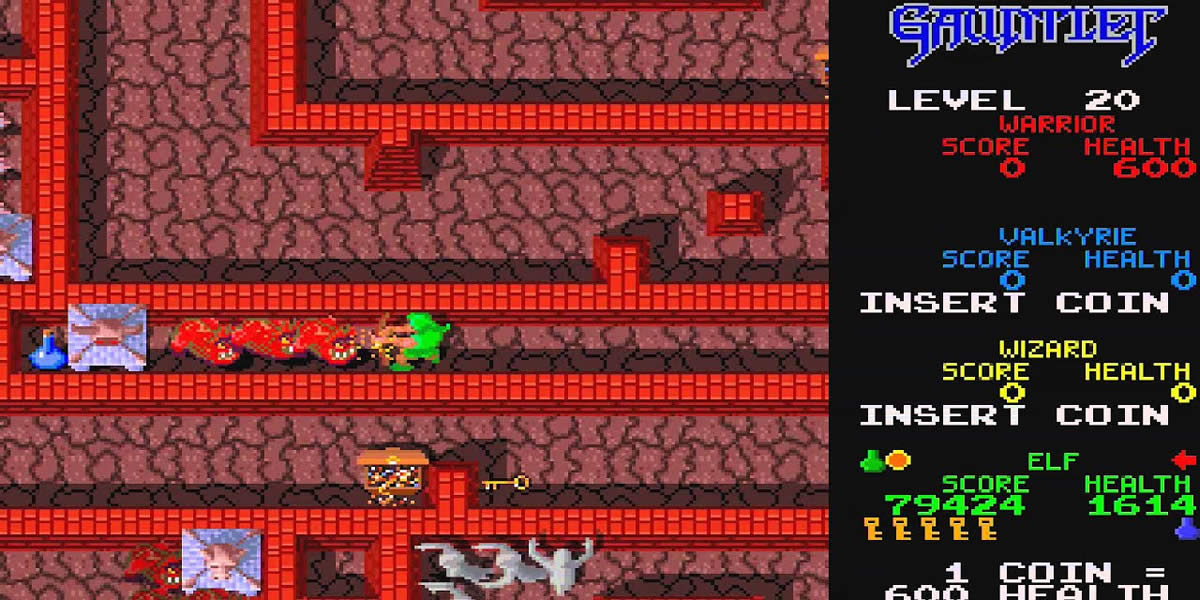
The heart of Gauntlet was its overhead view of a maze. Players moved through interconnected corridors, opening up the map as they explored. The objective was to find the exit and reach the next dungeon, but the route was rarely a simple walk from one end of the screen to the other.
Walls created bottlenecks. Keys opened locked doors. Treasure offered points, while food restored health. Magical potions could help clear enemies, and teleporters could move players to different parts of a level. Every object had a practical purpose, and each new room could change the group’s immediate priorities.
Unlike a conventional role-playing adventure, Gauntlet did not ask players to spend long stretches talking to characters, managing inventories, or following a branching narrative. Its dungeon crawling was built around motion. Players were almost always moving, shooting, collecting, or trying to avoid being surrounded.
The game also differed from many arcade titles that used a fixed sequence of obstacles. Its mazes encouraged exploration and offered choices about which route to take. Players could search for a more direct path to the exit, detour for useful items, or attempt to clear an area filled with enemies.
That freedom was exciting, but it came with pressure. Health continually drained over time, making hesitation expensive. Food was therefore more than a convenient pickup. It could determine whether a player survived long enough to reach the next level.
The game transformed a basic arcade resource into a source of social tension. When food appeared, everyone needed to decide who should collect it. A player who grabbed everything might keep their own character alive but leave teammates vulnerable. A group that shared supplies sensibly could remain together longer, although the game never guaranteed that everyone would agree on what sensible meant.
The same problem applied to treasure and magic. Players could work together against the monsters, but limited resources encouraged competition. A friend might save a teammate in one moment and snatch a valuable item from them in the next.
This blend of cooperation and rivalry gave Gauntlet a human quality that its simple graphics might not suggest. The game created situations in which players had to make decisions about one another, not just about the enemies on the screen.
It also encouraged experimentation. Different routes, character combinations, and strategies could produce different results. A player might discover that running straight for the exit was sometimes wiser than fighting every monster. Another might learn to save magic for a crisis rather than use it at the first sign of trouble.
The dungeon was not merely a place to defeat enemies. It was a system of choices, and the challenge came from deciding which risks were worth taking before health ran out.
The Four-Player Cabinet Made Gauntlet a Social Experience
The most important feature of Gauntlet was not a particular monster, weapon, or maze. It was the fact that four people could play together at the same time.
Many arcade games already offered multiplayer competition, but Gauntlet made simultaneous cooperative play central to its identity. Its wide cabinet accommodated four players, each with a joystick and buttons for attacking and using magic. Instead of taking turns, the group shared the adventure from beginning to end.
That arrangement changed the atmosphere around the machine. Players stood close enough to watch one another’s movements, and the screen became a shared space where every decision was visible. A player who rushed ahead could leave the others behind. Someone who failed to notice a group of enemies could force the team to respond to a sudden emergency.
The social dynamics were immediate. Friends could coordinate their attacks, split up to explore different corridors, or stay together to protect weaker characters. They could also tease one another over mistakes, argue about who had taken the last piece of food, and debate whether a particular route was worth the risk.
The game allowed players to join and leave during a session, making it easier for a group to change as people came and went. Someone could step away after losing a character, while another player could insert a coin and join the action. That flexibility suited the arcade environment, where people often played in groups that were never entirely fixed.
The cabinet itself encouraged spectatorship. People could gather around the four-player setup and follow the action even when they were not playing. The game became a small public performance, with each player’s successes and mistakes contributing to the entertainment.
This was part of what made Gauntlet different from playing a home computer game alone in a bedroom. Its appeal was immediate and communal. A person could learn the basics by watching for a few moments, then join a group and begin exploring almost immediately.
It also offered a different kind of achievement. In a competitive game, victory usually means outperforming an opponent. In Gauntlet, success could mean helping a group survive a difficult stretch of dungeon. A player who drew monsters away from a teammate or used magic at the right moment could contribute even without collecting the most treasure.
The game did not eliminate rivalry. Its limited supplies ensured that competition remained part of the experience. Instead, it placed cooperation and competition in the same space, allowing friendships and disagreements to develop naturally through play.
That balance helped establish a template for later cooperative action games. Gauntlet demonstrated that multiplayer gaming could be about shared progress and collective survival, not simply about deciding who won.

“Wizard Needs Food Badly”: How Gauntlet Found Its Voice
For many players, Gauntlet is as memorable for what it said as for what appeared on the screen. The game’s electronic narrator delivered short messages about the action, turning routine events into announcements that could be helpful, funny, or faintly accusatory.
The voice might warn that a character was running out of health, remind players about the rules, or comment on their behavior. Its most famous food-related messages became part of the game’s identity. When a character’s health dropped, the narrator’s warning made the situation sound urgent, even when the player had been ignoring the danger for several rooms.
This was more than a novelty. Speech in arcade games was still an attention-grabbing feature, and Gauntlet used it as a regular part of the experience rather than an occasional flourish. The voice helped communicate information without forcing players to stop and read a long block of text.
That mattered because the screen was often crowded. Enemies moved through the corridors, projectiles crossed the maze, and players tried to keep track of food, exits, and one another. A short spoken warning could cut through the visual clutter and deliver a clear message at the moment it was needed.
The narration also gave the machine a personality. The game could sound almost like a dungeon master, observing the players and commenting on their choices. It did not need a fully developed story or a cast of speaking characters. A few short phrases were enough to create the impression that the dungeon was aware of what was happening.
Some messages were useful reminders. Others carried an edge of humor, especially when the narrator pointed out that a player had made a poor decision. The machine’s voice could seem to judge the group, as if the game itself were amused by their predicament.
The effect was particularly strong in a noisy arcade. Speech helped Gauntlet stand out among machines that relied primarily on electronic effects and musical loops. A player might recognize the game from the narrator alone, even before seeing the cabinet.
The sound design reinforced the game’s pace. The steady flow of spoken warnings, combat sounds, and electronic effects made the dungeon feel busy and unpredictable. There was always something happening, and the narrator helped turn that constant activity into a recognizable rhythm.
The game’s voice lines also proved unusually durable in popular culture. They have been repeated, referenced, and remembered long after the original cabinets left many arcades. Their appeal comes from the way they combine practical information with a dry, almost theatrical sense of timing.
In a game built around constant pressure, the voice supplied a little comedy. The player might be surrounded by monsters, low on health, and unable to find the exit, but the narrator would still find time to explain the obvious.
Gauntlet’s Monsters Made Every Room a New Problem
The dungeons in Gauntlet were crowded with enemies, including ghosts, grunts, demons, sorcerers, and the particularly troublesome Death. Their different behaviors gave players reasons to change tactics rather than relying on a single attack pattern.
Some enemies moved directly toward the heroes. Others attacked from a distance or created problems that became more dangerous if left unchecked. Monster generators added another layer of urgency by continually producing enemies until players destroyed them or moved away from the area.
The generators were especially important to the game’s sense of pressure. A player could spend valuable time fighting an endless stream of monsters while the source of the trouble remained active. The longer the fight continued, the more likely the player was to lose health and become trapped.
This made target selection a practical skill. Should the group attack the nearest enemies, clear a path toward the exit, or concentrate on destroying the generator? The answer depended on the room, the characters involved, and the group’s current health.
The variety of enemies also created opportunities for cooperation. One player could draw attention while another attacked from a safer position. A faster character might move through a dangerous corridor to reach an exit, while a sturdier teammate held the line. A Wizard could use powerful magic to clear a packed room when ordinary attacks were no longer enough.
The game rewarded players who learned to recognize patterns. An experienced group could move more efficiently, save useful resources, and avoid wasting time on fights that offered little benefit. But the constant drain on health ensured that even familiar levels remained tense.
The challenge was not simply to kill every enemy. Sometimes survival meant knowing when to leave. A room filled with monsters might be worth fighting through if it contained food or a necessary key, but it could be wiser to escape if the exit was close and health was running low.
This gave the dungeon crawler a distinctive pace. Exploration created opportunities, enemies created pressure, and resource management forced decisions. The player was always balancing what could be gained against what might be lost.
It also meant that the game’s difficulty was social as well as mechanical. A group could fail because someone moved too quickly, used magic at the wrong moment, or took supplies that another player desperately needed. The monsters were dangerous, but the team’s own decisions often determined whether the situation became manageable or hopeless.
Gauntlet made its dungeons memorable by giving each room a practical question to answer. Fight, flee, explore, collect, or cooperate. The game rarely allowed players to stand still long enough to consider the options comfortably.
From Gauntlet to Home Consoles: The Dungeon Followed Players Home
A successful arcade game could reach a much wider audience when it appeared on home systems. By the middle of the 1980s, players were increasingly familiar with home computers and consoles, and publishers had strong reasons to bring arcade favorites into living rooms.
Gauntlet received versions for a range of home platforms, including the Commodore 64, Atari 8-bit computers, Apple II, and later the Nintendo Entertainment System. The conversions differed according to the hardware available, and not every home version could reproduce the arcade cabinet’s full four-player experience. Nevertheless, they allowed players to revisit the dungeons without needing to find a dedicated arcade machine.
The transition from arcade to home also changed how the game could be experienced. The original cabinet encouraged groups to gather in a public place, share the controls, and pay for each session. At home, players could spend longer periods learning the mazes, practicing routes, and experimenting with the characters.
The home releases helped keep the game’s design in circulation. Players who encountered Gauntlet in an arcade could continue exploring its world at home, while those without access to the original cabinet could discover its basic appeal through a computer or console.
The franchise continued to develop. Gauntlet II followed in arcades in 1986, expanding on the original formula while retaining the emphasis on cooperative dungeon action. Later entries carried the series into new hardware generations, including the more elaborate 3D environments of Gauntlet Legends in 1998 and Gauntlet: Dark Legacy in 2000.
The continuing series reflected the durability of the original idea. The details could change, the graphics could become more sophisticated, and the number of available features could grow, but the central pleasure remained recognizable: choose a hero, enter a dangerous place, gather resources, and survive together.
The original Gauntlet also helped make the dungeon crawler more accessible. Fantasy adventures could be intimidating when they required lengthy instructions, complex inventories, or extensive knowledge of role-playing conventions. The arcade game retained the imagery and strategic choices of dungeon exploration while delivering the action in short, understandable bursts.
Its influence is best understood as part of a wider evolution rather than the single origin of cooperative dungeon crawling. Earlier games had already explored related ideas, and designers continued to borrow from many sources. But Gauntlet brought a particularly effective combination of multiplayer action, character classes, resource management, and maze exploration to a broad arcade audience.
That combination proved adaptable. It could work in an arcade, at home, or in later action games that emphasized teamwork and shared survival.
Why Gauntlet Still Matters to Video Game History
Looking back, Gauntlet is a useful reminder that technological sophistication is not the only measure of a game’s importance. Its graphics were straightforward, its characters had limited backstories, and its narrative was little more than a journey through dangerous mazes. Yet its design created a social experience that was difficult to reproduce by playing alone.
The four-player cabinet remains one of the clearest symbols of the game’s achievement. It made cooperation visible and immediate, with each player responsible for a character whose survival affected the group. The design encouraged communication without requiring elaborate dialogue, and it created room for both generosity and selfishness.
Its mechanics were similarly economical. Health declined over time, food restored it, keys opened doors, treasure offered rewards, and magic could turn a dangerous encounter around. These systems were easy to understand, but their interaction produced meaningful decisions. Players had to think about the maze, the enemies, and their teammates all at once.
The game also understood the importance of sound. Its narrator became a memorable feature because it did several jobs at once: it communicated information, established atmosphere, and provided humor. The voice made the machine feel more present, almost like an observer following the group through the dungeon.
Its legacy continued through the wider popularity of cooperative games. Modern players may encounter teamwork through online matchmaking, voice chat, shared quests, and complex multiplayer campaigns. Gauntlet offered a much more direct version of the same social impulse. Four people stood around a cabinet and tried to keep one another alive.
The experience could be messy. Players made mistakes, disagreed over resources, and sometimes abandoned one another to save their own characters. But those moments were part of the appeal. The game generated stories through play, not through cutscenes or scripted dialogue. A successful run became memorable because of what the group had managed to do together.
That is why Gauntlet deserves a place among the iconic arcade games of the 1980s. It brought fantasy dungeon exploration into an accessible action format, made four-player cooperation a central attraction, and demonstrated that a game could create a rich social experience with a relatively simple set of rules.
The arcade era was full of machines that tested reflexes and rewarded individual mastery. Gauntlet offered something different. It invited players to become a party, with all the negotiation and unpredictability that such a group entails.
The dungeon was full of ghosts, demons, treasure, and traps. But the most interesting part of the adventure was often the person standing next to you, reaching for the same piece of food.