With haunted castles, relentless monsters, a legendary whip, and unforgettable music, Castlevania transformed 1980s video game horror into an enduring art form.
Picture a castle at midnight. The grounds are dark, the windows look blind, and something moves between the trees. Somewhere beyond the gates, a staircase leads into a stone corridor where bats gather overhead and the dead refuse to stay buried. There is no welcoming guide, no helpful map pointing toward safety, and no guarantee that the next doorway will lead anywhere good.
Now imagine facing all of it with a handful of lives, a short-range whip, and a controller that offers little room for error.
When Konami released Castlevania in Japan in September 1986, the company introduced players to a distinctly different kind of video game adventure. Rather than offering a bright, open world filled with cheerful discoveries, it presented a journey into Gothic horror, where every room carried a threat and every advance required concentration. The player took control of Simon Belmont, a vampire hunter armed with a whip, and set out to penetrate Dracula’s castle and destroy its master.
The premise drew on familiar horror traditions. Dracula, bats, skeletons, mummies, and other creatures came from a long history of monster movies, Gothic literature, and popular Halloween imagery. But Castlevania did not simply put those creatures on a screen. It used them to create a world with a particular atmosphere, one in which the architecture, music, movement, and difficulty all contributed to a feeling of unease.
The game first appeared as Akumajō Dracula for Japan’s Family Computer Disk System. Its arrival on Nintendo’s cartridge-based Entertainment System in North America in 1987 brought it to a much wider audience, helping establish the franchise internationally. For players encountering it during the 1980s, the experience could feel like stepping into an interactive horror film, except that the player was responsible for surviving every scene.
Four decades later, Castlevania remains one of the defining works of video game Gothic horror. Its influence can be heard in generations of game music, seen in countless haunted castles and monster-filled adventures, and felt in the careful balance between atmosphere and challenge that continues to shape action games. Its achievement was not simply that it made Dracula frightening again. It showed how a relatively small collection of pixels, sounds, and carefully designed obstacles could create a world that felt much larger than the screen.
Castlevania Brought Gothic Horror Into the 8-Bit Living Room
By the middle of the 1980s, home video games were becoming a familiar part of American family life. The Nintendo Entertainment System was helping revive the home console market, and children were spending afternoons mastering platform games, exploring fantasy worlds, and comparing their progress with friends. Video games were still young enough that their visual language was developing rapidly. A new release could feel genuinely different from what had come before.
Castlevania offered a change of mood. Its world was not built around colorful landscapes or playful characters. The setting was a place of shadows, ruined architecture, unnatural creatures, and ominous music. Even the title suggested a destination rather than a friendly adventure. This was a castle associated with a vampire, and the invitation was to enter at considerable risk.
The game’s Japanese title, Akumajō Dracula, translated roughly to Dracula’s Demon Castle. The North American release used the more internationally marketable name Castlevania, which became the identity of the series. Both titles conveyed the same essential idea: the player was going somewhere evil and would have to fight through it.
That premise had a long cultural history behind it. Bram Stoker’s Dracula had helped establish the vampire as one of modern horror’s central figures, while decades of film adaptations and monster movies had turned the count into a recognizable symbol of aristocratic menace. Frankenstein’s monster, mummies, werewolves, and other creatures occupied a similar place in popular culture. They were frightening, but also familiar enough to be reimagined for different audiences.
The game drew from this shared monster vocabulary and arranged it into a succession of challenges. Simon Belmont did not wander through a realistic castle. He moved through a carefully constructed series of stages populated by recognizable creatures, dangerous platforms, and traps. Each section introduced a different combination of enemies and environmental hazards, giving the journey the rhythm of a descent through a classic horror anthology.
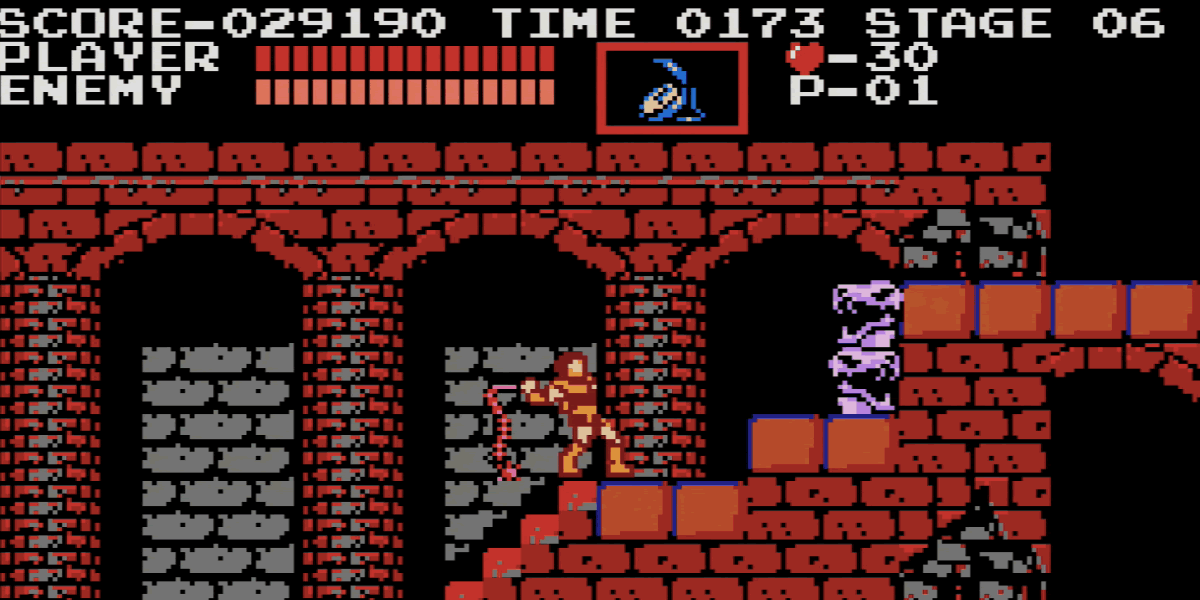
The 8-bit graphics were limited compared with the detailed imagery of a film, but those limitations helped concentrate the design. A dark background, a flickering torch, a cluster of bats, or a hulking boss could communicate danger without elaborate animation. The player’s imagination supplied the atmosphere that the hardware could only suggest.
For young players accustomed to the more inviting tone of many console adventures, the difference was striking. Castlevania did not need to frighten anyone in the way a live-action horror film might. It created tension through uncertainty, timing, and the possibility of failure. A monster approaching from the edge of the screen was not just an image. It was a problem that had to be solved before the player could continue.
Simon Belmont and the Art of Fighting Through Dracula’s Castle
At the center of Castlevania is Simon Belmont, a vampire hunter whose primary weapon is a whip. The choice was unusual enough to help distinguish him from the sword-wielding heroes common in fantasy games, but it also fit the character’s identity. A whip could reach enemies at a distance, strike creatures in the air, and become more powerful as the player discovered upgrades.
Simon is not an especially agile hero by modern standards. His jumps require commitment, his attacks have a deliberate rhythm, and changing direction or position at the wrong moment can leave him vulnerable. He cannot simply rush through a screen and trust that quick reactions will save him. The game asks the player to learn its timing.
That design gives even ordinary enemies a certain authority. A bat drifting toward Simon may seem harmless, but it can disrupt a jump or knock him into a hazard. A skeleton can interrupt forward movement. Enemies often arrive in combinations that make the player choose between attacking, jumping, and preserving a safe position.
The whip’s limitations are central to the experience. Simon initially attacks in front of him, so the player must judge distance and timing rather than simply holding down an attack button and moving forward. Upgrades strengthen the weapon, while additional tools provide different ways to handle enemies. Knives, axes, holy water, a returning cross, and a stopwatch each offer tactical possibilities, but the player cannot carry every option at once.
These decisions make Castlevania feel like a game about control as much as combat. Success depends on understanding how Simon moves, when an enemy becomes vulnerable, and which weapon is best suited to a particular situation. The player gradually develops a practical knowledge of the castle, learning where to pause and where forward movement is essential.
The game’s famous difficulty comes partly from this deliberate design. Simon has a distinctive movement pattern, and enemies exploit it. A badly timed jump can be costly. Taking a hit can knock him backward, sometimes into a pit or another hazard. The consequences can feel severe, particularly when a player has made it through a long section and must repeat the challenge.
Yet that severity gives progress a tangible quality. Defeating a difficult enemy is not simply another item checked off a list. It is evidence that the player has learned something about the game’s rules. A stage that once seemed impossible can become manageable through patience, repetition, and better decisions.
This is one reason Castlevania left such a strong impression. It did not make the player powerful by default. It made the player earn competence. Simon’s journey through Dracula’s castle becomes a test of discipline, and every new room asks whether the player has understood enough to survive what comes next.
The Monsters, Corridors, and Boss Battles That Made Castlevania Memorable
The original Castlevania draws on a library of classic horror imagery, but its creatures are more than decorative references. Each one contributes to the game’s rhythm and difficulty. Bats move unpredictably through the air. Skeletons attack from a distance. Other enemies demand different combinations of movement, timing, and weapon choice. The castle feels inhabited by things that are actively trying to stop Simon rather than waiting politely for him to arrive.
The architecture is equally important. Stairs, platforms, narrow passages, and open spaces alter the way the player approaches each encounter. A stretch of corridor may seem safe until an enemy enters from the side. A staircase can become a vulnerable point where the player’s movement is constrained. The environment is not merely a background. It participates in the challenge.
The game’s stages also build toward larger confrontations. The journey includes familiar monsters drawn from horror tradition, culminating in a battle with Dracula himself. The final encounter turns the entire adventure into a direct contest between the vampire hunter and the source of the castle’s evil.
The bosses give the game a theatrical quality. Each encounter creates a new kind of pressure, asking the player to recognize patterns and react under stress. The challenge is not simply to inflict damage. It is to stay alive long enough to understand what the enemy is doing.
That structure echoes the pacing of horror films. A monster appears, the danger becomes clearer, and the protagonist must find a way to survive. The game compresses that dramatic pattern into a series of interactive encounters. Unlike a film audience, however, the player cannot remain safely in the dark. Every mistake belongs to the person holding the controller.
The castle’s progression also creates a sense of movement through a larger place. The player begins outside and gradually advances into more threatening areas, passing through spaces that suggest a world beyond the immediate screen. The setting feels substantial because the journey is organized as a series of thresholds. Gates, corridors, staircases, and chambers continually promise another layer of danger.
This is Gothic storytelling adapted to the logic of a platform game. The castle embodies the threat, and its inhabitants turn the journey into a sequence of confrontations. The player does not need pages of dialogue explaining the history of the Belmont family or Dracula’s long rivalry with his enemies. The structure of the game tells the story through action.
The result is a world that remains easy to recognize decades later. A whip-wielding hero, a moonlit castle, a line of monsters, and a final encounter with Dracula are enough to evoke the entire experience. The visual and mechanical ideas are simple, but they work together so effectively that the game feels coherent from its opening stage to its conclusion.
Castlevania’s Music Turned Pixels Into a Gothic Experience
A haunted castle needs more than stone walls and monsters. It needs a sound that tells the player how to feel about the place. The music of Castlevania supplied that missing dimension, giving the game a dramatic identity that extended beyond its graphics and mechanics.
The original soundtrack was composed by Kinuyo Yamashita and Satoe Terashima, whose work demonstrated how expressive the Nintendo-era sound hardware could be in the hands of skilled composers. Rather than relying on a few repetitive tones to accompany the action, the music uses memorable melodies and driving rhythms to create a sense of urgency and grandeur.
The limitations of the hardware were real. The game could not reproduce the full orchestral sound of a horror movie, and its electronic tones were recognizably synthetic. But the compositions did not attempt to disguise those constraints. They used them. Bright melodic lines, sharply defined rhythms, and insistent bass patterns made the music energetic enough to support the action while giving it a distinctive Gothic character.
Yamashita later explained in an interview that she aimed to create music suited to the game’s movement and Gothic imagery. The rock-influenced approach developed naturally as she worked, rather than following a rigid plan to imitate a particular style. That combination of dramatic atmosphere and forward motion helped the soundtrack become one of the most enduring parts of the game.
The music is especially effective because it does not simply tell the player that the castle is frightening. It gives the adventure momentum. The melodies make progress feel purposeful, and their repeated phrases become associated with particular stages and challenges. After enough time with the game, a tune can recall a specific stretch of corridor or a difficult encounter as clearly as a screenshot.
For players in the 1980s, video game music often accompanied long periods of repeated play. A difficult section might be attempted many times, meaning the same musical passage could become familiar through repetition. In Castlevania, that repetition helped turn the soundtrack into part of the player’s memory of the castle.
The compositions also proved that video game music could have a life outside the machine that originally played it. The themes have been rearranged, remixed, performed, and revisited throughout the franchise. Later entries developed their own musical identities, but the original game established an expectation that Castlevania should sound as distinctive as it looked.
That legacy is significant because early console soundtracks were often treated as functional accompaniments. Castlevania showed how music could help establish a world, support dramatic pacing, and make a game recognizable from a few notes. The castle had an atmosphere not just because of its images, but because of the sound that accompanied every step inside it.

From Japan to the NES: How Castlevania Found Its 80s Audience
The history of Castlevania begins in Japan, where the original game was released on September 26, 1986, for the Family Computer Disk System under the title Akumajō Dracula. The Disk System was an add-on for Nintendo’s Family Computer, known internationally as the Famicom, and it used proprietary disks rather than the cartridges familiar to many North American console players.
The game subsequently appeared on the Nintendo Entertainment System in North America in 1987. That release helped bring the series to a much wider audience and established the name that would become familiar around the world. The European release followed in 1988.
This distinction matters because the year 1986 is often used when discussing the game’s origins, while American players generally encountered it in 1987. Both dates are correct in their respective contexts. The game began its life in Japan in 1986 and became part of the NES experience in North America the following year.
The North American release arrived during an important period for Nintendo. The NES was establishing itself as a major home entertainment platform, and its library was expanding beyond straightforward arcade-style challenges. Games such as Super Mario Bros. demonstrated how side-scrolling movement could create a world of exploration and discovery. Castlevania used a similar basic format but applied it to a different emotional register.
Instead of inviting the player into a cheerful fantasy, it created a place of danger and dread. Its monsters and Gothic architecture offered a more mature atmosphere than many family-oriented games, even though the actual presentation remained constrained by the hardware. That contrast was part of the appeal. Players could experience something darker and more dramatic without leaving the living room.
The NES also helped turn the game into a shared cultural reference. Players could compare strategies, discuss difficult bosses, and exchange advice about weapons and enemy patterns. Before widespread online guides, much of this knowledge moved through friends, siblings, magazine coverage, and the informal conversations that surrounded gaming.
A particularly difficult game could become a social experience. One person might reach a stage that another had not yet mastered. A successful run could be watched as closely as a sporting event, with friends waiting to see whether the player would survive the next encounter. The game’s challenge gave those moments weight.
The arrival of Castlevania also helped establish Konami’s reputation as a developer capable of building strong identities around its games. The company was already producing successful arcade and console titles, but the vampire-hunting series offered something more distinctive than a generic action premise. Its setting, music, weapons, and characters could be recognized as parts of the same fictional world.
By the end of the decade, Castlevania had already grown beyond its first release. Castlevania II: Simon’s Quest arrived for the NES in 1987 in Japan and in North America in 1988, taking the series in a more exploratory direction. Castlevania III: Dracula’s Curse appeared in Japan in 1989, although its North American release came in 1990. The franchise was becoming a continuing world rather than a single adventure.
How Castlevania Helped Shape the Action-Platformer
It would be an exaggeration to claim that Castlevania invented the action-platformer. Side-scrolling action games already existed, and other developers were experimenting with movement, combat, and stage design. Its importance lies in the way it brought those elements together into a recognizable style.
The game combined precise platforming with a deliberate combat system. The player had to judge jumps, manage enemy encounters, choose sub-weapons, and learn how the environment affected movement. Rather than making speed the only measure of skill, it rewarded observation and timing. Charging forward was often less effective than waiting for the right moment to strike.
That design gave the game a distinctive rhythm. The player advanced, encountered resistance, adjusted, and moved forward again. Every stage was a series of small tactical problems, with the larger goal of reaching Dracula providing a clear narrative direction.
The whip was central to that identity. Its limited range and committed animation made combat feel different from games in which the player could attack freely in several directions. Simon had to face threats, judge distance, and choose when to strike. The weapon was not merely a visual signature. It shaped the player’s relationship with the enemies.
The sub-weapons added another layer. Hearts collected throughout the stages served as ammunition for special attacks, creating a simple resource-management system within the action. A player could find a powerful weapon but still had to consider when to use it. Picking up a different sub-weapon could change the available strategy, so the decision had consequences.
The game’s difficulty also influenced how players thought about mastery. Progress required learning the rules rather than simply accumulating power. The castle became more manageable as the player became more familiar with its enemies and patterns, but it never stopped demanding attention.
Later games in the franchise expanded these ideas in different directions. Castlevania III: Dracula’s Curse introduced multiple playable characters and branching paths, while later entries explored more complex maps, abilities, and forms of progression. The series would eventually become closely associated with the style often called Metroidvania, a term referring to games that combine exploration, interconnected environments, and abilities that open previously inaccessible areas.
The original Castlevania was not yet that kind of expansive, interconnected adventure. Its stages were more linear, and its central structure was closer to a sequence of increasingly difficult action challenges. But it established a world and a set of design principles that the franchise could develop over time. The Gothic setting, methodical combat, distinctive weapons, and demanding movement became foundations for later experiments.
Its influence can be seen in the way action games use atmosphere as part of their mechanics. A dark corridor is not just scenery if it changes how the player approaches an enemy. A dramatic musical cue is not simply decoration if it makes an encounter feel more consequential. A boss fight becomes memorable when its mechanics and presentation reinforce one another.
Castlevania helped demonstrate that a strong genre identity could emerge from the interaction of these elements. It was not enough to place monsters in a platform game. The entire experience had to feel like a journey into a hostile Gothic world.
Why Castlevania Remains a Gothic Masterpiece
Looking back at Castlevania now, it is easy to focus on what has changed. Modern games can render elaborate castles, animate monsters with cinematic detail, and surround players with three-dimensional environments. They can provide maps, checkpoints, adjustable difficulty, and tutorials that explain the rules before a player has a chance to become frustrated.
The original game offers none of those conveniences in their modern form. Its stages are compact, its movement can feel unforgiving, and its challenge sometimes depends on repetition. A player encountering it for the first time today may notice limitations that were less conspicuous in the context of 1980s console gaming.
But the elements that made it memorable remain intact. The whip gives combat a clear identity. The monsters provide a recognizable set of threats. The castle creates a coherent atmosphere, and the music gives the journey emotional force. The game is difficult, but its difficulty is connected to a world that feels carefully constructed rather than randomly hostile.
Its enduring appeal also reflects the strength of Gothic horror as a cultural language. Castles, vampires, haunted corridors, and forbidden chambers remain useful symbols because they combine mystery with danger. They suggest a world with a history, where the visible threat may be only one part of a larger darkness. Video games can make that tradition interactive, giving players the responsibility to enter the forbidden place and confront what lives there.
Simon Belmont’s adventure has continued to resonate because it gives the player a clear role in that story. He is not a passive witness to a monster movie. He is the person who must cross the courtyard, survive the corridors, defeat the creatures, and face Dracula. The tension comes from the gap between knowing what must be done and having the skill to do it.
The soundtrack has helped preserve that identity across generations. The original themes remain recognizable, and the series’ later composers have continued to build on the relationship between dramatic music and Gothic atmosphere. The sound of Castlevania is not tied to one screen resolution or one console. It is tied to the emotional experience of moving through the castle.
The franchise’s later evolution also demonstrates how much potential existed inside the original idea. What began as a linear action game developed into a wide-ranging series with new protagonists, different eras, expanded maps, and more elaborate systems of progression. The castle could be reimagined, but its basic appeal remained: a dangerous place worth exploring, filled with monsters worth defeating and secrets worth uncovering.
That is the achievement that makes Castlevania more than a successful 1980s game. It established a distinctive world and gave that world a mechanical identity. The graphics, music, combat, and setting all pointed in the same direction. Even with the limitations of 8-bit hardware, the experience felt deliberate and complete.
For players who first encountered it in the 1980s, the memory may be of a particularly difficult boss, a stage that took several evenings to master, or a melody that remained in the mind long after the console was switched off. For newer players, the appeal lies in seeing how effectively the game uses a small set of tools to create tension and atmosphere.
The castle still stands because its design does not depend entirely on nostalgia. It depends on the enduring pleasure of learning a difficult game, recognizing its patterns, and gradually becoming capable of surviving its dangers. The shadows may be made of pixels, but the challenge is real.
Castlevania did not merely bring Dracula into the video game era. It made the act of confronting him into a defining adventure of the 1980s, one that helped shape action games for years to come. Its greatest achievement was not the number of monsters it placed inside the castle. It was the sense that, once the gates closed behind Simon Belmont, every step forward had to be earned.