The Goonies turned an ordinary gang of kids into unlikely heroes on a treasure hunt. Four decades later, its mix of friendship, danger, humor, and imagination still feels special.
A damp Oregon afternoon, a battered bicycle, a map marked with an X, and a group of kids who refuse to accept that their world is about to disappear. Before the adventure is even properly underway, The Goonies has established its most important idea: sometimes the greatest treasure is the life you are trying to save.
Released in 1985, The Goonies follows a group of friends who discover a mysterious treasure map and set out to find the legendary fortune of a pirate named One-Eyed Willy. Their search takes them beneath the landscape of their coastal hometown, into a world of hidden passages, booby traps, skeletons, and criminals who want the treasure for themselves. It is a story about childhood imagination, but also about something more tangible: the fear of losing home, the loyalty that binds a group of friends, and the exhilarating possibility that an ordinary afternoon could become extraordinary.
The film arrived during a particularly fertile period for American adventure movies. Steven Spielberg had helped popularize stories that combined youthful wonder with spectacular danger, while Hollywood was discovering how effectively a talented group of young performers could carry a major theatrical release. Directed by Richard Donner from a screenplay by Chris Columbus, based on a story by Spielberg, The Goonies brought those ingredients together in a film that was funny, unruly, occasionally frightening, and unmistakably its own creation.
Its appeal has endured beyond its original theatrical run. The film has become a touchstone for generations who recognize its mixture of neighborhood life and extravagant fantasy, while Astoria, Oregon, remains closely associated with the story’s fictional Goon Docks. Yet the movie’s lasting value is not simply that it offers a recognizable collection of 1980s details. It captures a particular way of seeing the world, when a few friends, a little independence, and a wildly implausible idea could turn the familiar landscape into a place of endless possibility.

The Goonies and the 1980s Dream of Childhood Freedom
One of the first things that makes The Goonies feel distinctive is the way its young characters inhabit their town. They ride bicycles, gather at home, tease one another, argue, and wander into trouble. Their world is not organized around adult supervision. It is organized around friendship, neighborhood geography, and the assumption that there is always somewhere else to explore.
That freedom was an especially potent idea in 1980s family entertainment. Children in films were increasingly being presented as capable of confronting problems that adults either misunderstood or could not solve. They could be frightened, foolish, impulsive, and occasionally selfish, but they were rarely helpless. Their independence was central to the adventure rather than a problem the story needed to correct.
The Goonies begin as recognizable kids rather than miniature action heroes. Mikey Walsh, played by Sean Astin, is earnest and determined, with a belief in adventure that his older brother Brandon and the other children do not always share. Mouth, played by Corey Feldman, is quick with a joke. Data, played by Ke Huy Quan, builds elaborate gadgets that do not always work as intended. Chunk, played by Jeff Cohen, is exuberant, talkative, and frequently overwhelmed by the situation.
Their differences create the group’s chemistry. Not everyone is brave at the same time, and not everyone understands what is happening. Their jokes are often interruptions rather than carefully timed punchlines. They talk over one another, make mistakes, and react to danger in ways that reflect their individual personalities.
That messiness is part of the film’s charm. The children do not resemble a perfectly coordinated team assembled for a mission. They resemble a group of friends who have been thrown into something much larger than themselves.
Their bicycles are more than a familiar period detail. They are a means of escape, a symbol of mobility, and an extension of the children’s independence. Before the story takes them into underground tunnels and pirate territory, their adventure begins in the ordinary spaces of a small community. The distance between home and the unknown seems short enough to cover on two wheels.
The film’s idea of childhood freedom is not entirely carefree. The children are threatened by forces they cannot control, and their independence comes with real risks. But The Goonies understands why that independence matters. It gives the young characters room to develop courage, test their friendships, and discover what they can do when no adult is available to make the decisions for them.
Why The Goonies Begins With Something Worth Saving
Underneath the treasure hunt is a surprisingly practical problem. The Walsh family faces the prospect of losing its home because of a development plan that threatens the neighborhood. The children are not simply looking for riches because buried gold sounds exciting. They believe that finding the treasure might give their families a chance to keep their houses.
That detail gives the adventure its emotional foundation. The stakes are larger than a collection of gold coins, but they are also smaller and more intimate than the fate of the world. The children want to protect the place where they live.
For Mikey, the neighborhood represents continuity. His friends, his family, and his everyday surroundings form a world that feels permanent until adults begin making decisions that suggest otherwise. The possibility of losing home makes the future frighteningly uncertain. A treasure map offers an improbable alternative, but the children are willing to pursue it because the more sensible options seem to be disappearing.
This conflict gives the movie an unusual connection to the realities of family life. Money, property, and development are not typically the stuff of childhood adventure fantasies. Yet children are often acutely aware of financial pressure, even when they do not understand every detail. They hear conversations, notice changes, and sense when something important is at risk.
The Goonies respond by imagining that a hidden fortune might solve the problem. Their plan is hardly practical, but its emotional logic is clear. If the adults cannot protect the neighborhood, perhaps the children can do something themselves.
The film does not turn this premise into a sustained examination of property development or economic insecurity. Its attention moves quickly toward tunnels, traps, and the criminal Fratelli family. Still, the threat to the Walsh home gives the adventure a reason to exist beyond excitement for its own sake.
It also explains why the treasure matters so much to Mikey. His enthusiasm is not merely an appetite for fantasy. It is a form of hope. He sees a chance to preserve the world he loves, and his friends eventually accept the journey because they understand what is at stake.
That emotional grounding helps the film avoid feeling like a succession of disconnected attractions. The adventure may be extravagant, but its starting point is ordinary and recognizable: the fear that the things you take for granted might not always be there.
The Goonies and the Treasure Hunt That Makes the World Feel Bigger
The treasure map is the film’s invitation to look at a familiar place differently. A coastal town becomes a landscape of clues. A seemingly unremarkable route leads toward a secret entrance. Ordinary geography conceals an entire second world, waiting for someone curious enough to investigate.
The story draws on a long tradition of adventure fiction, particularly tales of pirates, buried fortunes, secret chambers, and hidden mechanisms. Its reference to One-Eyed Willy gives the children a legendary figure to pursue, while the map turns the legend into something they can physically follow.
What makes the journey compelling is the way it escalates. The children move from a local mystery into increasingly elaborate spaces, encountering obstacles that require more than enthusiasm. They must interpret clues, cooperate, improvise, and sometimes recover from a mistake before they can move forward.
The underground passages are crucial to the atmosphere. They offer the opposite of the open suburban landscape familiar from many scenes in 1980s youth films. The tunnels are dark, cramped, wet, and unpredictable. The children cannot see far ahead, and every turn might lead to an answer or a new problem.
The film makes physical exploration feel consequential. The characters do not simply announce that they are having an adventure. They squeeze through confined spaces, scramble across uneven surfaces, and confront machinery whose purpose is not immediately clear. The environment becomes an active participant in the story.
This tactile quality distinguishes The Goonies from adventures built around abstract puzzles or purely imaginary landscapes. Its world has weight. Objects are handled, doors must be opened, and the children have to occupy the spaces they discover.
The treasure hunt also gives the film a useful rhythm. A clue creates anticipation; a discovery produces excitement; a trap interrupts the progress; and the next challenge demands another decision. The pattern keeps the story moving while allowing the audience to wonder what might be waiting beyond the next passage.
For young viewers, the appeal is easy to understand. The map suggests that secrets may exist just beyond the boundaries of everyday life. A town is no longer merely a collection of houses and roads. It becomes a puzzle, and the child who notices something unusual might be the one who discovers its hidden history.
That possibility is central to the film’s enduring imagination. The Goonies suggests that adventure does not require a distant continent or a sophisticated expedition. Sometimes it begins with a local legend, a strange piece of paper, and the conviction that the world contains more than adults have bothered to explain.
Richard Donner, Steven Spielberg, and the Making of an 80s Adventure Classic
The film’s energy reflects the collaboration of several major creative talents. Richard Donner directed The Goonies, Steven Spielberg developed the story, and Chris Columbus wrote the screenplay. Producer Harvey Bernhard also played an important role in bringing the production together.
Spielberg’s involvement placed the film within a recognizable tradition of 1980s popular entertainment. His work had helped establish a style that combined accessible storytelling, family relationships, extraordinary events, and a strong sense of visual discovery. The Goonies shares that interest in children confronting situations that seem impossible from an adult perspective.
Donner brought considerable experience with large-scale popular filmmaking. By the time he directed The Goonies, he had already made Superman and The Omen, and his ability to balance action with character helped give the children’s adventure a sturdy narrative framework. The film moves rapidly, but its central relationships remain visible amid the spectacle.
Columbus’s screenplay provides the characters with distinct comic personalities and a steady stream of verbal exchanges. The children are not simply there to witness the obstacles. Their arguments, misunderstandings, and jokes are part of the adventure’s momentum.
The result is a movie that occupies an appealing middle ground between family entertainment and a more unruly childhood fantasy. It has the scale and elaborate production design of a studio picture, but its central characters are still kids making decisions without a clear idea of what comes next.
The film was released in the United States on June 7, 1985. Its production was closely connected to Oregon’s northern coast, especially Astoria, whose streets, houses, and waterfront gave the fictional Goon Docks a specific physical identity.
That setting mattered. Rather than building an entirely artificial town, the production used a real community with a working waterfront and a distinctive mix of architecture and terrain. The landscape gives the film a lived-in quality that a generic suburban backdrop might not have supplied.
The combination of established Hollywood talent and a young ensemble also gave the movie an unusual balance. The adults provide the wider world of danger, authority, and criminal menace, while the children determine how the adventure unfolds. The story belongs to them even when the production around them is unmistakably ambitious.
The Goonies Cast and the Power of an Imperfect Group
A treasure hunt needs more than a map. It needs people whose different strengths and weaknesses can create both problems and solutions. The ensemble in The Goonies works because the characters are not interchangeable.
Astin’s Mikey is the emotional center of the story. His belief in the adventure is sometimes inconvenient to the others, but it gives the group a reason to continue. He approaches the possibility of treasure with a seriousness that helps the film connect its fantasy to the family’s threatened home.
Josh Brolin plays Brandon, Mikey’s older brother, who has a more grounded relationship with the world. Brandon is old enough to be embarrassed by some of the younger children’s behavior, yet he is also caught between the expectations of adolescence and his responsibility toward his family. His presence offers a reminder that growing up does not automatically mean knowing what to do.
Feldman’s Mouth supplies much of the group’s verbal mischief. His jokes can be provocative and badly timed, reflecting the way children sometimes use humor to disguise discomfort or gain attention. Cohen’s Chunk, meanwhile, provides physical comedy and a more openly emotional response to danger. His fear is often visible, but so is his capacity for loyalty.
Quan’s Data introduces another kind of childhood fantasy: the belief that a clever invention can solve almost any problem. His gadgets give the film opportunities for comic reversals, since a device that looks impressive in theory does not necessarily perform as expected. Data’s enthusiasm is as important as his inventions. He approaches obstacles with the confidence that there must be a technical solution somewhere.
The wider group includes Andy, played by Kerri Green, and Stef, played by Martha Plimpton. Their presence broadens the social dynamics beyond the boys’ existing friendships, bringing new tensions and alliances into the story. The film allows attraction, embarrassment, and rivalry to coexist with the larger adventure.
The performers’ different comic rhythms make the group feel lively rather than perfectly polished. Some characters talk too much; others are cautious; some rush forward while others hesitate. Their exchanges frequently interrupt the orderly progress of the plot, but those interruptions also make the friendships believable.
The adult cast provides a different register. Anne Ramsey and Robert Davi, along with Joe Pantoliano, help establish the Fratelli family as a dangerous and darkly comic threat. John Matuszak’s Sloth becomes a particularly important figure because the story gradually challenges the first impression created by his appearance. His bond with Chunk gives the film one of its clearest expressions of its broader moral outlook: people should not be judged solely by how they look or by the role others have assigned them.
The ensemble’s appeal lies in its refusal to make courage the exclusive property of the traditionally confident. The characters contribute in different ways, and their weaknesses are not simply erased once the danger begins. They become a team by learning to rely on one another.
The Goonies’ Fratellis, Sloth, and the Film’s Darker Edges
Although The Goonies is often remembered as a family adventure, it is not a particularly gentle one. The Fratellis are criminals, the children encounter genuine threats, and the underground world is filled with the possibility of injury or death. The comedy makes the danger easier to approach, but it does not remove it.
The Fratelli family gives the film a human antagonist rather than a faceless obstacle. Their pursuit of the treasure turns the children’s journey into a race, and their presence keeps the story from becoming a sequence of harmless discoveries. The villains are frequently ridiculous, but they remain threatening enough to make the children’s situation feel uncertain.
Sloth complicates that picture. Initially presented through the reactions of others, he seems frightening because of his appearance and the way his family treats him. His relationship with Chunk gradually reveals a different character: affectionate, playful, and capable of extraordinary loyalty.
That shift is important to the film’s emotional structure. Sloth is not simply another obstacle to overcome. He becomes an ally, and his friendship with Chunk demonstrates how quickly a first impression can obscure a person’s real qualities.
Modern audiences may also notice elements of the film’s humor that reflect the assumptions and limitations of its period. Some jokes depend on insults, stereotypes, or the discomfort created by a character’s appearance. Those moments deserve to be considered rather than automatically excused as products of their time.
Yet the film’s underlying sympathy for outsiders remains significant. The Goonies themselves are children who feel overlooked or underestimated. They are not the polished, popular figures who appear to have everything under control. Their friendship creates a space in which being awkward, frightened, talkative, or different does not automatically mean being excluded.
Sloth’s story extends that idea beyond the core group. His kindness becomes more important than the assumptions imposed on him, and his eventual place among the heroes challenges the narrow definitions of normality that shape the behavior of those around him.
The darker edges give the film more emotional texture than a purely sanitized adventure might have offered. The children are allowed to be scared. The villains are allowed to be cruel. Friendship is not presented as a magical quality that instantly fixes every problem, but as a source of courage that helps people act despite their fear.
Astoria, Oregon, and the Real Places Behind The Goonies
The setting of The Goonies is inseparable from its identity. Astoria, Oregon, sits near the mouth of the Columbia River, where the water meets the Pacific. Its steep streets, older houses, maritime history, and frequently moody coastal weather give the film a visual character that remains recognizable decades later.
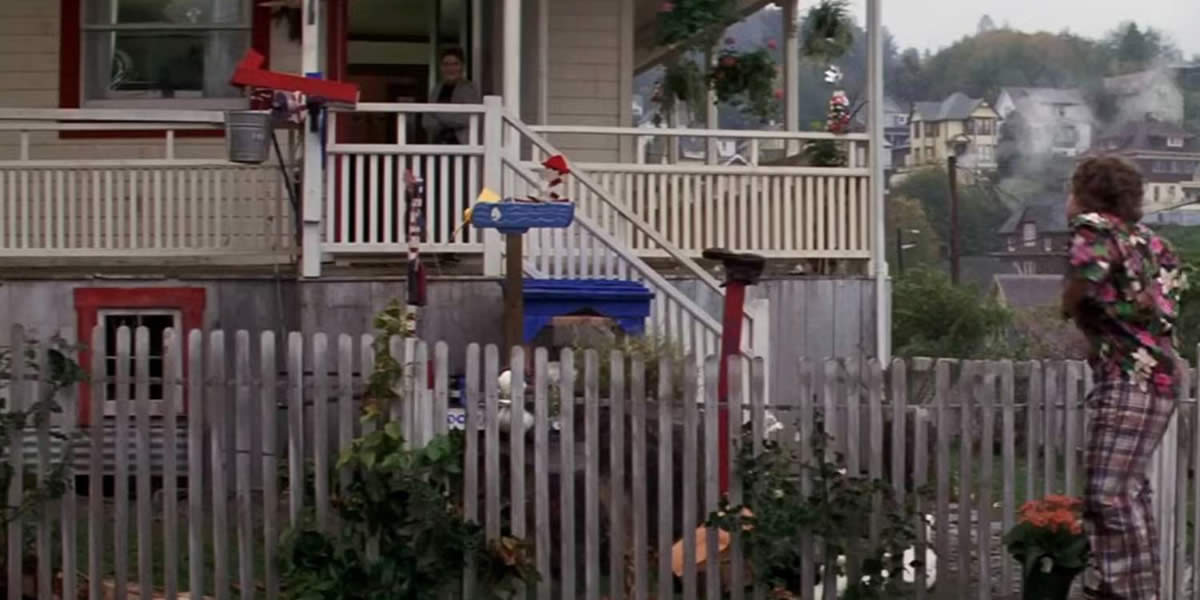
Filming began in Astoria in October 1984, with the production using locations around the city and nearby parts of the northern Oregon coast. The old Clatsop County Jail appears in the opening sequence, while the Walsh family home became one of the film’s most recognizable locations. The production also used sites around Cannon Beach and Ecola State Park.
The landscape contributes to the movie’s sense of possibility. Astoria does not look like an anonymous studio town. Its hills and waterfront suggest a community with its own history, while the nearby coastline provides a natural transition from familiar streets to a more remote environment. The film’s adventure feels as if it grows out of the place rather than being dropped into it.
The movie also helped give Astoria a lasting place in popular film culture. Visitors have continued to seek out locations associated with the story, and the region’s film heritage is now recognized through local museums, tours, and the Oregon Film Trail. Travel Oregon has highlighted the area’s connections to the movie and its other film productions.
That legacy brings practical complications. Some filming locations are privately owned homes or parts of residential neighborhoods, not public attractions designed for unlimited access. The popularity of the film has sometimes placed pressure on the people who live in those areas. Admiring the setting is best done with respect for private property and local residents.
For fans, visiting Astoria can be a way to connect the movie’s fantasy with an actual place. The streets and buildings have continued to change, but the geography still helps explain why the setting feels so convincing. The Goon Docks may be fictional, yet the film gives them enough physical detail to make them feel like a community that existed before the camera arrived and continued afterward.
The location’s significance is more than a matter of sightseeing. It is a reminder that memorable film worlds often emerge from the relationship between a story and a real landscape. The caves and treasure chambers supply the fantasy, but the streets of Astoria give that fantasy a home.
Why The Goonies Still Matters Four Decades Later
The long life of The Goonies is partly explained by its ability to speak to viewers at different ages. For children, it offers a story in which imagination and friendship can transform an ordinary day. For adults, it carries a more complicated recognition of how quickly childhood independence can give way to responsibilities, financial pressures, and the gradual disappearance of familiar places.
Its central adventure is also unusually easy to revisit. The treasure map provides a clear objective, the characters are immediately distinguishable, and the obstacles create a sequence of memorable set pieces. Viewers can remember the broad outline of the story while still enjoying the details of the journey.
The film’s cultural life has extended well beyond its initial theatrical release. Home video allowed audiences to return to it outside the time limits of a cinema engagement. Later television broadcasts, DVD releases, online discussion, and anniversary screenings helped new generations encounter the story. The result is a film whose reputation has been sustained through repeated viewing and shared recollection rather than through a single moment of popularity.
That process is especially important for movies built around childhood. The same scene can mean something different to someone who first watched it at ten and someone who returns to it at forty. A young viewer might focus on the treasure, the gadgets, or the thrill of escaping danger. An older viewer may notice the family facing the loss of its home, the awkwardness of the characters’ relationships, or the melancholy embedded in the children’s determination to preserve their neighborhood.
The film’s legacy also reflects a broader interest in stories about children who have agency. Its heroes are not powerful because they possess special abilities or access to sophisticated resources. They are powerful because they keep going, make mistakes, and help one another. Their success depends on cooperation rather than individual perfection.
Nostalgia can sometimes flatten the past into a collection of familiar objects and reassuring images. The Goonies offers more than that. Its period details are part of a larger emotional world, one in which children experience real uncertainty but still believe they might influence what happens next. The movie’s appeal survives because that feeling is not confined to the 1980s.
There is also something refreshing about its scale of ambition. The children are not trying to save the planet or change history. They are trying to save their homes, find a treasure, and get through a frightening adventure with their friendships intact. The stakes feel enormous to them because the world they inhabit is enormous to them.
That is one of the film’s quiet achievements. It respects the seriousness of childhood without pretending that children understand everything. Their fears can be disproportionate, their plans can be foolish, and their confidence can exceed their abilities. None of that makes their concerns meaningless.
The Goonies and the Treasure That Never Loses Its Value
The treasure at the end of The Goonies is real within the story, but it is not the only thing the children discover. Their journey changes the way they see themselves and one another. They begin as a loose collection of friends with different personalities and insecurities. They emerge with a clearer sense of what they can accomplish together.
The movie’s emotional conclusion is rooted in that change. The children have faced danger, discovered a hidden world, and confronted the possibility of losing the place they call home. The treasure matters because it offers a possible answer to their original problem, but the journey has already revealed something about their own resilience.
The film does not need to pretend that growing up is simple. Its characters are caught between childhood play and adult realities, and the adventure gives them a temporary space in which they can act decisively without fully understanding the consequences. They are still kids, but they are no longer quite as helpless as they first appeared.
That combination of wonder and uncertainty helps explain why The Goonies remains treasure worth hunting. It offers the pleasures of a well-made adventure while holding onto a recognizable emotional truth: the places and people that shape childhood can seem ordinary until the possibility of losing them makes their importance unmistakable.
Four decades after its release, the movie still invites viewers to look beyond the familiar. A neighborhood can conceal a mystery. A frightened friend can become a hero. Someone dismissed by others can prove to be the most loyal person in the room. And a group of kids who have little power in the adult world can still find a way to change their own story.
The real treasure is not simply the fortune buried beneath the coast. It is the sense of possibility that carries the Goonies forward, the belief that friendship can make a frightening world navigable and that even the smallest person can help uncover something extraordinary. That is why the adventure continues to welcome new viewers. The map may belong to 1985, but the desire to follow it has never gone out of date.