
Tecmo Bowl brought NFL stars, unforgettable touchdowns, and friendly rivalries to the Nintendo Entertainment System, changing how a generation played football.
It is a Sunday afternoon in the late 1980s. The television is already occupied, the family room smells faintly of popcorn, and somewhere between the couch and the coffee table sits a Nintendo Entertainment System with a cartridge pushed firmly into place. Outside, the neighborhood is quiet enough to suggest that football season has everyone occupied. Inside, a different kind of game is about to begin.
Two players grip their rectangular controllers. The screen fills with a green football field viewed from above, tiny players arranged across the turf. There is no elaborate pregame show, no commentary team debating the matchup, and no lengthy explanation of the rules. The teams line up. A play is selected. The ball is snapped.
Then somebody hands the ball to Bo Jackson.
The runner accelerates, slips past a defender, cuts toward the sideline, and leaves another would-be tackler diving at empty space. The person holding the controller begins to grin. The opponent leans forward, pressing buttons with increasing urgency. By the time Bo reaches the end zone, the result feels less like a routine touchdown than a small act of video game injustice.
Welcome to Tecmo Bowl.
Released for the Nintendo Entertainment System in North America in 1989, Tecmo Bowl turned professional football into an accessible, fast-moving contest that rewarded both anticipation and a willingness to exploit a ridiculous advantage. It did not attempt to reproduce every rule, formation, or tactical detail of the sport. Instead, it distilled football into its most immediately enjoyable elements: choosing a play, finding a gap, throwing a pass, making a tackle, and trying to outthink the person sitting beside you.
The game had actually begun in arcades in 1987, where its oversized cabinet and four-player setup offered a different kind of football experience. But it was the home version that cemented its place in American video game culture. With recognizable professional players, simple controls, colorful animation, and a playbook that could be learned in minutes, Tecmo Bowl made football gaming a natural extension of watching the NFL.
Its influence went beyond the screen. It turned players into neighborhood celebrities, made certain running backs seem almost supernatural, and gave friends a new reason to argue long after the television had been switched off. In an era when sports games were still finding their identity, Tecmo Bowl demonstrated that a game could be simplified without becoming forgettable.
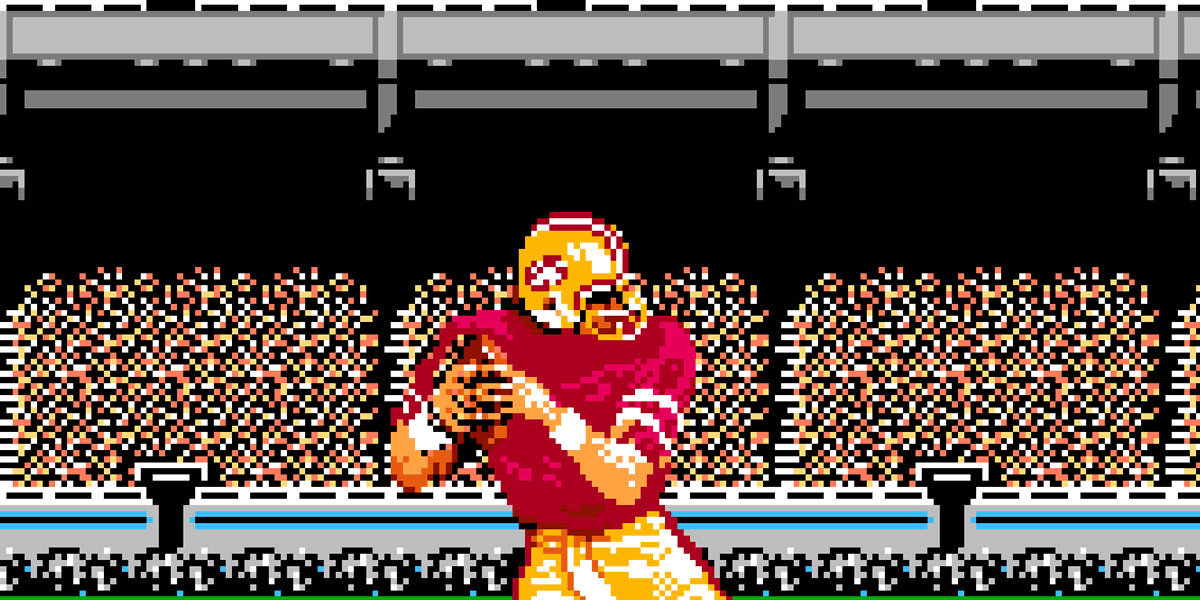
Tecmo Bowl Began in the Arcades Before Conquering the NES
To understand why Tecmo Bowl became such an important home video game, it helps to return to its original setting: the arcade.
In 1987, the arcade was still a place where games competed for attention through sound, movement, bright graphics, and the promise of immediate action. A good cabinet had to communicate its appeal before a player had even inserted a coin. Sports games faced a particular challenge. Football was a complex sport, played across a large field with elaborate formations, specialized positions, and a rulebook that could overwhelm a casual player.
Tecmo approached the problem with an arcade designer’s priorities. The original Tecmo Bowl featured a wide cabinet with two screens and controls for as many as four players. Its teams were fictional, called the Wildcats and the Bulldogs, and its presentation emphasized direct competition rather than an extensive simulation of the NFL.
That setup made the arcade game a social attraction. Two players could face off on each side, giving friends a chance to compete together against another pair. Unlike a solitary game of football on a home console, the cabinet made the contest a shared public event. Every successful tackle, breakaway run, and missed opportunity could be witnessed by the people standing nearby.
The arcade version also differed from the later Nintendo release in important ways. It featured more detailed sprites and a broader range of colors, and players could attempt to break tackles. But its team selection and controls were relatively limited compared with the NES version that followed.
When Tecmo Bowl arrived on Nintendo’s home console in North America in 1989, it became something more personal. The large arcade cabinet gave way to a cartridge, a television, and two controllers. The game was no longer tied to a trip to the arcade or the availability of a machine. It could be played in a living room, after school, or whenever two people could agree on who would get the next turn.
The transition from arcade to home console was not simply a matter of making the same game smaller. The NES version introduced a selection of 12 teams based on real professional football franchises, used real player names through a licensing agreement, and organized play around a compact set of offensive options. Its design was shaped by the limitations of the hardware, but those limitations helped make the game easy to understand.
The result was a football game that felt substantial without becoming intimidating. Players could recognize the sport, identify familiar stars, and begin competing almost immediately. The game had enough strategy to reward practice, but not so much complexity that newcomers needed a manual open beside the television.
That balance was one of its most important achievements. Tecmo Bowl made football gaming accessible to people who loved the NFL and to people who simply enjoyed beating their friends.
How Tecmo Bowl Made NFL Stars Part of the Game
One of Tecmo Bowl‘s biggest advantages was its use of recognizable professional players.
Sports games had often struggled to establish a connection between their simplified on-screen athletes and the stars people watched on television. A game might feature a football field and players in helmets, but the teams could feel interchangeable. Without names, recognizable identities, or distinctive abilities, the digital contest lacked some of the emotional investment that made real football compelling.
Tecmo’s NES release addressed that problem through a license from the NFL Players Association, which allowed the game to use real player names. The arrangement did not include the NFL’s license for official team names and logos. As a result, the game identified its teams by their cities or states rather than their full professional names.
Players could choose from 12 teams representing familiar football markets, including Chicago, Miami, San Francisco, Denver, Dallas, and Los Angeles. The rosters featured recognizable athletes, with their digital abilities shaped by the game’s ratings and design.
The distinction between player and team licensing may sound like a technical detail, but it had an important effect. The teams looked like simplified versions of real NFL organizations, and the players carried the names of athletes fans already knew. A matchup between San Francisco and Chicago was no longer just a contest between two collections of pixels. It could become a chance to put Joe Montana and Jerry Rice against Walter Payton and the Bears.
That recognition changed how players approached the game. Choosing a team became a statement of allegiance, personal taste, or competitive strategy. Fans could represent their favorite NFL club, while others chose the roster they believed gave them the best chance of winning.
The game was not a complete simulation of the professional sport. The NES version placed fewer players on the field than a real NFL team, and each team had a playbook of just four offensive plays. The rosters and ratings also reflected the period in which the game was developed rather than offering a continuously updated record of the league.
But realism was not the only objective. The important thing was that recognizable players could influence the contest. A star was no longer simply a name in a newspaper or a face on a football card. In Tecmo Bowl, that star could become the player who won the game for you.
This was a meaningful step in the evolution of sports video games. The connection between athletes and their digital counterparts would become a defining feature of later football titles, particularly as the technology grew capable of expressing more individual movement, statistics, and playing styles.
Tecmo Bowl helped establish that the identity of a sports game could come from more than its rules. It could also come from the people whose names appeared on the roster.
Tecmo Bowl’s Simple Playbook Made Every Decision Matter
At first glance, Tecmo Bowl appears straightforward. The field is visible from an overhead perspective, the players are easy to distinguish, and the available offensive plays are displayed before the action begins. The controls are simple enough that a new player can understand the basic sequence after a few possessions.
Yet the game’s limited playbook creates a surprising amount of tension.
Each team has four offensive plays, generally combining two running plays and two passing plays. Miami and San Francisco are notable exceptions, with three passing options and one running play. Before the snap, the player selects a play and then takes control of the quarterback as the offense begins moving.
A running play requires finding a route through the defense. A passing play requires identifying an available receiver and releasing the ball at the right moment. Defensively, the challenge is different. The player chooses a defensive play and tries to anticipate the opponent’s decision. A correct guess can leave receivers covered, disrupt the offensive line, or create an opportunity for a sack or interception.
The system turns play selection into a small contest of psychology.
If your opponent has been running the ball repeatedly, should you expect another handoff? If the defense has begun crowding the line, is a pass the obvious response, or is the opponent trying to trick you? The playbook may be short, but the number of ways two people can interpret each other’s habits is not.
This is where Tecmo Bowl found its rhythm. Football strategy was reduced to a series of understandable choices, but those choices still mattered. The game did not require players to manage a vast list of formations or make constant adjustments to complex tactical systems. It asked them to recognize patterns, take risks, and respond to an opponent.
The simplicity also made the game ideal for mixed groups of players. Someone who understood football could use that knowledge to predict plays and exploit weaknesses. Someone less familiar with the sport could learn by watching, experimenting, and discovering which decisions worked.
The result was a game that could accommodate casual play without becoming entirely random. Experienced players developed preferences, learned which teams suited their style, and recognized when a familiar play was likely to succeed. Rivalries emerged around those habits.
The limited playbook also made mistakes memorable. A poorly chosen pass could lead to an interception. A predictable running play could be stopped before it developed. A defender who guessed correctly could transform a promising drive into a frustrating loss of possession.
The best moments often came when a player abandoned the expected strategy. A run that looked doomed could become a long gain after a last-second turn. A pass thrown under pressure could find a receiver in open space. A defender could make a seemingly impossible interception.
Because the game was easy to learn, players could spend less time mastering the controls and more time trying to outwit one another. That was one of the reasons Tecmo Bowl worked so well as a social game. The rules were simple enough to share, but the competition could remain interesting for years.

Bo Jackson and the Legend of Tecmo Bowl’s Unstoppable Runner
No discussion of Tecmo Bowl is complete without Bo Jackson.
In real life, Jackson was already an extraordinary athlete. A star running back for the Los Angeles Raiders, he had also become famous for his baseball career, making him one of the most recognizable two-sport athletes of the era. His combination of speed, strength, and athletic versatility seemed almost improbable even before anyone tried to translate it into an 8-bit game.
The Nintendo version of Tecmo Bowl gave Jackson a digital identity that would eventually rival his real-world reputation. His speed and ability to break through defenders made him an unusually powerful choice. Once he had the ball in open space, stopping him could become an exercise in desperation.
The game’s limitations helped turn that advantage into legend. Defenders followed relatively simple movement patterns, and the player controlling Jackson could use sharp turns and changes of direction to evade tackles. A well-timed cut could send defenders diving past the runner. A successful breakaway might turn an ordinary play into a touchdown that seemed to cross the entire length of the field.
The experience was not quite a simulation of Jackson’s real football ability. It was an exaggerated interpretation of his most recognizable qualities, shaped by a game that needed to make every athlete’s strengths visible within a small number of pixels.
That exaggeration was part of the fun. Players did not need to calculate Jackson’s actual rushing average or compare his statistics with those of another running back. They needed only to hand him the ball and discover how much damage he could do.
Soon, the question of whether someone could stop Bo became part of the social life of the game. One player might insist that the Raiders were unfairly powerful. Another might claim that a particular defensive strategy could contain Jackson. The argument would then move from theory to the television screen, where the next run would decide the matter.
Bo Jackson’s digital dominance became one of the most enduring stories associated with the original NES game. Sports media and gaming fans have repeatedly returned to the image of Jackson running through defenders, sometimes using exaggerated zigzag routes that would look absurd on a real football field.
The appeal was not just that he was powerful. It was that everyone understood why he was powerful. Jackson’s real-world reputation made his in-game ability feel like an extension of an existing legend, even when the game pushed that ability far beyond realistic limits.
There was a broader lesson here about sports game design. A digital athlete does not have to reproduce every detail of a real performance to feel recognizable. Sometimes a small number of exaggerated traits can communicate a player’s identity more effectively than a complicated statistical model.
Jackson became the perfect example. His speed was immediately apparent, his power could be felt through the controller, and his presence changed the way people approached a matchup. He was not simply one player among many. He was the reason some games felt decided before the opening kickoff.
The legend would become even larger in Tecmo Super Bowl, the 1991 sequel, but the foundation was already present in the original game. For many players, the name Tecmo Bowl and the image of Bo Jackson remain inseparable.
Why Tecmo Bowl Fit So Naturally Into 1980s Living Rooms
The NES became a central part of home entertainment during the 1980s. It offered a different kind of activity from watching television, yet it could occupy the same physical space and involve many of the same people. A console connected to the family television could turn an ordinary evening into a shared competition.
Tecmo Bowl was especially well suited to that environment because it did not demand a long commitment before the fun began. A player could select a team, choose a play, and get moving within moments. The game was accessible to newcomers but offered enough depth to encourage repeat play.
That combination mattered in a decade when video games were becoming a regular part of domestic life. The living room was no longer just a place to watch programs together. It could also become a place where family members and friends competed directly, taking turns with a controller or watching a match unfold.
Football supplied an additional advantage. The sport already had a place in the American weekly routine, particularly during the fall and winter. Fans followed teams, remembered great plays, debated coaching decisions, and discussed star players. Tecmo Bowl allowed them to take that familiar interest into their own hands.
The game could reproduce some of the social rituals surrounding football without requiring a full afternoon. Players could choose a favorite team, try to win a championship run, or challenge a friend to a single game. They could argue over a questionable play, celebrate a long touchdown, and immediately begin another contest.
Its graphics also suited the hardware. The overhead field made it easy to follow the action, while the colorful sprites and animated players gave the game a lively character. The visuals were not realistic by modern standards, but they communicated the important information quickly. You could see where the ball was, where the defenders were moving, and where an opening might appear.
The sound design helped reinforce that clarity. Short musical cues and recognizable gameplay sounds gave the action a steady rhythm. The game did not need a full broadcast soundtrack to make a touchdown feel satisfying. Its visual and audio feedback supplied the excitement directly.
For children and teenagers, Tecmo Bowl could become a way of participating in football culture even if they were not playing the sport themselves. It allowed them to learn player names, recognize team strengths, and develop their own ideas about strategy. For adults who already followed the NFL, it offered a quick, playful extension of their existing fandom.
The game also worked as a shared language. A reference to Bo Jackson, a debate about the best team, or a complaint about an impossible run could be understood by anyone who had played it. Those experiences helped the game remain memorable beyond its original hardware.
Its place in the living room was therefore important to its success. Tecmo Bowl was not only a football game. It was an activity built for the way people gathered around a television, competed with friends, and made entertainment out of a few simple choices.
Tecmo Bowl Helped Shape the Future of Football Video Games
When Tecmo Bowl appeared on the NES, sports games were still working out how to translate real athletic competition into an interactive format. Developers had to decide which aspects of a sport to preserve, which to simplify, and how to make the result enjoyable within the limits of the hardware.
Some football games emphasized simulation, while others concentrated on quick action. Tecmo Bowl found a particularly effective balance between the two. Its real player names and recognizable teams gave it a connection to professional football, while its compact playbook and exaggerated athletes kept the action immediate.
That approach influenced the expectations players brought to later sports titles. Fans increasingly wanted to control recognizable athletes, not just anonymous figures on a screen. They wanted meaningful differences between teams, strategic decisions before the action, and enough personality in the gameplay to make one matchup feel different from another.
The evolution of football gaming would eventually bring more detailed graphics, larger rosters, deeper playbooks, statistics, season modes, and increasingly sophisticated artificial intelligence. The genre moved toward greater realism as consoles became more powerful. But the desire for accessible, competitive play remained.
The next major step in the Tecmo series was Tecmo Super Bowl, released for the NES in 1991. It expanded the experience with all 28 NFL teams of the period, a more extensive roster of players, season play, and statistical tracking. It also carried forward the series’ distinctive balance between strategic choices and exaggerated individual abilities.
The sequel is often remembered as one of the most influential sports games of its generation. Its lasting appeal illustrates how much the original Tecmo Bowl had established. The basic idea of combining recognizable NFL players with quick, readable action had proved powerful enough to support a more ambitious game.
Still, the original should not be treated merely as a rough draft for its successor. Tecmo Bowl has its own identity. Its smaller roster of teams, limited playbook, and focused championship format give it a directness that later games would not necessarily preserve. It is a concentrated experience, built around the immediate pleasure of making a good decision and watching it succeed.
That focus helps explain why the game remained playable long after more advanced football titles arrived. Better graphics do not automatically produce better competition. A game that allows two people to understand the rules quickly, recognize the stakes, and develop their own rivalries can retain its appeal even when newer systems offer far more technical detail.
The history of football gaming is not simply a march toward realism. It is also a history of discovering how much complexity a game needs to be satisfying. Tecmo Bowl found an answer that worked remarkably well for its era.
From Cartridge to Cult Classic: The Enduring Appeal of Tecmo Bowl
By the time 16-bit consoles and more sophisticated sports simulations became widely available, Tecmo Bowl was no longer the most advanced way to play football at home. The technology that once made its presentation impressive had become a point of comparison with newer games. Players could now expect more elaborate animations, richer sound, and greater control over the sport.
But technical progress did not erase the original game’s appeal.
Part of its durability comes from the way its limitations produce a recognizable style. The players are small, the field is simple, and the available plays are few. Yet the action is easy to follow, and every decision can have immediate consequences. A single missed tackle or successful pass can change the entire game.
Another part comes from its social history. For many players, Tecmo Bowl was associated with the people they played against, the teams they preferred, and the arguments that developed around its most powerful athletes. The cartridge became a container for memories of competition, but the game itself remained capable of generating new ones.
That legacy continued through re-releases and retro gaming. The NES version appeared on Nintendo’s Virtual Console services, and the original arcade game was made available to later audiences through arcade compilations and digital releases. These versions allowed players to revisit the experience without relying exclusively on original hardware.
The game has also remained part of a wider conversation about sports video games. Bo Jackson’s digital dominance is still used as an example of an overpowered athlete, while the series’ combination of simplicity and strategic play continues to attract retro enthusiasts. Its appeal is not based solely on the belief that older games were better. It rests on specific design decisions that still make sense.
A game does not need hundreds of player ratings, dozens of camera angles, or a detailed simulation of every rule to create a compelling contest. It needs clear choices, understandable consequences, and room for players to develop their own skills. Tecmo Bowl offers all three.
Its imperfections are part of its character. A defender may seem inexplicably slow, a runner may escape a tackle that should have stopped him, and Bo Jackson may turn a carefully planned defensive effort into a long touchdown. Those moments are not realistic, but they are memorable. They give the game a personality that is difficult to separate from its mechanics.
The best retro games do more than preserve a technology or a visual style. They preserve a way of playing. Tecmo Bowl captures a time when the pleasure of a sports game could be measured in a few decisive seconds: a play called correctly, a pass completed under pressure, a defender sent in the wrong direction, or a running back disappearing down the sideline.
Why Tecmo Bowl Still Defines 80s Football Gaming
The legacy of Tecmo Bowl rests on a deceptively simple achievement. It made a complicated sport understandable without stripping away the tension that makes football exciting.
Its original arcade release introduced the idea in a public, competitive setting. The NES version brought the experience home, added recognizable professional players, and made the game a natural part of the era’s emerging console culture. Its playbook encouraged strategic thinking, while its exaggerated athletes made every matchup distinctive.
Bo Jackson became the game’s most famous figure, but the broader achievement was larger than one unstoppable running back. Tecmo Bowl showed that a sports game could build an identity through a combination of recognizable stars, accessible controls, and carefully chosen exaggerations. It could be simple enough for a newcomer and competitive enough to keep experienced players interested.
The game also reflected the culture around it. Professional football was already a major part of American entertainment, and the NES gave fans a way to take ownership of that experience. Instead of merely watching the stars, players could choose their teams, call their plays, and decide which athletes would make the difference.
That interaction changed the relationship between the audience and the sport. The television broadcast remained a shared spectacle, but the video game turned football into something friends could argue over and control themselves. The living room became a miniature stadium, and a successful run could be celebrated with the same intensity as a real touchdown.
Today, football games offer extraordinary detail, from complex playbooks to elaborate player animations and full seasons of statistics. Tecmo Bowl belongs to an earlier stage of that history, when designers had to make every feature count. Its field was small, its players were pixelated, and its rules were simplified. Yet it understood that the heart of competition was not the number of features on the screen. It was the moment when one player made a choice and another tried to stop it.
That is why the game still matters. It did not reproduce professional football perfectly. It created a version of football that was instantly playable, socially engaging, and full of memorable possibilities. It gave a generation a way to bring the NFL into the home, one controller and one touchdown at a time.
And if that touchdown happened to come from Bo Jackson, with defenders trailing behind him and a friend protesting from the other side of the couch, so much the better.